Bitcoin and ether fall, then rebound as Trump retreats from Greenland tariffs

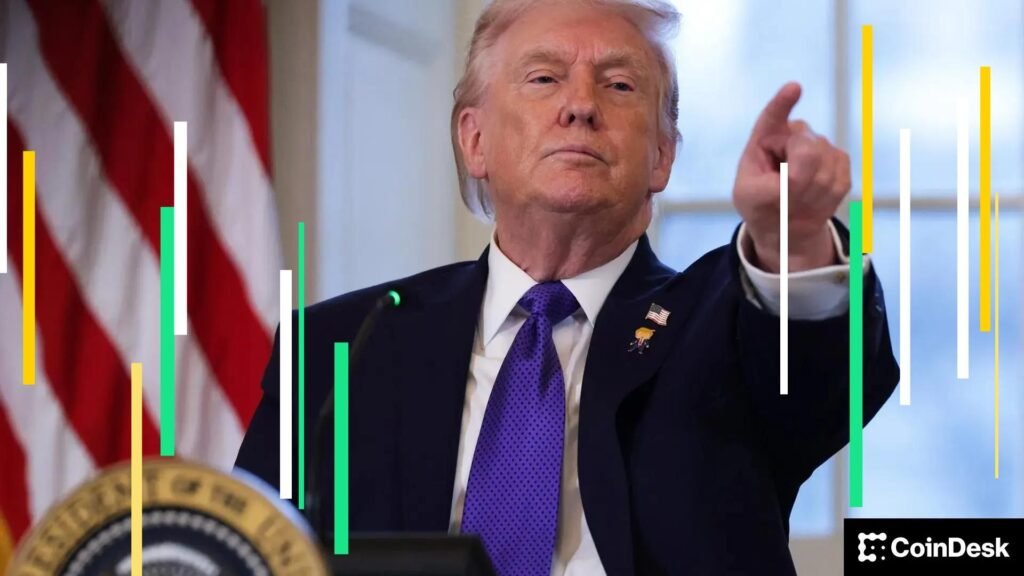
Bitcoin and ether fall, then rebound as Trump retreats from Greenland tariffs
The sharp reversal showed how closely crypto prices remain tethered to macro headlines. Solana, XRP, Cardano and dogecoin followed a similar pattern of quick losses and partial recoveries
What to know:
- Bitcoin plunged below $88,000 before rebounding toward $90,000 in Asian trading after former President Donald Trump softened tariff threats tied to Greenland during his Davos appearance.
- The sharp reversal showed how closely crypto prices remain tethered to macro headlines, with shifting trade rhetoric, bond yields and risk sentiment driving rapid swings.
- Major tokens including Ethereum, Solana, XRP, Cardano and dogecoin followed a similar pattern of quick losses and partial recoveries, signaling stabilization rather than a renewed risk-on rally.
Bitcoin staged a sharp overnight round trip during Asian trading hours, sliding below $88,000 before rebounding toward $90,000, according to CoinDesk market data, after President Donald Trump walked back tariff threats tied to Greenland during his World Economic Forum appearance in Davos.
The move capped a volatile 24 hours for crypto markets, which were dragged lower earlier in the week by a global risk-off wave sparked by Trump’s threats toward Europe, a jump in bond yields, and renewed anxiety across equity markets.
By Thursday morning in Asia, those pressures had begun to ease — and crypto followed.
Bitcoin briefly fell to around $87,300 late Wednesday as U.S. markets digested Trump’s aggressive rhetoric and bond markets remained unsettled.
But sentiment shifted quickly after Trump said he would refrain from imposing tariffs on European nations opposing U.S. control of Greenland, citing what he called a “framework of a future deal.”
That reversal helped calm broader markets. U.S. equity futures turned higher, Japanese government bonds rebounded for a second session, and haven demand cooled after gold touched fresh highs earlier in the week.
Bitcoin bounced alongside that stabilization, recovering to near $90,000 and erasing most of the overnight drop.
The episode is indicative of how closely crypto remains tied to macro headlines during periods of uncertainty.
While bitcoin is often marketed as an alternative asset, it still trades like a high-risk position when investors rush to protect capital. Sudden shifts in trade policy, bond yields and global liquidity tend to spill directly into digital assets — especially when positioning is crowded.
Price action across major tokens reflected that same pattern. Ethereum dipped below $3,000 during the selloff before climbing back above $3,020, trimming its daily loss. Solana rebounded to around $130 after sliding earlier in the session, while XRP traded back near $1.95. Cardano rose toward $0.37 after touching weekly lows, and dogecoin clawed back some losses near $0.127. Across the board, gains were modest, pointing to stabilization rather than a renewed risk-on push.
What made this move notable was the speed of the reversal.
Crypto prices fell quickly as Trump’s comments reignited fears of trade conflict and policy unpredictability, then recovered just as fast once the rhetoric softened.
That kind of whipsaw action has become common in a market where traders react instantly to macro signals.
Bond markets were a key driver. Earlier in the week, a sharp selloff in long-dated Japanese government bonds sent yields to record levels, tightening global financial conditions and pushing investors out of speculative trades.
By Thursday, Japanese yields pulled back after officials called for calm, easing pressure across global rates and giving risk assets room to breathe.
As markets shift back toward Asia and Europe trading hours, crypto traders will be watching whether bitcoin can hold above $90,000, or whether the Davos relief fades and volatility returns. The past two days made one thing clear: global politics and bond markets still have the power to send crypto on a rollercoaster.
More For You
KuCoin Hits Record Market Share as 2025 Volumes Outpace Crypto Market
KuCoin captured a record share of centralised exchange volume in 2025, with more than $1.25tn traded as its volumes grew faster than the wider crypto market.
What to know:
- KuCoin recorded over $1.25 trillion in total trading volume in 2025, equivalent to an average of roughly $114 billion per month, marking its strongest year on record.
- This performance translated into an all-time high share of centralised exchange volume, as KuCoin’s activity expanded faster than aggregate CEX volumes, which slowed during periods of lower market volatility.
- Spot and derivatives volumes were evenly split, each exceeding $500 billion for the year, signalling broad-based usage rather than reliance on a single product line.
- Altcoins accounted for the majority of trading activity, reinforcing KuCoin’s role as a primary liquidity venue beyond BTC and ETH at a time when majors saw more muted turnover.
- Even as overall crypto volumes softened mid-year, KuCoin maintained elevated baseline activity, indicating structurally higher user engagement rather than short-lived volume spikes.
More For You
Here’s why bitcoin’s is failing its role as a ‘safe haven’ versus gold
Bitcoin behaves more like an “ATM” during uncertain times, with investors quickly selling it to raise cash.
What to know:
- During recent geopolitical tensions, Bitcoin lost 6.6% of its value, while gold rose 8.6%, demonstrating bitcoin’s vulnerability in times of market stress.
- Bitcoin behaves more like an “ATM” during uncertain times, with investors quickly selling it to raise cash, contrary to its reputation as a stable digital asset.
- Gold remains the preferred hedge for short-term risks, while bitcoin is better suited for long-term monetary and geopolitical uncertainties that unfold over years.
Sui Group charts new course for crypto treasuries with stablecoins and DeFi
The big U.S. crypto bill is on the move. Here is what it means for everyday users
The fight over stablecoin yield isn’t really about stablecoins
Here’s why bitcoin’s is failing its role as a ‘safe haven’ versus gold
Coinbase CEO says Big banks now view crypto as an ‘existential’ threat to their business
Agora’s Nick van Eck bets on stablecoin boom in enterprise payments
Here’s what bitcoin bulls are saying as price remains stuck during global rally
Ethereum Foundation makes post quantum security a top priority as new team forms
Bitcoin’s weakness versus gold and equities puts quantum computing fears back in focus
Senate Agriculture’s crypto market structure draft peppered with Democrat pitches
Here is why investors are snubbing Michael Saylor’s 10% dividend offer in Europe
Days of our market structure bills: State of Crypto
Sui Group charts new course for crypto treasuries with stablecoins and DeFi
The big U.S. crypto bill is on the move. Here is what it means for everyday users
The fight over stablecoin yield isn’t really about stablecoins
Here’s why bitcoin’s is failing its role as a ‘safe haven’ versus gold
Coinbase CEO says Big banks now view crypto as an ‘existential’ threat to their business
Agora’s Nick van Eck bets on stablecoin boom in enterprise payments
Here’s what bitcoin bulls are saying as price remains stuck during global rally
Ethereum Foundation makes post quantum security a top priority as new team forms
Bitcoin’s weakness versus gold and equities puts quantum computing fears back in focus
Senate Agriculture’s crypto market structure draft peppered with Democrat pitches
Here is why investors are snubbing Michael Saylor’s 10% dividend offer in Europe
Days of our market structure bills: State of Crypto
!–>!–>!–>!–>!–>!–>!–>!–>
Read More
Be the first to write a comment.