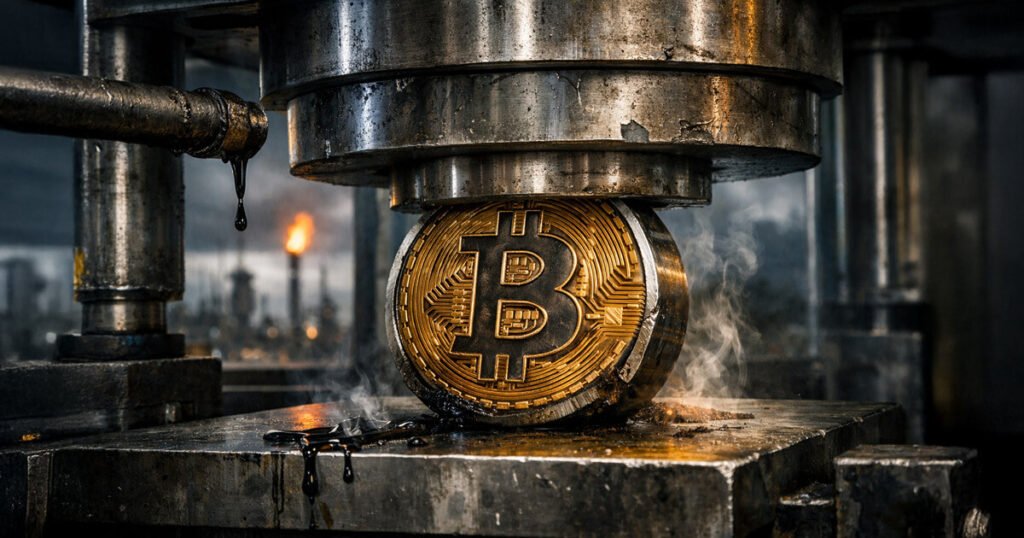
Bitcoin holds $71,000 despite Trump warning of strikes on Iran’s oil-rich Kharg Island

Bitcoin holds $71,000 despite Trump warning of strikes on Iran’s oil-rich Kharg Island
The largest cryptocurrency is up 4.2% on the week despite Friday’s reversal, with attention now turning to the Fed meeting on March 17-18 and whether oil above $100 forces a shift in rate expectations.
What to know:
- Bitcoin has held above its prewar level and trades around $71,000, showing resilience despite intensified conflict in the Middle East and U.S. strikes on Iran’s Kharg Island.
- Crypto markets have broadly risen over the past week, with major tokens like ether, dogecoin, solana and BNB all posting gains even as bitcoin repeatedly fails to break through the $73,000 to $74,000 resistance range.
- Traders are increasingly treating war-related headlines as temporary shocks, but rising oil prices, record energy supply disruptions and next week’s Federal Reserve meeting pose renewed risks to risk assets, including cryptocurrencies.
Two weeks into a Middle Eastern war and bitcoin is higher than where it started.
The largest cryptocurrency was trading at $71,000 on Saturday morning, down 0.7% over the past 24 hours after the U.S. bombed military targets on Kharg Island, Iran’s main crude export facility.
The reversal from Friday’s $73,838 high was sharp but contained. Bitcoin gave back 3.5% on the Kharg headlines and stopped. A month ago, a comparable escalation would have triggered a much deeper sell-off.
The weekly numbers tell the resilience story. Bitcoin is up 4.2% over seven days. Ether gained 5.5% to $2,090. Dogecoin added 5%. Solana rose 4.2% to $88. BNB climbed 4.5% to $655. Every major is green on the week despite the war intensifying, not easing.
The market is adapting to the conflict in real time. Early in the war, every headline produced an outsized reaction because nobody could price the tail risk. Now, traders have a framework, where strikes happen, oil spikes and bitcoin dips only to recover again.
The pattern has repeated enough times that the reflexive sell-the-headline impulse has faded. However, the $73,000-$74,000 resistance level stays in place, and has now rejected bitcoin four times in two weeks.
Trump’s language on Kharg Island added a new variable in the markets.
In a Truth Social post late Friday, he said he spared oil infrastructure “for reasons of decency” but would “immediately reconsider” if Iran continued blocking the Strait of Hormuz.
Iran responded that any strike on energy infrastructure would trigger retaliatory attacks on U.S.-linked facilities in the region. That’s a conditional escalation threat that didn’t exist 48 hours ago. If oil infrastructure becomes a target, the supply disruption, which the IEA already called the largest in history, gets dramatically worse.
Meanwhile, the $371 million in liquidations over the past 24 hours reflected the two-way nature of Friday’s session. Short liquidations outpaced longs at $207 million versus $163 million, meaning the initial surge to $73,800 squeezed bears before the Kharg headlines squeezed the longs who had just entered.
Attention now shifts to the Fed meeting on March 17-18. Oil above $100, the largest energy supply disruption in history, and a war entering its third week with no resolution make the stagflation case harder to dismiss.
CME FedWatch still prices a 95%+ probability of a hold at 3.5% to 3.75%, but the dot plot and Powell’s press conference will matter more than the decision itself. Any hint that rate hikes are back on the table would hit risk assets hard, including a crypto market that has spent five months pricing in cuts that keep not arriving.
More For You
The Definitive Stablecoin Landscape Series: North America
As stablecoins evolve into core financial infrastructure, North America leads. This report maps the regulation, market shifts, and players driving adoption.
Why it matters:
Stablecoins are entering their third phase of evolution – the institutionalization era – becoming increasingly embedded into core financial infrastructure. As institutions prioritize transparency and compliance, regulated issuers like USDC, RLUSD, and PYUSD are steadily gaining share with RLUSD surpassing $1B in market cap within its first year. North America, leading in regulatory frameworks and institutional distribution, is at the center of it all.
Більше для вас
Trump-backed American Bitcoin hits 7,000 BTC as holdings expand rapidly
Satoshis per share climbs past 660, reinforcing rapid treasury expansion since Nasdaq debut.
Що варто знати:
- American Bitcoin reserves reach 7,000 BTC, roughly tripling in under seven months.
- Shares slide even as reserves surge and bitcoin exposure per share climbs.
Jack Dorsey’s Square auto-enables bitcoin payments for millions of U.S. businesses
Trump-backed American Bitcoin hits 7,000 BTC as holdings expand rapidly
Bitcoin hashrate posts first-quarter drop for first time in 6 years as miners pivot to AI
The SEC’s latest crypto guidance still leaves too much unsaid
Bitmine makes biggest ether purchase in 2026 while other digital asset treasuries pull back
Bernstein says the 60% crash in crypto stocks is a rare chance to buy the dip at a ‘big’ discount
Bitcoin rises as Trump says U.S. in talks with ‘new regime’ in Iran, threatens oil infrastructure if deal fails
Ethereum Foundation stakes additional $42 million of ether
Rate hike bets are building for the Fed – and now the Bank of Japan too
Bitcoin bullish bets hit a 28-month high on Bitfinex, and that’s music to bears’ ears
Yield-hungry bitcoin holders may be keeping BTC stuck in a sideways grind
Hyperliquid traders in Tokyo get 200-millisecond edge, Glassnode research shows
!–>!–>!–>!–>!–>!–>
Read More
Be the first to write a comment.