A New “War on Terrorism” Is the Wrong Way to Fight Domestic Extremists

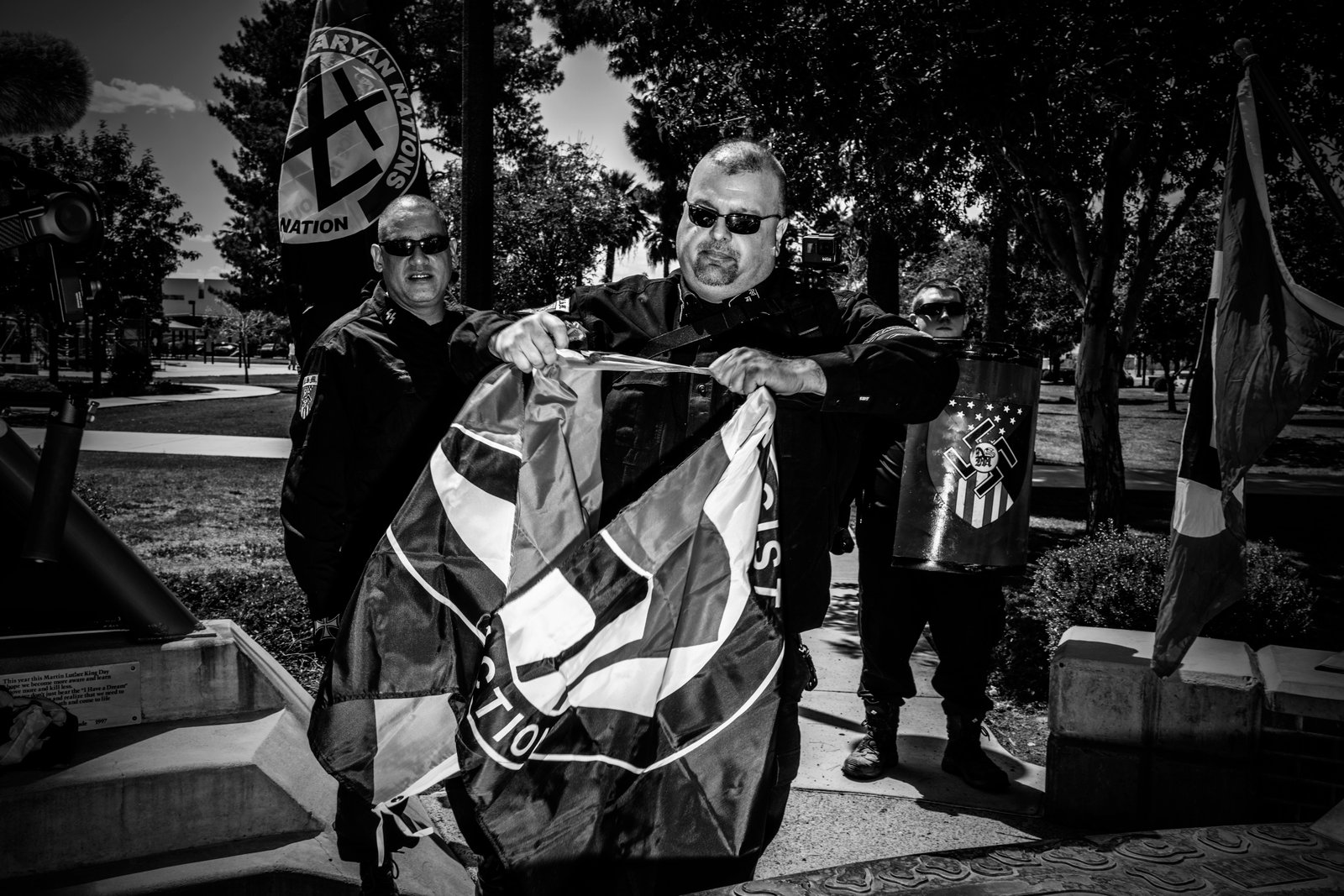
On January 6, as insurrectionists stormed the U.S. Capitol building, pro-Trump rioters outside set up a noose. In one photo, taken by a reporter from USA Today, a woman draped in a Trump flag stands on the wooden gallows, clutching the unambiguous symbol of white supremacist terror. She is smiling.The attack, which left five dead, was the crowning moment of a slew of eminently preventable instances of far-right violence throughout the Trump era. The display of white resentment that day hearkened back to the former president’s 2016 campaign. Trump’s early comments, disparaging Mexicans as “rapists” and demanding a “complete shutdown of Muslims entering the United States,” had animated far-right extremists. Over the course of his administration, they found comfort in Trump’s America. Meanwhile, the president himself made clear, time and again, that he would, at best, ignore the extreme right’s acts of terroristic violence or, at worst, encourage them—just as he did on January 6. “The call was from inside the house,” said Cynthia Miller-Idriss, the author of Hate in the Homeland and the director of American University’s Polarization and Extremism Research and Innovation Lab. “This was democracy itself being challenged.”In the months since, the question of how to stem the tide of domestic extremism has been met with appropriate seriousness from most corners, save certain factions on the right. But many of the solutions offered pose serious problems themselves. Among the more troubling developments is an explosion in calls for a domestic “war on terrorism.” Proposals along this line, emanating from federal law enforcement, intelligence officials, and lawmakers, have run the gamut, from invocations to use the tools and institutions refined during the Bush- and Obama-era “war on terrorism” to demands for a new criminal domestic terrorism statute. The Department of Homeland Security, a sprawling bureaucratic behemoth created in the aftermath of the 9/11 attacks and branded during the Bush era as one of the “essential institutions” in fighting terrorism, has reportedly been tapped by the Biden administration to play a greater role in combating white supremacist extremism. Likewise, the federal No Fly list—which names people who are prohibited from boarding commercial aircraft for travel within, into, or out of the country, and has been referred to as a “due-process nightmare” by civil liberties advocates—has been trotted out as a potential means of restricting the freedom of movement of insurrectionists.Rhetoric supporting these tactics arose out of the cottage counterterrorism industry that blossomed in the aftermath of 9/11, said Michael German, a fellow at the Brennan Center for Justice and a former FBI agent. “You had all these people who were looking for a new target,” German explained. “And that happened just at the time that the public was growing more concerned about unenforced white supremacist violence.”Supporters of a domestic terrorism statute claim that it would provide the government with a mandate to redirect its sprawling intelligence and investigative resources toward pursuing white supremacists. If the FBI could step up its intelligence gathering, the argument goes, it could more effectively disrupt plots, and elevating certain offenses to the level of federal crimes would serve as a deterrent against future organizing. The most important plank of such an approach would be the creation of a special designation for domestic terror organizations, enabling the conviction and imprisonment of those who offer material support.To call these proposals an effort to bring the “war on terrorism” home would be to ignore the fact that most of these tools and tactics have been used on Americans already—for example, in the relentless surveillance of Muslim Americans. And it is unclear what, if anything, such a huge national security push would achieve, aside from creating an even more massive dragnet. Indeed, rather than catching propagandists of hate who incite violence or members of white supremacist paramilitary groups training for the day they can overthrow the U.S. government, American counterterrorism officials have tended to ensnare those who are most frequently the victims of white supremacist violence—Black and brown Americans, immigrants, and religious minorities. After years of Trump’s frantic calls to designate anti-fascists as members of a terrorist organization, it’s near impossible to believe that the right wouldn’t use such a statute against its political opponents the next time it is in power.From left: insignia appropriated from the Nazis on the collar of a member of the National Socialist Movement; tactical headgear worn by a demonstrator at a Second Amendment rally in Richmond, Virginia, in 2020.The stories of two men—a former State Department official, Matthew Q. Gebert, and an Army veteran, Joshua Beckett—make clear that the “war on terrorism” approach, beyond being a civil liberties nightmare, is also, quite simply, unnecessary. We already have the tools to pursue such people, we just aren’t using them correctly. Gebert embedded himself in the national security bureaucracy while organizing events with some of the white power movement’s most prominent figures. He was investigated twice by federal officials vetting him for a high-level security clearance, yet his involvement in the movement—conducted under the protection of a pseudonym but otherwise barely veiled—went unnoticed. Meanwhile, Beckett used his military training to bolster a neo-Nazi group with terroristic aspirations—which was then successfully disbanded. These men illustrate the pitfalls of addressing white supremacist violence through a “war on terrorism” against domestic extremism.Developed in the aftermath of 9/11, the “war on terrorism” tool kit was designed to target a network of international terrorist groups with broad directives of surveillance, as well as on-the-ground military operations overseas. Over the course of the next two decades, federal officials pursued an array of groups and individuals, both in the United States and abroad. A major problem with repurposing the tool kit is that white supremacist violence, merely a radical expression of beliefs baked into the founding of this country, is anything but foreign—and is finding itself increasingly at home.In late November 2016, at a conference in Washington, D.C., after Trump’s election, the white nationalist leader Richard Spencer told a crowd of supporters that the alt-right had “crossed the Rubicon in terms of recognition.” In so doing, it had become more difficult to ignore, its adherents more difficult to spurn. Spencer was referring to Trump and his supporters’ growing enthusiasm for motifs cherished by the extreme right, as well as the outpouring of press attention to his movement. But the comment could easily have been about white supremacists’ ability to actuate political change through the co-option of mainstream conservative institutions, as well as the government itself. Thus, when a pseudonymous Twitter account offered to help European far-right extremists dodge new State Department regulations requiring most visitors and immigrants to turn over their social media histories, it should have been cause for alarm.On March 29, 2018—a Thursday and, therefore, a workday for most federal employees—a user going by the handle @RevengeCoach on Twitter blasted out a message targeted at European extremists. He alluded to having enough sway with State Department visa officials to convince them that a European far-right extremist was a suitable visitor. In case of trouble with U.S. government bureaucrats, @RevengeCoach implied, call up your “good friend,” “Coach Finstock.”“Coach Finstock,” whose name was likely derived from a character in the 1985 film Teen Wolf, wasn’t a mere low-level apparatchik. As my colleague Michael Edison Hayden reported in August 2019, he was Matthew Q. Gebert, an official in the U.S. State Department. In a series of articles at Hatewatch, the Southern Poverty Law Center’s publishing arm that is focused on hate and extremism, Hayden detailed Gebert’s extensive ties to the white power movement. As “Coach,” Gebert had called for a nuclear-armed white ethnostate and led a meetup group tied to the white nationalist media outlet The Right Stuff. Meanwhile, as a foreign affairs officer in the Bureau of Energy Resources, he attended meetings with high-ranking officials in the United States, as well as internationally.According to a later article in Vanity Fair, Gebert had a Top Secret, Sensitive Compartmented Information clearance—one of the highest levels of authorization, and one that had to be renewed every five years. In 2020, Amos Hochstein, the former head of President Barack Obama’s special envoy for international energy at the State Department, told the Southern Poverty Law Center’s podcast, Sounds Like Hate, that Gebert “had full access to classified information and classified computer systems that would give him access to quite a bit of information outside of the purview of the energy bureau alone.” The year after he marched alongside Klansmen, neo-Nazis, white nationalists, and other far-right extremists at the 2017 Unite the Right rally in Charlottesville, Virginia, Gebert’s security clearance was renewed.The “war on terrorism” approach, beyond being a civil liberties nightmare, is also, quite simply, unnecessary.Gebert’s tenure at the State Department began a few years prior to his work as an organizer within the white power movement. He joined in 2013 as a presidential management fellow—a prestigious two-year program that places recent graduates from advanced degree programs at U.S. government agencies. At the time, he was assigned to the State Department. An organizational directory that was declassified in early 2017 lists Gebert as a fellow assigned to the Office of Russian Affairs. Even though the fellows are given two-year appointments, many of the program’s participants, including Gebert, graduate into a permanent position at their assigned agency. Over the course of the next couple of years, he served as the desk officer on energy, where, according to Hochstein, he focused on a few South and Central Asian countries: Pakistan, Afghanistan, and India.Gebert claimed that his in-person involvement with the movement began in 2015, around the time that the alt-right started to pick up steam. He credited The Right Stuff and Richard Spencer’s white nationalist organization, the National Policy Institute, for introducing him to real-life organizers. The Southern Poverty Law Center has identified at least 10 accounts online that have belonged to him throughout the years, with handles such as @Cue1933—an apparent reference to the year Hitler came to power—and @nevercuck. Gebert later moved on to help lead the “D.C. Helicopter Pilots”—an offshoot of The Right Stuff that brought together white nationalists in the Washington, D.C., and Northern Virginia area. With his wife, Anna Vuckovic, herself a white nationalist pundit under the nom de plume “Wolfie James,” Gebert hosted parties and events for far-right extremists at his home in Leesburg, Virginia. At one gathering, the pair served cookies in the shape of swastikas.In August 2019, in response to Michael Edison Hayden’s reporting at the Southern Poverty Law Center, the State Department placed Gebert on immediate administrative leave. The blowback elsewhere was equally rapid. Investigations were launched in the State Department and on Capitol Hill. Gebert’s neighbors in Greenway Farms, a development of quaint single-family homes and townhouses in Leesburg, expressed alarm. One nearby resident reached out to Hayden, saying that they had spotted Gebert standing in his lawn with a handgun on his waist.If the revelations about Gebert sparked an appropriately swift and severe response, it’s not clear why it took so long to out him. The hate he spewed could have come up in the course of the federal government’s exhaustive background check. His involvement in Unite the Right should have. Gebert wasn’t a member of any far-right extremist group that’s been mentioned as meriting the designation of a terrorist organization, but because he was an applicant for a security clearance, the government had numerous ways to pry at his background; his facade as an innocuous, hardworking family man could have been revealed for what it was. There were questions on Standard Form 86—the form used by the government to facilitate background checks for those seeking a security clearance—that should have turned up evidence of Gebert’s involvement in white supremacist organizations, or his involvement in groups that sought to dismantle the U.S. government. Officials could have inquired about his comments calling for “a country founded for white people with a nuclear deterrent,” or his involvement in Unite the Right. People have lost security clearances for less. But no one, it seemed, had asked the right questions.Gebert and others like him saw their positions in government, think tanks, and media as incubators for shifting the mainstream political discourse further to the right. Alongside their efforts arose another wing of the movement, whose enmity toward the state caused them to eschew the nuances of the political process. These extremists—often referred to as white supremacist accelerationists—embrace terroristic violence and glorify the trappings of America’s militaristic culture. Their goals include a revolutionary race war, and their ranks contain current or former members of the military whose combat training was acquired and honed through America’s “war on terrorism.”Among them was Joshua Beckett, a U.S. Army veteran (he served between 2011 and 2015 as a combat engineer) and a self-described former wounded warrior, who later joined the neo-Nazi group Atomwaffen Division as its Ohio cell leader. Beckett was first identified by Ali Winston, Jake Hanrahan, and A.C. Thompson at ProPublica as one of several members of Atomwaffen who were either veterans or active-duty military. Beckett, ProPublica’s reporting revealed, had trained Atomwaffen members in firearms and hand-to-hand combat in 2017. Chat logs provided to the Southern Policy Law Center, detailing Atomwaffen’s inner workings from mid-2017 to early 2018, make clear that Beckett, under the name “Johann Donarsson,” discussed his training in some detail with other members, as well as his skills with weaponry. But they also reveal a side of Beckett that hasn’t been reported on, namely how he presented his own radicalization narrative, and the role he claimed his own military experience played in it. (Beckett declined to participate in this story.)By the time Beckett, then an Ohio resident, appeared in Atomwaffen chats, he had been out of the military for two years. He described himself as a college student (he went to Ohio University between August 2015 and May 2019), and discussed his “red-pilling”—a term used by many members of the white power movement, especially those younger, to denote their radicalization to far-right extremism—over the course of several conversations with chat room members. In particular, he connected his deployment to Afghanistan, a key battleground in the “war on terrorism,” with his turn to terroristic national socialism. “I was slightly pro-white pre-Army but the Army made me full blown [National Socialist],” he wrote on the messaging platform Discord. At the same time, he professed to having received “more respect from Taliban detainees than the k***s that sent me over there to kill them.”Beckett told Atomwaffen members that he’d returned to the United States with a diagnosis of post-traumatic stress disorder and cancer, and joined up with a program offering services to wounded warriors, though it is unclear which one. He also claimed to have attended events hosted by the Wounded Warrior Project, a charity and veterans’ services organization. (However, Sherry Sanderford, public relations manager for the organization, told me in an email that there was no Joshua Beckett from Washington, D.C., or Ohio signed up for the program in 2013.) Beckett bragged that he had “met all the big name politicians,” while in the U.S. capital: “The more I’d meet them the more I’d hate them. That’s when I realized Mein Kampf was still relevant and that’s how I started hating Jews.” (One of these “big name politicians” was President Barack Obama; Beckett and three dozen other people identified as part of a “Wounded Warriors tour” visited the White House two years prior to his discharge.)Beckett’s Ohio cell consisted of just one person: himself. But the combat training he supplied at an Illinois Atomwaffen “hate camp”—the term used by the group to describe meetups where members of various cells would gather in a remote area to prep for their dreamed-of race war—came at a time when the group’s thirst for extreme violence had begun to play out in the real world. In May 2017, Atomwaffen member Devon Arthurs was arrested while holding store employees at a Tampa-based smoke shop hostage. Officers searched Arthurs’s apartment, which he shared with former Atomwaffen leader and Florida National Guard member Brandon Russell, where they found the bodies of two other members of the group shot to death at close range. In the garage stood a cooler with a white, cakelike substance, later identified as explosive hexamethylene triperoxide diamine, which has been used in terrorist attacks, such as the 2005 London bombing, and a framed photo of Oklahoma City bomber Timothy McVeigh.Less than a year later, in January 2018, Atomwaffen members on Discord celebrated the brutal murder of Blaze Bernstein, a 19-year-old openly gay Jewish man. His alleged killer, Samuel Woodward, was described by ProPublica as a key member of Atomwaffen’s California cell. Like Beckett, Woodward had also attended a “hate camp,” this one in Texas.Russell’s imprisonment, the subsequent change in leadership, and the fallout from Unite the Right, which the group saw as evidence that mass organizing and political tactics were bound to fail, whetted the group’s appetite for revolutionary violence. What Atomwaffen sought, in short, was an apokalypsis—literally an “unveiling”—of either a white ethnostate or a national socialist utopia through an outburst of violence. The group claimed to stand for what the alt-right was not. Where alt-right leaders held rallies and conferences in an effort to exert political influence, accelerationists saw no merits in political praxis. “When shit hits the fan, these fakes are going to run for the hills,” wrote John Cameron Denton under the username “Rape” on August 15, 2017, three days after Unite the Right, referring to those who organized the event. “And we need to be there to guide those who will prove to be worthwhile in this struggle.” At one party, Matthew Q. Gebert and his wife served cookies in the shape of swastikas.“This movement has always been capable of violence, but right now there is especially interest in building paramilitary structures and gaining specialized training in firearms, explosives, and operations,” said my colleague Cassie Miller, a senior research analyst and spokesperson at the Southern Poverty Law Center. As a result, she added, “people with military training are highly prized because they not only increase the movement’s capacity for violence with their own set of skills, but are capable of training others.” Beckett, for instance, not only provided on-the-ground combat training to Atomwaffen members, but also said he would construct weaponry, specifically an AK-47, at one point offering to do so “for free.”Armed adherents of the far-right anti-government Boogaloo movement demonstrated at the Second Amendment rally in Richmond in 2020.Mark Peterson/Redux“They don’t have to get that [training] from veterans,” said Kathleen Belew, the author of Bring the War Home: The White Power Movement and Paramilitary America. “We’re in the age of the internet. They can go get that in a whole bunch of other ways.” But, she added, “it’s more deadly when it comes from the armed forces, who are very good at the use of deadly force in training and munitions.” And because their military background gives them a kind of “social capital,” as Belew put it, they can have an especially influential role in extremist groups. One Pentagon report, obtained in early 2021 by Roll Call, referred to those with experience in the armed services as “highly prized” members or recruits. While it offered no statistics on the number of current or former members associated with hate groups, the report noted that the radicalization of members of the military presented a unique concern because of their “proven ability to execute high-impact events.”After a series of high-profile arrests targeted the core leadership of Atomwaffen Division, the group found itself rudderless, and James Mason, a prominent neo-Nazi and the group’s unofficial mentor, announced its disbandment. “The decision is a matter of the plainest reality,” Mason said in a recording posted on a number of different sites. “Over the course of the past weeks and months, the level and degree of federal infiltration and the numerous arrests stemming from that have so severely hampered the group’s ability to function as a group that it would be pointless to even pretend that anything resembling organizational activity could continue.”The disbandment of Atomwaffen coincided with speculation that the State Department planned to name the group, which was based and founded in the United States by U.S. citizens, a foreign terrorist organization. Doing so, some counterterrorism experts posited, would empower law enforcement to better track and prosecute alleged members within the United States. Atomwaffen didn’t receive the designation, but the State Department did choose to list an ultranationalist organization in Russia, the Russian Imperial Movement, as a “specially designated global terrorist,” in part because it had provided paramilitary training to some other European far-right groups, as well as two individuals charged with bomb attacks in Sweden in 2017. This more limited classification of a foreign terrorist organization allows the United States to implement sanctions against the group but prevents it from aggressively pursuing those American citizens who provide material support of any kind to these groups. Since then, lawmakers re-upped their calls to designate overseas white supremacist organizations. In April, Representative Elissa Slotkin, a Michigan Democrat, called on the Biden administration to classify a number of groups, including the German-based Atomwaffen Division Deutschland, in this manner.However, the disbandment of Atomwaffen demonstrates, again, that traditional law enforcement doesn’t need the expanded tools and tactics of the “war on terrorism”; it simply needs to better exploit its existing ability to investigate and prosecute acts of white supremacist violence. What’s more, while there have been other white supremacist accelerationist cells like Atomwaffen operating within the United States, such as the Base—another group that was torn apart in early 2020, after a series of arrests of its U.S.-based leadership—the reality is that, for years, white supremacist organizing has occurred not in secretive cells but in full view of the authorities. The Capitol insurrection and Unite the Right were organized on social media, often by accounts that did not conceal the identities of their owners.How effective could the tools of the national security state be against white supremacists when white supremacists themselves are deploying them?An effective approach to combating white supremacist violence would be one that uses existing laws to root out propagandists like Gebert, disarm paramilitaries like Beckett, and manage public actions like the Capitol insurrection and Unite the Right so that they don’t become violent. That said, making real progress against the extreme right requires that we not rely solely on law enforcement either. The tool kit of the “war on terrorism” isn’t necessary, and law enforcement isn’t enough—so what do we need?In considering the question, it’s worth keeping in mind that despite the mantra that there is no domestic terrorism statute on the books, domestic terrorism is already proscribed within federal law. A report from the Brennan Center for Justice details some 50 or more predicate offenses that could apply to cases of domestic terrorism, ranging from the destruction of infrastructure and U.S. government property to killing or attempting to kill government officials. This list is far from exhaustive, as the report goes on to note that the Justice Department has used a number of other statutes to prosecute cases of domestic terrorism, such as wire fraud and manufacturing weapons without paying tax, as well as federal hate crime laws.Extremists’ organizing and fundraising capabilities can be curtailed in other ways. Civil lawsuits, such as the one targeting Unite the Right, have hampered organizing and fundraising activities. On the tech side, experts have pointed to deplatforming—a term used to refer to the act of removing groups or individuals, usually extremists, from internet platforms—as one starting point, given that the organizers of events like Unite the Right and the Capitol insurrection were reliant on mainstream social media sites and payment platforms. A suite of alternative platforms—some of which, like Gab, catering openly to extremists—is on the rise, so deplatforming can only go so far. But far-right extremists on these decentralized, sometimes encrypted platforms can still be monitored by journalists, researchers, and law enforcement, as evidenced by the reporting on and the charges against members of Atomwaffen. A federal investigation into a massive Bitcoin donation from a deceased French programmer to a slew of far-right propagandists and activists demonstrated that these alternative payment platforms are not immune to legal intervention.Then there are those, such as Cynthia Miller-Idriss, of the Polarization and Extremism Research and Innovation Lab, who have pointed to the need for broader protective measures that could stop radicalization from happening in the first place. If we don’t want a “securitized future,” she said, “the alternative is investing in prevention.” Such measures might focus on inoculating the public—not just the fringe—against extremist propaganda and disinformation, perhaps by educating parents and caregivers on how to identify extremist propaganda read by their children, creating a German-style program of political education, or even developing a Finnish-style curriculum to build up media literacy.From left: a customized AR-15 worn by a Boogaloo Boi at the Second Amendment rally in Richmond; members of the National Socialist Movement giving a Nazi salute at the group’s annual meeting in April 2021.The military has already taken steps of its own. After nearly one in five people facing charges tied to their alleged involvement in the insurrection were revealed to be either veterans or active-duty military, Secretary of Defense Lloyd J. Austin III ordered a temporary “stand down” to address extremism within the ranks. Units were instructed to reaffirm the oath of enlistment and were provided with a number of case studies and some questions for discussions. A series of slides, provided to Military Times by a Naval Reserve training officer, discussed what constitutes unlawful behavior with regard to extremist or criminal groups, alongside permissible political activities. In April, Austin announced additional changes, including a review and revision of the Department of Defense’s definition of extremist activities and of the screening questionnaires administered prior to recruitment, as well as the establishment of a Countering Extremism Working Group. While these initial steps would not do much to keep someone like Beckett from becoming radicalized during their enlistment, it could help limit the number of white supremacists enlisting in the first place—a problem that has continued to this day, as a recent HuffPost investigation revealed.Gebert’s case presents its own challenges, but his ability to retain a top-secret security clearance raises serious concerns about the process by which investigations are carried out. It’s especially worrying given that some members of the national security infrastructure have suggested such exhaustive background checks as a means of rooting out far-right extremists in the military and elsewhere in government. The whole purpose of a domestic “war on terrorism” would be to turn the tools of the national security state against white supremacists, but how effective could such tools be when white supremacists themselves are deploying them? Furthermore, the means to root out people like Gebert already exist. Much of his activity and commentary as a far-right extremist, though under a pseudonym, was carried out in public. Since 2016, a policy document, Security Executive Agent Directive 5, has ensured that federal investigators can take publicly available social media posts into account while “cyber vetting” applicants. Standard Form 86, a questionnaire given to all applicants seeking a security clearance, does ask for nicknames or other aliases, which presumably guide the assessment of social media accounts. Another section asks explicitly about affiliations with groups promoting or using violence against those exercising their constitutional rights, as well as promoting terrorism.German, the Brennan Center fellow, said part of the problem was the FBI’s limited role in holding participants at Unite the Right accountable for the violence. “I assumed that at the very least the FBI was going to have extensive enforcement coverage and video coverage of everything that happened there,” he said. Instead, he observed, the FBI turned its sights on only one of the dozens of extremist groups involved in the protest. Specifically, the agency targeted the white nationalist street-fighting group the Rise Above Movement, after reports from ProPublica and PBS’s Frontline detailed its involvement in the demonstration and in other instances of violence throughout the country. A handful of participants faced significant criminal charges, but the majority of organizers have faced civil lawsuits, not criminal charges. In this climate of law enforcement apathy, someone like Gebert, then, could slip through the cracks.With Gebert’s departure from the State Department, the white power movement lost one of its men on the inside. But for Gebert himself, the news was far from catastrophic for his career as a hawker of white nationalist propaganda. He had mentally prepared for this moment, he confessed on an episode of the alt-right podcast Fatherland—losing his job, his paycheck, and perhaps even some of his friends—because the formation of a whites-only ethnostate was, at the end of the day, “the most important thing to me in my life.” Thus, in 2020, Gebert and his family fled for even whiter pastures. In the midst of a nationwide Covid-19 lockdown, Gebert and his wife sold their Virginia home and moved into a two-bedroom house in Purgitsville, West Virginia. That August, someone, presumably Gebert or his wife, registered a business consulting firm dubbed Young Wolf Consulting at their new home. Officials at the State Department have not confirmed whether Gebert is still being paid, despite several requests for comment by the Southern Poverty Law Center since 2019. (A spokesperson from the State Department said it does not comment on an individual’s security clearance and stated that matters of payroll were protected from disclosure by the Privacy Act. Gebert himself did not respond to The New Republic’s request for comment.) Vanity Fair speculated that he was on unpaid leave, adding that a source had told the magazine that he had not been on payroll since October 2019. All the while, Gebert has remained active in hate groups, and his once part-time gig as a peddler of racist dreck has transformed itself into a full-time job.The government’s response to Gebert’s activities did nothing to dissuade his continued involvement in the white power movement. There were inquiries from the House Committee on Foreign Affairs into how much, or how little, the Bureau of Diplomatic Security—the office charged, in part, with vetting security clearance applicants—knew regarding Gebert’s involvement with white supremacist groups and organizing, but they went unanswered. In the meantime, news of two other similar cases broke. One, reported by Politico in February, involved a foreign services officer who derided Jews as the “wholly Anti-Christ” and claimed whites were on the road to “self-extermination.” In March, a former Trump appointee and State Department aide was arrested on charges tied to storming the Capitol on January 6.“When Gebert was exposed by the SPLC, I said he was symptom of a bigger problem,” Hochstein told me in an email, a few weeks after Politico outed the foreign services officer as an antisemitic blogger. “Sadly, my warnings were ignored and tragically, I was right.”On the evening of January 7, Gebert logged onto DLive, a youth-targeted livestreaming site that has become popular with far-right extremists. Alongside a cadre of white nationalist propagandists, he proceeded to unpack the events of some 24 hours prior. The episode, entitled “DCville”—a portmanteau of “DC” and “Charlottesville”—seemed intended to evoke memories of Unite the Right. While warning insurrectionists of the legal, political, and personal fallout that was to come, Gebert got personal. In a back-and-forth with his cohost, “Sam,” he sought to offer a glimmer of hope to pro-Trump rioters as arrests began to pick up steam. “The experience of the past year and a half has taught me that it’s extraordinarily liberating to not have to live in a little bit of a shell,” said Gebert, who has continued to refer to himself as “Coach Finstock” online. A little more than a month later, he and his wife posted a selfie celebrating 20 years of marriage on Gebert’s now-defunct Twitter account, @RadByReality. It was likely their first post as open white nationalists on a public social media site.Of course, the Trump supporters who stormed the Capitol on January 6 didn’t seem to feel they were hiding from anything. They didn’t live in a “shell”—there was no need to. The insurrectionists knew, as prosecutors underlined during impeachment hearings in February, that they were abiding by the president’s orders. “We love you, you’re very special,” Trump had told his supporters in a video posted to his now-banned Twitter account on the evening of January 6. Attendees crowdfunded their travels on sites like GoFundMe. On the day of the attack, public social media posts, not private communiques, prompted a number of arrests. When they returned home, some rioters even bragged about their excursion to the nation’s capital.Their act of terror, which took place at the behest of the president of the United States, was planned and carried out in full view. In 2017, when Gebert and others marched in Unite the Right, they were emboldened by Trump’s recent election; they too saw no reason to hide. In 2021, after the president’s enthusiastic endorsement, they saw no reason to back down.In the end, the grim truth is that any attempts to curtail the actions of white supremacists—those of sensible law enforcement or those of an overreaching “war on terrorism” tool kit—are treating merely the symptoms, and not the cause. White supremacist ideology has been knitted into American society since the country’s founding. To try to undo the conditions that produce individuals like Gebert or Beckett is to undertake a vast cultural project. Some white nationalists “may be members of foreign terrorist organizations, but others are members of Congress or popular Fox News hosts,” pointed out Emerson Brooking, a fellow at the Digital Forensic Research Lab of the Atlantic Council, a think tank in Washington. “There’s no way to ‘other’ a movement that wields so much power and so much influence over American life.”
Read More
Be the first to write a comment.