A Trial Can’t Bring Justice for George Floyd

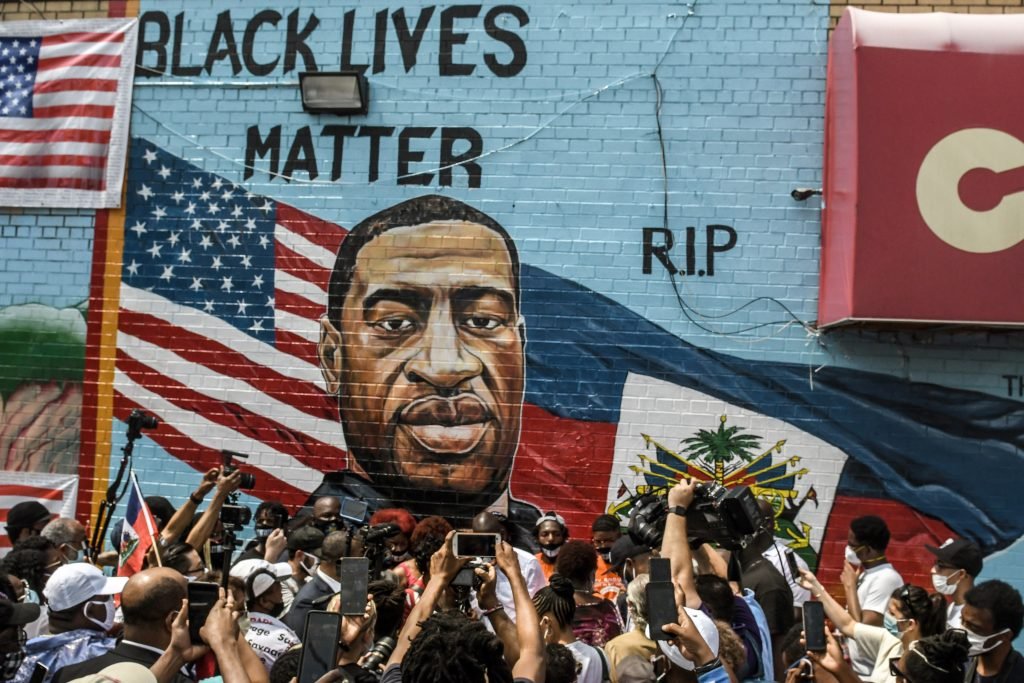
On Sunday, the day before the opening of the trial of former Minneapolis police officer Derek Chauvin, charged with murdering George Floyd, protesters gathered around the county court building, in black T-shirts that read, “A man was lynched in Minneapolis on May 25, 2020.” The building has been largely emptied out, 58 judges sent home to conduct court business by video conference. “The fear of having the government center overrun is real,” Chief Hennepin County District Judge Toddrick Barnette told the Minneapolis Star-Tribune. “After January 6, there was a significant change in how we’re going to protect the buildings and how we’re going to protect the people coming and going in the courthouse.” The building itself has been transformed into “something reminiscent of Cold War-era Berlin,” observed Matt Sepic at MPR News. “The grounds are encircled with concrete barricades, chain-link fencing and razor wire.” Minneapolis Mayor Jacob Frey has now asked the state legislature to pass Governor Tim Walz’s proposed security fund for the trial of $35 million.The whole trial is a rarity, as exceptionally few of the people police kill, around 1,000 each year, will have their stories heard by a court considering whether their death was a murder. More people know by now—after Breonna Taylor, after Eric Garner, after Tamir Rice, all killed by police whom prosecutors failed to indict for their role in their deaths—that the likelihood that the Chauvin trial will produce justice is small, if a murder conviction could even be considered justice for George Floyd. Just a few days before jury selection began Monday, the House of Representatives passed the George Floyd Act, another attempt at reform that moves more funding to police, while using Floyd’s name, and without addressing the factors that led to his killing. While attention may be pulled to the trial and police reform measures, the work that has arguably most decreased the chances that police will kill is the grassroots campaigns across the country that, collectively, have cut more than $840 million from police departments, according to a new analysis from Interrupting Criminalization, an initiative at the Barnard Center for Research on Women, while securing investments of at least $160 million in communities. Justice for George Floyd isn’t just or only about using the criminal legal system to convict a police officer of murder, or making it likelier to indict a police officer, or creating more oversight of police misconduct. Justice is—or perhaps only begins with—ending police killings.For all the unknowns and potential system failures presented by Chauvin’s trial, the public will at least have access to it through a livestream. Few observers, including members of the media, will be physically present, making a livestream a serious accessibility issue. Inside the courtroom, all participants will be masked, with plexiglass partitions erected between them. The coronavirus was a considerable factor in when and how the trial will proceed, including who is available to sit on the jury. Some data suggests that Black and Latinx people are less likely (or able) to report for jury duty during the pandemic, because they have been disproportionately more likely to contract or otherwise be impacted by Covid-19. Lower-income people are in a similar situation with the economic fallout from the virus. As a result, “people who might be willing to serve on a jury right now skew whiter and more conservative,” writes Cara Bayles at Law360.The trial will be shaped by the inequities deepened by the pandemic, along with the routine mechanics of the court system’s biases against Black people. Prospective jurors have already completed an unusually lengthy questionnaire, which, in addition to asking about their familiarity with the case, probes their political beliefs and opinions about systemic racism. Jurors have been asked if they participated in a protest this summer, if they carried a sign, and what it said. They were instructed to rank how strongly they agree with the following statements, among others: “I think that news reports about police brutality against racial minorities [are] only the tip of the iceberg,” “I support defunding the Minneapolis Police Department.” How favorably or unfavorably, they were asked, do they view Black Lives Matter and Blue Lives Matter? “In an ideal world you want somebody who hasn’t formed an opinion,” Aviva Orenstein, a law professor at Indiana University Maurer School, told Reuters. “Do you know a Black person who has not formed an opinion about George Floyd?” What also concerns some legal observers is that these questions will become a pretext for excluding Black jurors, which is barred based on the Batson decision by the Supreme Court. “They’ll be able to point to a question and go, ‘No, here’s why we challenged this guy. Not because of his race, because of his answer on Question 23,’” a jury consultant told Bayles at Law360. “There’s going to be a lot of attorneys bending over backwards to make it clear they’re not just going along racial lines.”At the same time, Congress is considering its own role in police reform, taking up legislation driven by the summer’s uprisings and demands to defund the police. Yet the first such bill to pass the House, the George Floyd Act, increases police funding. “Congress made sure to include $750M in the George Floyd Act to investigate the deadly use of force by law enforcement,” wrote Derecka Purnell at The Guardian. “Protesters have been demanding to defund the police to keep us safe; not spend millions of dollars to investigate how we die. We know how we die—the police.” A very different approach is found in the BREATHE Act, backed by the Electoral Justice Project of the Movement for Black Lives, and supported by Democratic Representative Ayanna Pressley from Massachusetts and Representative Rashida Tlaib, a Democrat from Michigan. It is a bill more clearly aligned with the analysis of policing you could find on the streets this summer: Defund the police and invest in communities.Whether or not Congress acts, organizers in around two dozen cities have concretized and even won some of those demands. In addition to the $840 million redirected from police departments to communities, Interrupting Criminalization found, around $34 million was saved by removing police from schools. This should not be understood as an austerity measure, it cautions. “#DefundPolice is a strategy that goes beyond dollars and cents,” the group’s recent update to its #DefundPolice toolkit states, “it is not just about decreasing police budgets, it is about reducing the power, scope, and size of police departments. It is about delegitimizing institutions of surveillance, policing and punishment, and of these strategies, no matter who is deploying them, to produce safety.”The work that made these wins possible, in Interrupting Criminalization’s analysis, took place outside the criminal legal system: It was through building power with groups’ “outside game” in the streets and through direct action to put pressure on those making decisions “inside.” It took “sustained pressure from thousands of people who called their local council-members, Zoomed into budget hearings, and participated in digital actions and social media campaigns in the midst of a pandemic.” People had to teach each other how these systems worked and then took action together to dismantle them.There is no room in a courthouse for that way of arriving at some justice. When prospective jurors filed in on Monday morning, they entered a heavily guarded court building and a sparsely occupied courtroom. Out of social distancing concerns, one observer each is permitted for Chauvin and for the family of George Floyd. The jurors will see how the justice system itself was fortified at great expense against—possibly—the people who were driven to protest all summer, when Officer Chauvin forced George Floyd’s last breaths out of his restrained and prone body. Though jurors will be selected in part based on how they feel about the police and about Black Lives Matter and how much or how little they already know about the events of May 25, the building they will sit in over the weeks of the trial tells a lot of the story already: who deserves protection, who is a threat.
Read More
Be the first to write a comment.