Internet Security

A Trial Can’t Bring Justice for George Floyd

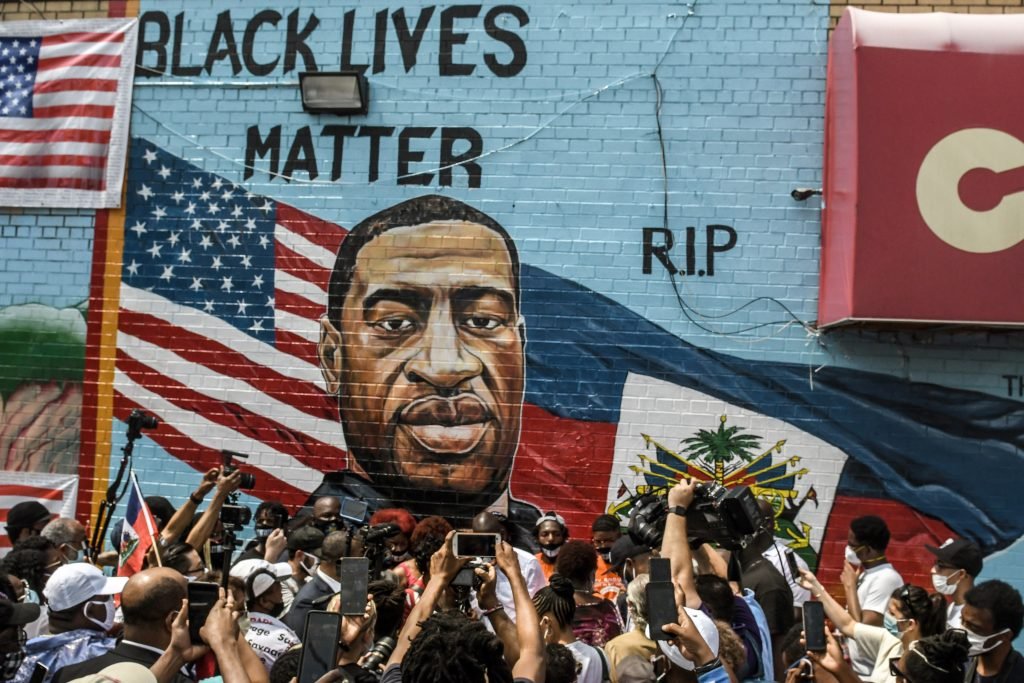
On Sunday, the day before the opening of the trial of former Minneapolis police officer Derek Chauvin, charged with murdering George Floyd, protesters gathered around the county court building, in black T-shirts that read, “A man was lynched in Minneapolis on May 25, 2020.” The building has been largely emptied out, 58 judges sent home…

On Sunday, the day before the opening of the trial of former Minneapolis police officer Derek Chauvin, charged with murdering George Floyd, protesters gathered around the county court building, in black T-shirts that read, “A man was lynched in Minneapolis on May 25, 2020.” The building has been largely emptied out, 58 judges sent home to conduct court business by video conference. “The fear of having the government center overrun is real,” Chief Hennepin County District Judge Toddrick Barnette told the Minneapolis Star-Tribune. “After January 6, there was a significant change in how we’re going to protect the buildings and how we’re going to protect the people coming and going in the courthouse.” The building itself has been transformed into “something reminiscent of Cold War-era Berlin,” observed Matt Sepic at MPR News. “The grounds are encircled with concrete barricades, chain-link fencing and razor wire.” Minneapolis Mayor Jacob Frey has now asked the state legislature to pass Governor Tim Walz’s proposed security fund for the trial of $35 million.The whole trial is a rarity, as exceptionally few of the people police kill, around 1,000 each year, will have their stories heard by a court considering whether their death was a murder. More people know by now—after Breonna Taylor, after Eric Garner, after Tamir Rice, all killed by police whom prosecutors failed to indict for their role in their deaths—that the likelihood that the Chauvin trial will produce justice is small, if a murder conviction could even be considered justice for George Floyd. Just a few days before jury selection began Monday, the House of Representatives passed the George Floyd Act, another attempt at reform that moves more funding to police, while using Floyd’s name, and without addressing the factors that led to his killing. While attention may be pulled to the trial and police reform measures, the work that has arguably most decreased the chances that police will kill is the grassroots campaigns across the country that, collectively, have cut more than $840 million from police departments, according to a new analysis from Interrupting Criminalization, an initiative at the Barnard Center for Research on Women, while securing investments of at least $160 million in communities. Justice for George Floyd isn’t just or only about using the criminal legal system to convict a police officer of murder, or making it likelier to indict a police officer, or creating more oversight of police misconduct. Justice is—or perhaps only begins with—ending police killings.For all the unknowns and potential system failures presented by Chauvin’s trial, the public will at least have access to it through a livestream. Few observers, including members of the media, will be physically present, making a livestream a serious accessibility issue. Inside the courtroom, all participants will be masked, with plexiglass partitions erected between them. The coronavirus was a considerable factor in when and how the trial will proceed, including who is available to sit on the jury. Some data suggests that Black and Latinx people are less likely (or able) to report for jury duty during the pandemic, because they have been disproportionately more likely to contract or otherwise be impacted by Covid-19. Lower-income people are in a similar situation with the economic fallout from the virus. As a result, “people who might be willing to serve on a jury right now skew whiter and more conservative,” writes Cara Bayles at Law360.The trial will be shaped by the inequities deepened by the pandemic, along with the routine mechanics of the court system’s biases against Black people. Prospective jurors have already completed an unusually lengthy questionnaire, which, in addition to asking about their familiarity with the case, probes their political beliefs and opinions about systemic racism. Jurors have been asked if they participated in a protest this summer, if they carried a sign, and what it said. They were instructed to rank how strongly they agree with the following statements, among others: “I think that news reports about police brutality against racial minorities [are] only the tip of the iceberg,” “I support defunding the Minneapolis Police Department.” How favorably or unfavorably, they were asked, do they view Black Lives Matter and Blue Lives Matter? “In an ideal world you want somebody who hasn’t formed an opinion,” Aviva Orenstein, a law professor at Indiana University Maurer School, told Reuters. “Do you know a Black person who has not formed an opinion about George Floyd?” What also concerns some legal observers is that these questions will become a pretext for excluding Black jurors, which is barred based on the Batson decision by the Supreme Court. “They’ll be able to point to a question and go, ‘No, here’s why we challenged this guy. Not because of his race, because of his answer on Question 23,’” a jury consultant told Bayles at Law360. “There’s going to be a lot of attorneys bending over backwards to make it clear they’re not just going along racial lines.”At the same time, Congress is considering its own role in police reform, taking up legislation driven by the summer’s uprisings and demands to defund the police. Yet the first such bill to pass the House, the George Floyd Act, increases police funding. “Congress made sure to include $750M in the George Floyd Act to investigate the deadly use of force by law enforcement,” wrote Derecka Purnell at The Guardian. “Protesters have been demanding to defund the police to keep us safe; not spend millions of dollars to investigate how we die. We know how we die—the police.” A very different approach is found in the BREATHE Act, backed by the Electoral Justice Project of the Movement for Black Lives, and supported by Democratic Representative Ayanna Pressley from Massachusetts and Representative Rashida Tlaib, a Democrat from Michigan. It is a bill more clearly aligned with the analysis of policing you could find on the streets this summer: Defund the police and invest in communities.Whether or not Congress acts, organizers in around two dozen cities have concretized and even won some of those demands. In addition to the $840 million redirected from police departments to communities, Interrupting Criminalization found, around $34 million was saved by removing police from schools. This should not be understood as an austerity measure, it cautions. “#DefundPolice is a strategy that goes beyond dollars and cents,” the group’s recent update to its #DefundPolice toolkit states, “it is not just about decreasing police budgets, it is about reducing the power, scope, and size of police departments. It is about delegitimizing institutions of surveillance, policing and punishment, and of these strategies, no matter who is deploying them, to produce safety.”The work that made these wins possible, in Interrupting Criminalization’s analysis, took place outside the criminal legal system: It was through building power with groups’ “outside game” in the streets and through direct action to put pressure on those making decisions “inside.” It took “sustained pressure from thousands of people who called their local council-members, Zoomed into budget hearings, and participated in digital actions and social media campaigns in the midst of a pandemic.” People had to teach each other how these systems worked and then took action together to dismantle them.There is no room in a courthouse for that way of arriving at some justice. When prospective jurors filed in on Monday morning, they entered a heavily guarded court building and a sparsely occupied courtroom. Out of social distancing concerns, one observer each is permitted for Chauvin and for the family of George Floyd. The jurors will see how the justice system itself was fortified at great expense against—possibly—the people who were driven to protest all summer, when Officer Chauvin forced George Floyd’s last breaths out of his restrained and prone body. Though jurors will be selected in part based on how they feel about the police and about Black Lives Matter and how much or how little they already know about the events of May 25, the building they will sit in over the weeks of the trial tells a lot of the story already: who deserves protection, who is a threat.
Read More

Be the first to write a comment.

Leave a Reply

Your email address will not be published. Required fields are marked *

Internet Security

How a national security threat label has reignited Indonesia’s LGBTQ debate

Advertisement Asia How a national security threat label has reignited Indonesia’s LGBTQ debate Indonesia last October classified the “spread of LGBTQ culture” as one of the country’s non-military threats. A series of developments thrust the provision into the public eye this month, sparking a debate.   A street vendor walks past a banner reading ‘Indonesia

Advertisement

Asia

How a national security threat label has reignited Indonesia’s LGBTQ debate

Indonesia last October classified the “spread of LGBTQ culture” as one of the country’s non-military threats. A series of developments thrust the provision into the public eye this month, sparking a debate.


How a national security threat label has reignited Indonesia's LGBTQ debate

A street vendor walks past a banner reading ‘Indonesia LGBT Emergency’ in front a mosque in Jakarta, Indonesia, January 25, 2018. (REUTERS/Beawiharta)


New: You can now listen to articles.


This audio is generated by an AI tool.

Ericssen

Ericssen

Ericssen

21 Jul 2026 06:00AM
(Updated: 21 Jul 2026 10:59AM)


Bookmark


Bookmark


Share

SINGAPORE: For more than eight months, a provision tucked away in an Indonesian presidential regulation on national defence drew little public attention.

In an appendix to Presidential Regulation No. 111/2025 on the General National Defence Policy signed in October last year, the government classified the “spread of LGBTQ culture” as one of the country’s non-military threats. 

The clause, referring to lesbian, gay, bisexual, transsexual and queer culture, appeared alongside a range of other threats deemed capable of affecting national resilience. They included illegal trafficking, natural resource theft, terrorism, atheism and radicalism.

A presidential regulation is a legally binding regulation published in the State Gazette, while General National Defence Policy documents are highly technical and usually attract little public attention outside government and defence circles.

But a series of developments thrust the provision into the public eye this month, sparking a debate on the place of LGBTQ issues in state policy and the extent to which social issues should be framed within Indonesia’s defence strategy.

The issue quickly spread beyond social media into mainstream Indonesian media with national outlets including Antara, Kumparan, and Tempo examining the regulation and prompting public responses from senior government officials.

Some observers and activists say the clause could heighten discrimination against LGBTQ individuals in society, even as Indonesian ministers have defended the regulation while saying the government has no intention of curtailing the fundamental rights of citizens.

“As Indonesian citizens, LGBTQ people are entitled to education, employment, healthcare and other public services without restrictions, segregation or discrimination,” Indonesia’s Human Rights Minister Natalius Pigai told CNA in a phone interview.

CNA Games
Guess Word
Guess Word
Crack the word, one row at a time

Buzzword
Buzzword
Create words using the given letters

Mini Sudoku
Mini Sudoku
Tiny puzzle, mighty brain teaser

Mini Crossword
Mini Crossword
Small grid, big challenge

Word Search
Word Search
Spot as many words as you can

Show More

Show Less

Indonesia’s Human Rights Minister Natalius Pigai. (Photo courtesy of Human Rights Ministry)

But he added that Indonesian society is not ready to accept the LGBTQ community, even as the state remains obliged to respect, protect and fulfil every citizen’s rights to education, employment, healthcare and public services.

“The time has not yet come to formally recognise them as an official group because society is not yet ready to accept them,” he said.

HOW THE CLAUSE CAME TO PUBLIC ATTENTION

While it remains unclear what first drew widespread attention to the provision, it resurfaced amid a series of developments involving LGBTQ issues. One was a Pride Month-themed social media post in mid-June by Suara Mahasiswa, a student publication at the University of Indonesia.

The post had led to a heated online debate, with critics arguing it was inconsistent with Indonesia’s religious and social norms. They questioned why it invoked the Pancasila national ideology to defend the LGBTQ community. Pancasila comprises five principles: Belief in one God, civilised humanity, national unity, democracy and social justice.

The backlash prompted the university to publicly distance itself from the post and launch an internal review.

Then in late June, the Indonesian Ulema Council (MUI) said it was preparing an academic paper and a draft bill to criminalise LGBTQ-related conduct for Parliament’s National Legislation Programme.

MUI deputy chairman Muhammad Cholil Nafis argued that moral appeals alone were no longer sufficient to curb what he described as the growing activities and campaign surrounding LGBTQ culture.

“If there are no legal penalties at all, it eventually becomes normal. We should not normalise it. Punishment helps people understand that it is not normal,” he said.

“Deviant activities, such as same-sex parties, are now increasingly being displayed openly in public without any sense of shame,” he added.

Scrutiny then shifted to the new regulation that had previously gone largely unnoticed.

The belated attention came as no surprise to Agus Wahyudi, head of the Inter-Religious Studies Programme at Gadjah Mada University (UGM) in Yogyakarta.

Documents such as the General National Defence Policy typically circulate within government bureaucracy and rarely become the subject of public debate, he said.

But a provision can take on political significance when a series of events – in this case, the Pride Month-themed social media post and the MUI’s planned bill – draws the public’s notice, said Agus.

“What changed was not necessarily the policy itself, but the public attention it attracted,” Agus said.

WHY WAS IT PLACED IN A NATIONAL DEFENCE DOCUMENT?

Asked whether the presidential regulation represented the first national policy to explicitly mention LGBTQ, human rights lawyer Asfinawati said Indonesia’s 2008 Pornography Law referred to “lesbian” and “homosexual” acts in its explanatory notes to a provision banning the production, distribution and sale of pornographic material.

It defined what the law described as “deviant sexual intercourse” for the purposes of pornography offences, rather than creating a standalone offence based on sexual orientation or gender identity.

Presidential Regulation No. 111/2025 goes further by classifying the “spread of LGBTQ culture” itself as a non-military threat, argued Asfinawati, the former chair of the Indonesian Legal Aid Foundation.

“This regulation no longer links it to sexual conduct. Simply having a particular sexual orientation or gender identity is placed within a threat framework,” she said.

Experts have questioned whether a national defence framework was an appropriate instrument for addressing issues such as sexual orientation and gender identity.

In principle, national defence should focus on military threats, said Tangguh Chairil, a lecturer in security studies at the Department of International Relations at Binus University, Jakarta.

Indonesia, however, classifies threats into three categories: Military, non-military and hybrid. As a result, issues beyond the traditional defence sphere are increasingly viewed as national security issues.

“Because the definition is so broad, almost anything can be treated as a national security threat,” Tangguh told CNA.

Classifying LGBTQ culture as a non-military threat under a defence framework means the issue may be treated as a security concern requiring state attention and resources, he added.

“Issues that have been successfully securitised tend to receive greater attention than others,” he said.

Yusril Ihza Mahendra, Coordinating Minister for Legal Affairs, Human Rights, Immigration, and Corrections, told news outlet Tempo on Jul 9 that “non-military threat” was used to categorise risks against national resilience.

In the socio-cultural context, “resilience” refers to values, ethics, character of the younger generation, families, digital space, and social cohesion, he said.

“What the government perceives as a threat is the campaign, propaganda, and dissemination of LGBT behaviour aimed at altering the values that align with the nation’s culture and morality,” he added.

Indonesia’s Chief Minister for Law and Human Rights, Yusril Ihza Mahendra, speaks as Australia’s Minister for Home Affairs, Tony Burke, listens during a press conference following their meeting in Jakarta, Indonesia, December 3, 2024. (REUTERS/Willy Kurniawan)

Asfinawati said the regulation cannot serve as the legal basis for introducing new criminal provisions or for regional governments to impose criminal sanctions unless authorised by law.

Under Indonesian law, a person’s sexual orientation as well as consensual same-sex relations between adults are not, by themselves, criminal offences. The exception is Aceh province, which implements Islamic crimina

Read More

Continue Reading
Internet Security

Nigeria: UNICEF chief urges child protection amid security, humanitarian crises

Violence in Nigeria The head of the U.N. children’s agency visited northwestern Nigeria on Friday as conflict, poverty and rising food insecurity leave millions of children in the region in need of aid. Catherine Russell, executive director of UNICEF, toured the state of Sokoto, where the agency is seeking to draw attention to worsening humanitarian

Violence in Nigeria

The head of the U.N. children’s agency visited northwestern Nigeria on Friday as conflict, poverty and rising food insecurity leave millions of children in the region in need of aid.

Catherine Russell, executive director of UNICEF, toured the state of Sokoto, where the agency is seeking to draw attention to worsening humanitarian challenges facing children.

She met with state officials and visited UNICEF-supported programs aimed at improving the health of both mothers and children and protecting vulnerable youngsters.

“We have to make sure that children are protected in these conflicts,” she said.

“That their healthcare is protected, that their food is protected, that their education is protected. Children can’t waste years of their life because conflicts are going on.”

Northern Nigeria is already gripped by an intensifying security crisis that has killed thousands.

The ongoing Middle East conflict has deepened food insecurity for millions living in poverty, making children in poor households more vulnerable.

According to UNICEF between 18.3 million and 23.4 million more children in monetarily poor households worldwide have fallen into deeper poverty, including 6.5 million to 8.8 million in Africa.

Nigeria has one of the world’s largest populations of impoverished children, and humanitarian organizations warn that those in the country’s conflict-torn north remain among the most vulnerable.

For some, UNICEF-supported programs have made a tangible difference.

Zainab Bello, 19, said she had been out of school before joining the agency’s “Digital Village” program.

“I was taught digital literacy… how to use a digital tool,” she said.

“I also learned how I can promote my vocational skills on various social media platforms.”

The head of the U.N. children’s agency visited northwestern Nigeria on Friday as conflict, poverty and rising food insecurity leave millions of children in the region in need of aid.

Catherine Russell, executive director of UNICEF, toured the state of Sokoto, where the agency is seeking to draw attention to worsening humanitarian challenges facing children.

She met with state officials and visited UNICEF-supported programs aimed at improving the health of both mothers and children and protecting vulnerable youngsters.

“We have to make sure that children are protected in these conflicts,” she said.

“That their healthcare is protected, that their food is protected, that their education is protected. Children can’t waste years of their life because conflicts are going on.”

Northern Nigeria is already gripped by an intensifying security crisis that has killed thousands.

The ongoing Middle East conflict has deepened food insecurity for millions living in poverty, making children in poor households more vulnerable.

According to UNICEF between 18.3 million and 23.4 million more children in monetarily poor households worldwide have fallen into deeper poverty, including 6.5 million to 8.8 million in Africa.

Nigeria has one of the world’s largest populations of impoverished children, and humanitarian organizations warn that those in the country’s conflict-torn north remain among the most vulnerable.

For some, UNICEF-supported programs have made a tangible difference.

Zainab Bello, 19, said she had been out of school before joining the agency’s “Digital Village” program.

“I was taught digital literacy… how to use a digital tool,” she said.

“I also learned how I can promote my vocational skills on various social media platforms.”

Read More

Continue Reading
Internet Security

UK police arrest man over threat to shoot Reform leader Nigel Farage

A man who threatened on social media in May to shoot Reform UK party leader Nigel Farage was arrested, London police said on Wednesday, as concerns grow over the security of politicians following the killing of Ann Widdecombe, a former member of parliament. The man was arrested on Tuesday on suspicion of sending threatening communications

A man who threatened on social media in May to shoot Reform UK party leader Nigel Farage was arrested, London police said on Wednesday, as concerns grow over the security of politicians following the killing of Ann Widdecombe, a former member of parliament.
The man was arrested on Tuesday on suspicion of sending threatening communications to a member of parliament…
Read More

Continue Reading
Internet Security

Kiambu CCTV captures 2 young men’s suspicious activity in apartment: “Who knows them?”

CCTV footage captured two young men attempting a daytime break-in in Ndumberi, sparking social media reactions amid rising insecurity and calls for vigilance…

CCTV footage captured two young men attempting a daytime break-in in Ndumberi, sparking social media reactions amid rising insecurity and calls for vigilance…
Read More

Continue Reading