Antivirus

Best internet security suites of 2019

The best internet security software of 20191. BitDefender Total Security Multi-Device 2018 2. Kaspersky Total Security 2018 3. McAfee LiveSafe 4. Symantec Norton Security Premium 5. BullGuard Premium ProtectionThese days it pays to get protection for all your devices – whether its a PC, Mac or smartphone. But with so many options out there, where…


The best internet security software of 2019

1. BitDefender Total Security Multi-Device 2018
2. Kaspersky Total Security 2018
3. McAfee LiveSafe
4. Symantec Norton Security Premium
5. BullGuard Premium Protection

These days it pays to get protection for all your devices – whether its a PC, Mac or smartphone. But with so many options out there, where do you start?  Our list of the best Internet Security software suites in 2019 can help.

The threat landscape has never been so varied and attackers have never been so sophisticated. This means that although our PCs are more secure than they have ever been, it’s important to have the right security tools.

It’s hard to buy bad virus protection (especially if you chose them from our list of best antivirus) but many vendors offer packages of the basics plus other tools – such as firewalls and specific protections – that cover PCs, Macs and mobile devices.

But with wildly differing features and pricing it can sometimes be tough to pick the best one.

So if you’re looking for some additional protection in the form of Internet Security, then you’ve come to the right place. Here are our picks

  • This is our best antivirus buying guide

Bitdefender Total Security Multi-Device 2019 is the bigger brother of Antivirus Plus and adds a lot more features

1. Bitdefender Total Security Multi-Device 2019

An excellent security solution

Bitdefender is a regular visitor to the top of the security charts, and with good reason – it’s lightning fast, exceptionally accurate and boasts a range of tools including secure browsing, a password manager and a very effective spam filter.

In its Total Security guise, it also delivers password management, secure browsing, battery management, VPN (with 6GB monthly allowance), Wi-Fi protection, ransomware protection, system optimisation, file encryption and shredding, and a licence for five PCs, Macs or Android devices (and up to 10) plus an option to get it installed and setup for you, presumably remotely.

The most recent version of the suite is Bit Defender Total Security 2019, which adds Ransomware Remediation, Network Threat Prevention, a new look dashboard and a more intelligent AutoPilot system.

Bitdefender is currently offering a a 50 percent discount which means you can protect up to five devices for £35 a year.

Note these discounts only apply to the first payment, but Bitdefender’s secret is simple: it’s very, very good at what it does.
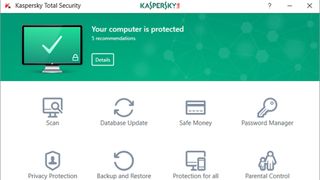
Despite the recent controversy behind Kaspersky's products, the brand (and its Total Security solution) remains one of the most popular in the security market

Despite the recent controversy behind Kaspersky’s products, the brand (and itsTotal Security solution) remains one of the most popular in the security market

2. Kaspersky Total Security 2019

It even includes a VPN service

Total Security product starts at £27.99 for one device, rising to £42 ($50) per year for five devices, with support for 10 devices and up to three-year subscription.

With Kaspersky Total Security 2019, smarter navigation makes it easier to understand the additional tools beyond the core functionality.

Total Security protects PC, Mac, iOS and Android devices, with very solid security scanning supplemented with file backup and encryption, password management, parental controls and child safety measures, along with privacy protection, including a VPN for trace-free browsing. 

McAfee LiveSafe is highly user-friendly and covers you for unlimited devices

3. McAfee LiveSafe

A tried-and-trusted household name

LiveSafe isn’t the cheapest product out there, but it’s particularly user-friendly. There are parental controls and anti-spam, password management and identity protection, website scanning and a guaranteed 100% virus removal or your money back. The licence covers unlimited PCs, Macs, phones and tablets, although as with any such suite the PC gets all the toys while Macs and mobile get a subset of the main package. 
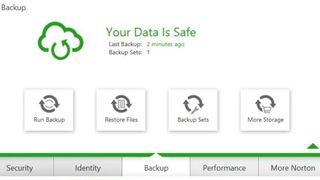
Symantec Norton Security Premium boasts high quality malware scanning and a 100% virus removal guarantee

4. Symantec Norton Security Premium

A well-known name that’s sticking around

Norton Security Premium is usually £79.99 (around $110, AU$150) per year for up to 10 PCs, Macs, iOS and Android devices, but at the time of writing it’s just £39.99 (around $55, AU$75) – making it less than half the price of other premium suites.

Once again we have parental controls, identity protection and excellent malware scanning, and there’s also a useful Android feature that warns of dodgy apps – the biggest current source of Android malware. There’s a 100% virus removal guarantee, 25GB of cloud backup and a network firewall, but you don’t get a password manager or any system optimisation tools.
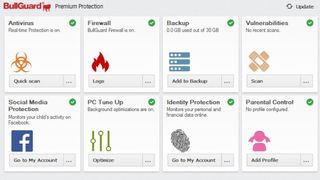
BullGuard Premium Protection gives you identity protection, online backup facilities and much more

5. BullGuard Premium Protection

A good security package

BullGuard is usually £69.95 (around $100, AU$130) per year for 10 devices but is always available for cheaper. Once again the basic protection is enhanced – you get parental controls, anti-spam, identity protection, 25GB of online backup and automatic upgrades, and BullGuard also offers to warn you about inappropriate content on your children’s social media. There’s no password manager or support for mobile devices, but BullGuard is a solid offering for protecting PCs. 
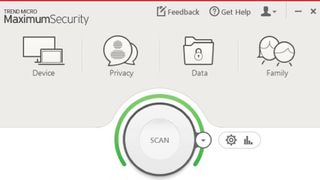
Trend Micro Maximum Security boasts a password manager, not to mention PC optimisation tools

6. Trend Micro Maximum Security

A multitude of tools available

Trend Micro is on sale! We’re starting to detect a trend here, and that trend would make us very wary of signing up for any security suite that isn’t currently offering a big discount on the RRP. You don’t want to be the only person who paid full price for a sofa, after all.

Trend Micro’s Maximum Security protects up to 10 PCs, Macs or mobiles for $59.95 or £29.95 per year (it’s usually $99.95 or £69.95), and the suite includes ransomware protection, identity protection, parental controls and a password manager. It also offers PC optimisation tools to speed up sluggish computers.
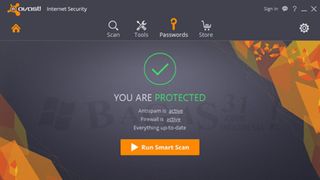
Avast Internet Security is a powerful suite offering features like router security and sandboxed downloads

7. Avast Internet Security

Going beyond the call of duty

Internet Security starts at $47.99 (around £35, AU$65) per year for one PC. In addition to the core antimalware product you get router security, browser clean-up, password management, sandboxed downloads, DNS hijacking protection, secure browsing and anti-spam. It’s a very good product but it can’t help but look awfully expensive when everybody else appears to be offering double-digit discounting.
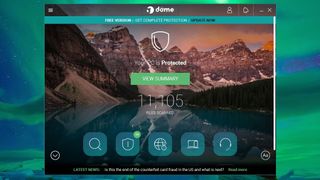
Panda Dome Premium

8. Panda Dome Advanced

Rebranded but with the same solid protection

Panda Dome  (re-branded from Panda Global Protection) alleviates that issue by providing all of the company’s security tools into a single suite. What you

Read More

Be the first to write a comment.

Leave a Reply

Your email address will not be published. Required fields are marked *

Antivirus

Your antivirus is probably slowing your PC more than protecting it

Antivirus is one of the first things most people install on a new PC. After all, nobody wants malware ruining their PC or, worse, stealing their data. And to be fair, most popular antivirus suites do a decent job of protecting your PC. But the problem is, they aren’t exactly optimized to be lean or

Antivirus is one of the first things most people install on a new PC. After all, nobody wants malware ruining their PC or, worse, stealing their data. And to be fair, most popular antivirus suites do a decent job of protecting your PC. But the problem is, they aren’t exactly optimized to be lean or lightweight. And things have become even worse ever since antivirus suites have started bundling extras like VPNs, parental controls, and browser add-ons.

All of this leaves the apps and games you actually use with fewer resources, which causes frequent slowdowns and even lag. So the uncomfortable irony is that the software meant to protect your PC ends up being the very thing holding it back.

How antivirus software can slow down your PC

When constant protection becomes constant pressure

Antivirus softwares love to present themselves as silent protectors. Always watching, always keeping you safe, and never getting in your way. Sure enough, part of this is true. They work in the background, but it’s not without any impact.

Antivirus programs work by scanning files as they are opened, downloaded, copied, or modified. That means every app you launch and every document you touch triggers a quick inspection. There are also the scheduled scans, which often run when you least expect them. So if your PC has ever felt slow, even when you’ve got nothing running, it’s probably the antivirus program combing through your files in the background.

Now, the performance hit isn’t the same every time. During light, routine scans, the impact can be minimal, anywhere from 0 to 20 percent. However, during full or partial scans, this can rise up to as high as 50 percent. The impact also varies depending on the antivirus program you’re using. Some are lightweight and efficient, while others are far more demanding.

Most of the time, you may not even notice this slowdown. But as soon as you start gaming, editing videos, or running any resource-intensive apps, the story will change. That’s when both your app or game and antivirus program start to compete for the same system resources, and the performance takes a hit.

To make matters worse, modern antivirus rarely sticks to just antivirus duties. Most of them come bundled with all sorts of extras, like VPNs, password managers, and system optimizers. All of these extras run separate processes. So yes, it’s not just one program you’re dealing with. Your PC is actually running multiple different software under a single name.

You can verify if the antivirus is the bottleneck

Be sure before you act

!–>

Read More

Continue Reading
Antivirus

If you’re struggling to play tactics sim Menace, it could be because your antivirus is randomly deleting files

This week saw the early access launch of turn-based tactics game Menace, created by the piss-swigging misanthropes behind Battle Brothers. Julian has been having a wonderful time playing it and learning about the importance of spare ammo and adequate reconnaissance. It could have been worse, Julian…

This week saw the early access launch of turn-based tactics game Menace, created by the piss-swigging misanthropes behind Battle Brothers. Julian has been having a wonderful time playing it and learning about the importance of spare ammo and adequate reconnaissance. It could have been worse, Julian…
Read More

Continue Reading
Antivirus

You don’t need to pay for third-party antivirus software to protect your PC anymore

Summary Most consumer devices already come with strong default security measures equivalent to or better than third-party software. Common vectors of attack for malware are already blocked by modern systems before they even reach your antivirus program. Individual consumer PCs are not a primary target for cybercriminals, and cyberattacks are often conducted by exploiting vulnerabilities

Summary

  • Most consumer devices already come with strong default security measures equivalent to or better than third-party software.
  • Common vectors of attack for malware are already blocked by modern systems before they even reach your antivirus program.
  • Individual consumer PCs are not a primary target for cybercriminals, and cyberattacks are often conducted by exploiting vulnerabilities against third-party software, not the computer OS itself.

Do you still pay for third-party antivirus software like Norton or McAfee? You may be surprised to learn that there’s no real benefit to doing so. Software like this is mostly obsolete today.

Who pays for third-party antivirus software, and why?

It might sound like a bold claim, saying that you don’t need third-party antivirus software anymore. After all, recent statistics show that roughly half of American consumers use such programs. Interestingly enough, those same statistics also show that users over 65 are more than twice as likely to subscribe to paid antivirus software than those under 45.

Why is that? Well, there is certainly more than one reason, but a big one is simply misunderstanding and tradition.

In the past, having third-party antivirus software was prudent, almost mandatory to keep your computer safe. Some people who grew up in that era are comfortable with the idea of paying for these subscriptions, not realizing that things have changed: your computer protects itself just fine these days.

Not only do computers come out of the box equipped with incredibly good security these days, but most malware threats aren’t even targeting individual consumers. But you don’t have to take my word for it right away. Let’s dive into this in more detail.

Default security measures are more than enough today

All of your consumer devices come with default protection right off the shelf. With iOS and Android, their official app stores weed out malware and keep you safe. Mac has been using XProtect anti-malware for more than a decade, and it has an excellent record.

A screen showing an update for Windows Defender on Windows 11. Credit: Microsoft

Windows has Microsoft Defender Antivirus, which has consistently aced security tests run by third-party organizations. Since around seven years ago, Defender Antivirus has consistently earned perfect or near-perfect scores in protecting your PC.

Needless to say, that’s as good as it gets, and the program comes free with your Windows computer. There’s no paid antivirus software that can outperform this free, default option from Microsoft. They may offer more features, but not more practical benefits. But even beyond these built-in systems, there are other re

Read More

Continue Reading
Antivirus

AV vendor goes to war with security shop over update server scare

eScan lawyers up after Morphisec claimed ‘critical supply-chain compromise’ A spat has erupted between antivirus vendor eScan and threat intelligence outfit Morphisec over who spotted an update server incident that disrupted some eScan customers earlier this month.……

eScan lawyers up after Morphisec claimed ‘critical supply-chain compromise’ A spat has erupted between antivirus vendor eScan and threat intelligence outfit Morphisec over who spotted an update server incident that disrupted some eScan customers earlier this month.……
Read More

Continue Reading