Bitcoin Miners Pivot to Southeast Asia After China Crackdown



Bitcoin Miners Pivot to Southeast Asia After China Crackdown
Miners are setting up in pockets of Malaysia, Indonesia, Laos and Thailand after China banned the industry in 2021.
Author of the article:

Article content
(Bloomberg) — The 17-acre cement slab in the middle of a Borneo industrial area once belonged to a logging company. Long ago that business abandoned the site to the elements, leaving just rudimentary structures and a four-story-tall concrete birdhouse made to lure swiftlets whose nests, built with saliva, fetch high prices in China.

tap here to see other videos from our team.
Bitcoin Miners Pivot to Southeast Asia After China Crackdown Back to video
But in 2023, another industry moved in: Bitcoin miners. Sheltered by a vast, sheet-metal roof, over 1,000 machines now roar away, while hundreds more sit nearby in cardboard boxes waiting to be unpacked.
The site in Tanjung Manis, Sarawak, is the largest of four operations in the area run by miner Bityou. Owner Peter Lim chose the location after he was forced to shutter a larger 10,000 rig, 20-megawatt operation in China, following a ban on Bitcoin miners in 2021. “Most of the companies already left this industrial park,” said Lim. “We decided, why don’t we make use of these abandoned resources?”
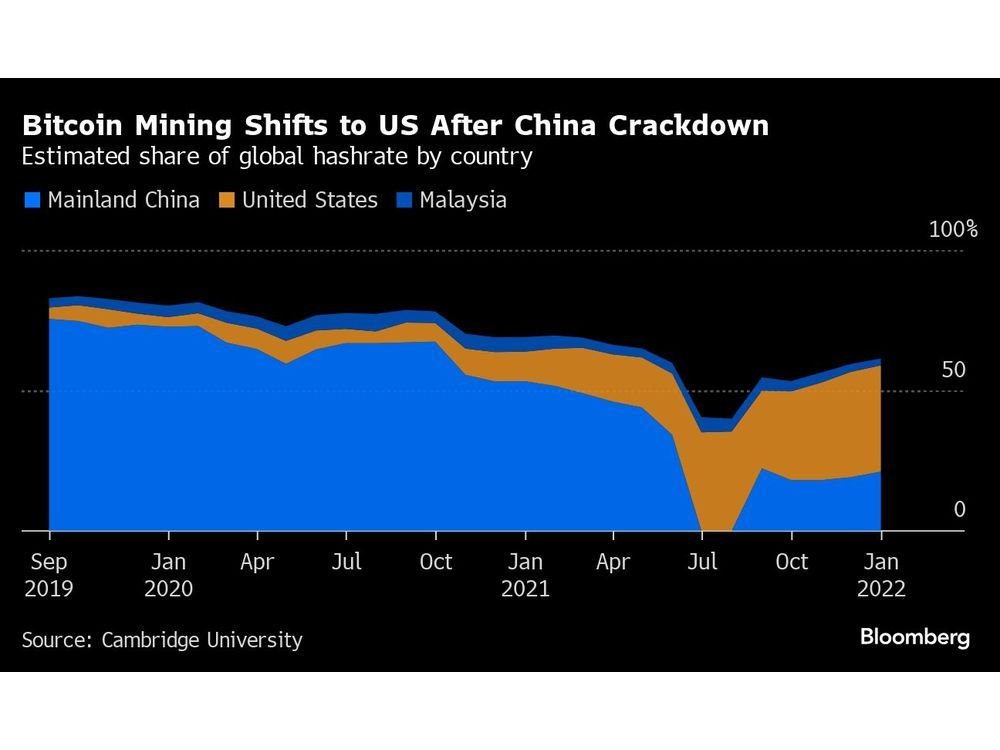
He’s one of many miners popping up in Southeast Asia — not all of them entirely legal, although Lim says Bityou’s operations are above board — after China’s crackdown. China was once the dominant country for Bitcoin mining, the process of using computing power to solve encryption puzzles in return for new tokens. In 2019 it accounted for about three-quarters of global activity, according to data collected by Cambridge University.
But when the Chinese authorities declared that any crypto-related transactions would be considered illicit financial activity, the industry was decimated.
“Back then, some of the state governments, they just seize your property,” said Alex Loh, Lim’s colleague at Bityou, in an interview.

Loh said some 3,000 of his machines were seized at a mine he used to run in Inner Mongolia. He was also a stakeholder in a 120-megawatt site in Sichuan province that suffered a similar fate. “We spent about three months to build that place,” Loh said. “But once we started our operation, less than a month, we have to stop.”
Despite China’s clampdown, Bitcoin has more than quadrupled since the start of last year to trade around $67,000 at lunchtime in Singapore on June 13, helped in part by the US launch of spot Bitcoin ETFs in January. Renewed institutional interest has been a boon for miners, who earned revenue of $960 million in May, according to data tracked by The Block Research. Bitcoin’s strong performance partially offsets the impact of April’s “halving,” a quadrennial event that slashes the rewards earned by miners for maintaining the network.
China Crackdown
The US had become the global leader in terms of hashrate — a measure of the computational power used to process transactions on the Bitcoin network — by January 2022, according to Cambridge University data.
Now Southeast Asian nations are also climbing the ranks. Malaysia contributed 2.5% of the global hashrate, the Cambridge data show, ranking it among the top 10 nations. Preliminary results from more recent mining research suggest activity in Indonesia “markedly rose” in 2022 to between “lower and mid-single digit percentages,” said Alexander Neumüller, a research lead at Cambridge.
The availability of competitively priced power, skilled labor and, crucially, existing infrastructure add to the region’s allure for miners, Lim said.
Rigs are popping up all over Southeast Asia in abandoned shopping malls, former steel factories and on the side of hydro-electric power projects, as miners try to find sites where they can access the ample electricity they need. That’s because the region doesn’t have the option of exploiting “gluts of power” like miners in the US, who can dial up their activity in periods of lower power demand for preferential prices, according to Fred Thiel, CEO and chairman of Marathon Digital Holdings, one of the world’s largest Bitcoin miners.
Manufacturers of mining rigs have followed the miners to Southeast Asia, shifting some operations to the region as they seek to meet burgeoning demand and, like many other industries, to avoid US tariffs on China. Until 2018, when former President Donald Trump imposed a 25% duty on a range of electronic goods from China, Bitcoin rig production was “almost entirely” based in Shenzhen and Guangzhou, according to Ben Gagnon, chief mining officer at Bitfarms, which is currently the target of a $950 million takeover bid.
“The vast majority of miners now are produced in Malaysia. There are manufacturing locations also in Thailand, Indonesia, Taiwan, the US also to some extent,” said Gagnon, who has visited manufacturing facilities in Penang and Indonesia to run quality control checks for the Toronto-based miner. Some of sites belong to Bitmain, others to its closest rival MicroBT. Bitmain declined to comment while MicroBT said, in emailed comments, it had manufacturing in the region and facilities in both Thailand and the US.
Finding a Home
Setting up shop is not always straightforward for miners. Like Lim, many are taking root in unexpected places, often leading a precarious existence thanks to frequent shifts in the stance of regulators as well as conditions that tend to favor smaller-scale outfits.
Mining in Laos, which has a burgeoning hydropower industry, was derailed by an extreme drought this year, which meant the state-run power company withdrew electrical supply from miners. Today, crypto mining accounts for more than a third of all power demand in the country, Somboun Sangxayarath, an advisor at Electricite Du Laos, recently told Reuters.
Police raids on Bitcoin miners illegally siphoning energy are a regular occurrence in Malaysia, Indonesia and Laos. Electricity theft by Bitcoin miners had cost Malaysia an estimated 2.3 billion ringgit ($550 million) and rising as of early 2022, according to Takiyuddin Hassan, at that time Malaysia’s energy and natural resources minister. Nearby Lim’s Sarawak operation, in Kuching, another miner is looking to set up in the shells of former steel plants and plastics factories, according to a pitch deck seen by Bloomberg. A partnership between Sovereign Sengalang and Sprint Capital Management kicked off operations in the region earlier this year and is now seeking investment to develop “new brownfield sites.” The investment comes as state authorities last year unveiled plans for Sarawak to transition from a resource-based economy to an “environmentally sustainable technology-based economy” by 2030.
Despite the challenges, significant growth is expected in both mining and manufacturing . “Southeast Asia is poised to take off in the next few years,” said Taras Kulyk, founder and CEO of SunnySide Digital, a distributor of data center hardware.
Surrounded by his boxed-up machines, Bityou’s Lim said Southeast Asia’s miners “have to find some kind of unique setup, whether it be in terms of the price of power or lack of local competition, some sort of incentive, something to give them a bit of an edge.”
-
The Conservatives have proposed a complete taxation review — it’s about time
![Conservative Leader Pierre Poilievre during Question Period in the House of Commons on Parliament Hill in Ottawa.]()
-
Canadians getting more anxious about their finances as they await more rate cuts
![Pedestrians walk past the Bank of Canada in Ottawa.]()
-
Diane Francis: Protecting the ‘traitors’
![Prime Minister Justin Trudeau.]()
-
Ted Rechtshaffen: Canada’s shifting values are leading us to a scary economic future
![Peace Tower on Parliament Hill in Ottawa.]()
-
Bank of Canada rate cut seen revitalizing housing market after ‘sleepy’ May
![The national benchmark home price slid to $714,3srcsrc, down src.2 per cent from April to May 2src24, and 2.4 per cent year over year.]()


Article content
(Bloomberg) — The 17-acre cement slab in the middle of a Borneo industrial area once belonged to a logging company. Long ago that business abandoned the site to the elements, leaving just rudimentary structures and a four-story-tall concrete birdhouse made to lure swiftlets whose nests, built with saliva, fetch high prices in China.
tap here to see other videos from our team.
Bitcoin Miners Pivot to Southeast Asia After China Crackdown Back to video
But in 2023, another industry moved in: Bitcoin miners. Sheltered by a vast, sheet-metal roof, over 1,000 machines now roar away, while hundreds more sit nearby in cardboard boxes waiting to be unpacked.
The site in Tanjung Manis, Sarawak, is the largest of four operations in the area run by miner Bityou. Owner Peter Lim chose the location after he was forced to shutter a larger 10,000 rig, 20-megawatt operation in China, following a ban on Bitcoin miners in 2021. “Most of the companies already left this industrial park,” said Lim. “We decided, why don’t we make use of these abandoned resources?”
He’s one of many miners popping up in Southeast Asia — not all of them entirely legal, although Lim says Bityou’s operations are above board — after China’s crackdown. China was once the dominant country for Bitcoin mining, the process of using computing power to solve encryption puzzles in return for new tokens. In 2019 it accounted for about three-quarters of global activity, according to data collected by Cambridge University.
But when the Chinese authorities declared that any crypto-related transactions would be considered illicit financial activity, the industry was decimated.
“Back then, some of the state governments, they just seize your property,” said Alex Loh, Lim’s colleague at Bityou, in an interview.
Loh said some 3,000 of his machines were seized at a mine he used to run in Inner Mongolia. He was also a stakeholder in a 120-megawatt site in Sichuan province that suffered a similar fate. “We spent about three months to build that place,” Loh said. “But once we started our operation, less than a month, we have to stop.”
Despite China’s clampdown, Bitcoin has more than quadrupled since the start of last year to trade around $67,000 at lunchtime in Singapore on June 13, helped in part by the US launch of spot Bitcoin ETFs in January. Renewed institutional interest has been a boon for miners, who earned revenue of $960 million in May, according to data tracked by The Block Research. Bitcoin’s strong performance partially offsets the impact of April’s “halving,” a quadrennial event that slashes the rewards earned by miners for maintaining the network.
China Crackdown
The US had become the global leader in terms of hashrate — a measure of the computational power used to process transactions on the Bitcoin network — by January 2022, according to Cambridge University data.
Now Southeast Asian nations are also climbing the ranks. Malaysia contributed 2.5% of the global hashrate, the Cambridge data show, ranking it among the top 10 nations. Preliminary results from more recent mining research suggest activity in Indonesia “markedly rose” in 2022 to between “lower and mid-single digit percentages,” said Alexander Neumüller, a research lead at Cambridge.
The availability of competitively priced power, skilled labor and, crucially, existing infrastructure add to the region’s allure for miners, Lim said.
Rigs are popping up all over Southeast Asia in abandoned shopping malls, former steel factories and on the side of hydro-electric power projects, as miners try to find sites where they can access the ample electricity they need. That’s because the region doesn’t have the option of exploiting “gluts of power” like miners in the US, who can dial up their activity in periods of lower power demand for preferential prices, according to Fred Thiel, CEO and chairman of Marathon Digital Holdings, one of the world’s largest Bitcoin miners.
Manufacturers of mining rigs have followed the miners to Southeast Asia, shifting some operations to the region as they seek to meet burgeoning demand and, like many other industries, to avoid US tariffs on China. Until 2018, when former President Donald Trump imposed a 25% duty on a range of electronic goods from China, Bitcoin rig production was “almost entirely” based in Shenzhen and Guangzhou, according to Ben Gagnon, chief mining officer at Bitfarms, which is currently the target of a $950 million takeover bid.
“The vast majority of miners now are produced in Malaysia. There are manufacturing locations also in Thailand, Indonesia, Taiwan, the US also to some extent,” said Gagnon, who has visited manufacturing facilities in Penang and Indonesia to run quality control checks for the Toronto-based miner. Some of sites belong to Bitmain, others to its closest rival MicroBT. Bitmain declined to comment while MicroBT said, in emailed comments, it had manufacturing in the region and facilities in both Thailand and the US.
Finding a Home
Setting up shop is not always straightforward for miners. Like Lim, many are taking root in unexpected places, often leading a precarious existence thanks to frequent shifts in the stance of regulators as well as conditions that tend to favor smaller-scale outfits.
Mining in Laos, which has a burgeoning hydropower industry, was derailed by an extreme drought this year, which meant the state-run power company withdrew electrical supply from miners. Today, crypto mining accounts for more than a third of all power demand in the country, Somboun Sangxayarath, an advisor at Electricite Du Laos, recently told Reuters.
Police raids on Bitcoin miners illegally siphoning energy are a regular occurrence in Malaysia, Indonesia and Laos. Electricity theft by Bitcoin miners had cost Malaysia an estimated 2.3 billion ringgit ($550 million) and rising as of early 2022, according to Takiyuddin Hassan, at that time Malaysia’s energy and natural resources minister. Nearby Lim’s Sarawak operation, in Kuching, another miner is looking to set up in the shells of former steel plants and plastics factories, according to a pitch deck seen by Bloomberg. A partnership between Sovereign Sengalang and Sprint Capital Management kicked off operations in the region earlier this year and is now seeking investment to develop “new brownfield sites.” The investment comes as state authorities last year unveiled plans for Sarawak to transition from a resource-based economy to an “environmentally sustainable technology-based economy” by 2030.
Despite the challenges, significant growth is expected in both mining and manufacturing . “Southeast Asia is poised to take off in the next few years,” said Taras Kulyk, founder and CEO of SunnySide Digital, a distributor of data center hardware.
Surrounded by his boxed-up machines, Bityou’s Lim said Southeast Asia’s miners “have to find some kind of unique setup, whether it be in terms of the price of power or lack of local competition, some sort of incentive, something to give them a bit of an edge.”
-
The Conservatives have proposed a complete taxation review — it’s about time
![Conservative Leader Pierre Poilievre during Question Period in the House of Commons on Parliament Hill in Ottawa.]()
-
Canadians getting more anxious about their finances as they await more rate cuts
![Pedestrians walk past the Bank of Canada in Ottawa.]()
-
Diane Francis: Protecting the ‘traitors’
![Prime Minister Justin Trudeau.]()
-
Ted Rechtshaffen: Canada’s shifting values are leading us to a scary economic future
![Peace Tower on Parliament Hill in Ottawa.]()
-
Bank of Canada rate cut seen revitalizing housing market after ‘sleepy’ May
![The national benchmark home price slid to $714,3srcsrc, down src.2 per cent from April to May 2src24, and 2.4 per cent year over year.]()
Be the first to write a comment.



Postmedia is committed to maintaining a lively but civil forum for discussion. Please keep comments relevant and respectful. Comments may take up to an hour to appear on the site. You will receive an email if there is a reply to your comment, an update to a thread you follow or if a user you follow comments. Visit our Community Guidelines for more information.