Crypto Currency

How Chinese Lending Firm Cango Became a Bitcoin Mining Powerhouse

Markets Share Share this article Copy link X icon X (Twitter) LinkedIn Facebook Email How Chinese Lending Firm Cango Became a Bitcoin Mining Powerhouse Cango purchased 50 EH/s worth of mining power towards the end of 2024, making it one of the biggest players in the bitcoin mining industry. By Tom Carreras| Edited by Benjamin

Markets

Share this article

X iconX (Twitter)LinkedInFacebookEmail

How Chinese Lending Firm Cango Became a Bitcoin Mining Powerhouse

Cango purchased 50 EH/s worth of mining power towards the end of 2024, making it one of the biggest players in the bitcoin mining industry.

By Tom Carreras|Edited by Benjamin Schiller
Jan 3, 2025, 3:25 p.m. UTC
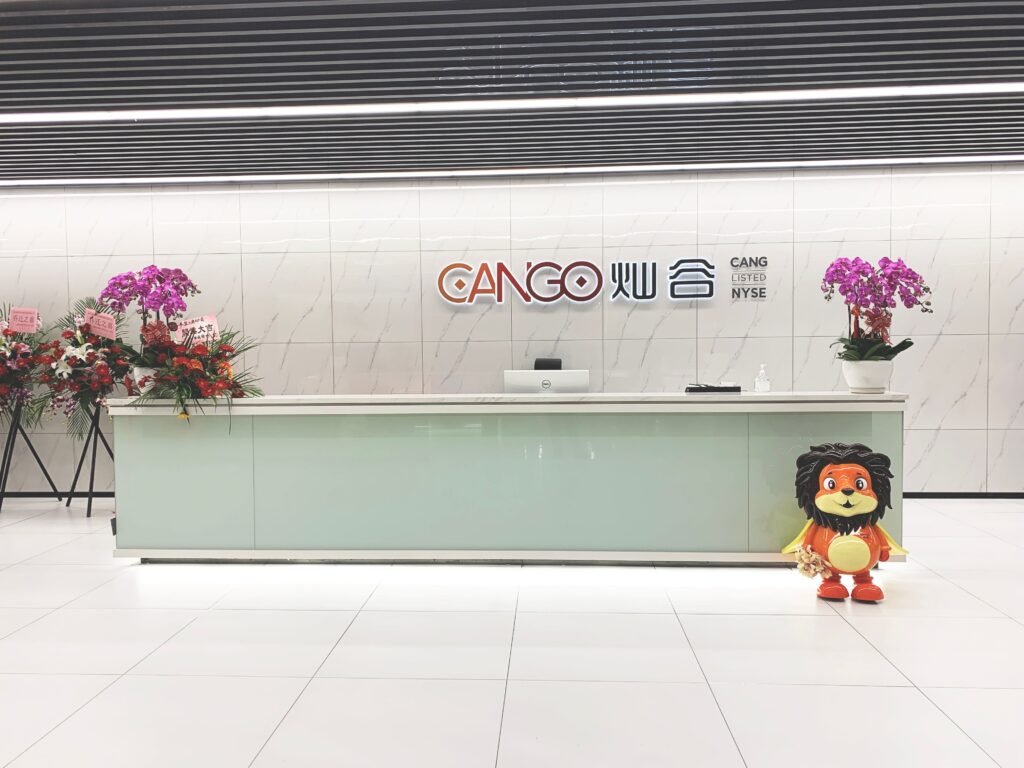
Cango reception (Credit: Cango)

Cango reception (Credit: Cango)

What to know:

  • Cango, a Chinese automotive transaction service platform, forayed into bitcoin mining in November.
  • The company spent $400 million to acquire 50 EH/s of mining power, immediately becoming one of the largest miners in the world.
  • The firm is heavily relying on Bitmain for operational services.

The bitcoin (BTC) mining industry was shaken up in the last months of 2024 by the sudden entrance of a new player: Cango (CANG), a Chinese firm that specializes in providing loans to automobile buyers.

Based in Shanghai and valued at $363 million on the stock market, Cango is in the process of acquiring 50 exahashes per second (EH/s) worth of mining power, meaning that the auto lending platform will become one of the largest bitcoin miners in the world once its entire fleet goes online.

STORY CONTINUES BELOW
Don’t miss another story.Subscribe to the Crypto Long & Short Newsletter today. See all newsletters

By signing up, you will receive emails about CoinDesk products and you agree to our terms of use and privacy policy.

“I guess it’s surprising for people in the [bitcoin mining] industry because nobody has ever heard of Cango before,” Juliet Ye, the company’s senior director of communications, told CoinDesk in an interview. “But the history of Cango is a history of adaptation. We’ve diversified into different areas at least two or three times [since the firm was established in 2010].”

Getting such a large bitcoin mining fleet isn’t cheap. Cango paid $256 million in cash for the first 32 EH/s worth of computing power, which it purchased from bitcoin mining machine manufacturer Bitmain. It will be issuing $144 million worth of shares for the remaining 18 EH/s, which it is acquiring from Golden TechGen — a firm owned by former Bitmain Chief Financial Officer Max Hua — as well as other undisclosed mining machine sellers. Once the transaction is settled, Golden TechGen and these other sellers will end up owning approximately 37.8% of Cango.

The diversification into bitcoin mining is already bearing fruit. Cango’s stock finished 2024 at $4.56, up more than 362% from the start of that year. Even better, Ye said, this new bitcoin mining strategy has catapulted Cango into the spotlight.

“It’s been really hard for us to gain traction around the company, as a small- to mid-cap listed Chinese firm in the U.S.,” Ye said. “All of a sudden, a lot of people are very much interested in Cango. The buzz around the company — we’ve never seen this before in the past.”

50 EH/s

Cango is more used to helping Chinese banks issue loans for people looking to buy cars. But the firm, which went public in 2018, was already diversifying its operations years before acquiring its bitcoin fleet.

Cango started facilitating car exports from China to other parts of the world and has invested in Li Auto, a Chinese electric vehicle manufacturer. Following that investment, Cango explored business opportunities in the renewable energy sector, including high-compute power projects related to AI, before venturing into on bitcoin mining.

“Bitcoin mining is a very good way to rebalance energy grids,” Ye said, referring to the fact that bitcoin miners can easily switch their rigs off and on again. Some jurisdictions, like Texas, take advantage of that ability by encouraging miners to operate in periods of low energy consumption, and paying them to shut down their machines when local demand surges, like during heatwaves or blizzards.

With Bitcoin’s hashrate now hovering at 823 EH/s, Cango will be providing roughly 6% of the total computing power behind Bitcoin once the firm’s 50 EH/s fully come online. For reference, MARA Holdings (MARA), the largest publicly traded miner in the world, owned a little over 47 EH/s worth of computing power as of November, per TheMinerMag data. CleanSpark (CLSK) and Riot Platforms (RIOT), the two next largest, stood at 32 EH/s and 26 EH/s respectively.

“The Bitcoin mining sector’s imperative for scaled operations was a pivotal consideration in our decision to enter this domain,” Cango’s management team told CoinDesk in an email.

“The current landscape is marked by industry consolidation, with larger-scale operations becoming increasingly dominant due to escalating mining difficulty and the necessity for state-of-the-art hardware.”

One major difference between Cango and other mining heavyweights is that Cango isn’t operating its own mining fleet right now. With machines spread out around the world — including in the U.S., Canada, Paraguay and Ethiopia — Cango is still relying heavily on Bitmain for facilities and infrastructure, and to make sure the sites run smoothly.

“Even though we enter the industry with a significant amount of computing power, we are still new here, and we need time to adapt to the norms, and get a better understanding of the tax situation and the rest of the market,” Ye said. “So at the beginning, we chose to work together with Bitmain and to use its operations teams.”

That situation is likely to change over time, Ye said, as Cango gains experience in the sector and seeks to make its bitcoin mining operations more economically efficient. Nurturing an in-house mining team would likely be cheaper than relying on Bitmain’s expertise in the long run.

As for what Cango plans to do with its growing bitcoin stash, that will depend on how the year unfolds, Ye said. “We don’t rule out the possibility of making some tactical reductions [to the bitcoin holdings] based on market conditions,” she said. Cango mined 363.9 BTC in November alone, a sum worth roughly $35 million at the time of writing.

CangoBitcoin MiningChina
Tom Carreras

Tom writes about markets, bitcoin mining and crypto adoption in Latin America. He has a bachelor’s degree in English literature from McGill University, and can usually be found in Costa Rica. He holds BTC above CoinDesk’s disclosure threshold of $1,000.

X icon

Tom Carreras

!–>!–>!–>
Read More

Be the first to write a comment.
Leave a Reply

Your email address will not be published. Required fields are marked *

Crypto Currency

Bitcoin climbs as Trump grants five days for Iran negotiations

The original cryptocurrency advanced more than 5% to trade as high as $71,794 in New York before paring some of the gain…

The original cryptocurrency advanced more than 5% to trade as high as $71,794 in New York before paring some of the gain…
Read More

Continue Reading
Crypto Currency

Bitcoin price analysis sees new short squeeze as open interest nears $25B

Bitcoin open interest hit five-week highs while funding rates mimicked the BTC price collapse below $60,000, leading analysis to predict a new short squeeze…

Bitcoin open interest hit five-week highs while funding rates mimicked the BTC price collapse below $60,000, leading analysis to predict a new short squeeze…
Read More

Continue Reading
Crypto Currency

Bitcoin signals potential seller exhaustion as realized losses decline

Markets Share Share this article Copy link X icon X (Twitter) LinkedIn Facebook Email Bitcoin signals potential seller exhaustion as realized losses decline On-chain data points to easing selling pressure, with realized losses falling and spot markets shifting toward net buying. By James Van Straten| Edited by Stephen Alpher Apr 11, 2026, 6:00 p.m. 1

Share this article
X iconX (Twitter)LinkedInFacebookEmail

Bitcoin signals potential seller exhaustion as realized losses decline

On-chain data points to easing selling pressure, with realized losses falling and spot markets shifting toward net buying.

By James Van Straten|Edited by Stephen Alpher
Apr 11, 2026, 6:00 p.m. 1 min read
Make preferred on
Profit/Loss Ratio (Glassnode)

What to know:

  • Realized losses on bitcoin have dropped to around $400 million per day from peaks of $2 billion, suggesting diminishing forced selling.
  • The profit-to-loss ratio has risen to 1.4, indicating that realized profits now outweigh losses as market conditions improve

Bitcoin may be entering a phase of seller exhaustion. After bottoming near $60,000 on Feb. 5, the asset has spent more than two months consolidating, gradually grinding higher toward the $70,000 level. This came alongside macro uncertainty with the Middle East conflict pushing oil prices well above $100 a barrel.

Data from CheckonChain suggests that selling pressure is beginning to ease. Realized losses are currently around $400 million per day, still elevated compared to previous years, but trending lower in recent weeks.
Realized losses had spiked to as much as $2 billion on Nov. 21 and Feb. 5, reaching levels not seen in several years and surpassing those seen during the 2022 bear market, according to the data.

“Spot markets are shifting from aggressive selling to net buy side pressure, realized profits and losses are both declining,” said CheckonChain.

Realized Loss (CheckonChain)

Glassnode data reinforces this trend. On a seven-day moving average, realized profits are around $300 million per day, near twelve-month lows. This suggests that investors who accumulated bitcoin at $60,000 are now marginally in profit and beginning to take some gains.

Meanwhile, the realized profit-to-loss ratio has risen to 1.4, its highest level since January, according to Glassnode data. This metric, which compares the value of coins moved at a profit to those moved at a loss, shows that realized profits now outweigh losses.

These indicators point toward a market where selling pressure is fading, raising the likelihood that bitcoin is approaching a phase of seller exhaustion.

Bitcoin News

Mais para você

Kevin O’Leary says Wall Street’s tokenization boom is all talk without crypto rules

Kevin O'Leary speaking at Consensus in Miami (CoinDesk)

O’Leary says institutional investors still see tokenization as too risky without clear U.S. crypto regulation and compliance standards.

O que saber:

  • Kevin O’Leary told the Consensus conference in Miami that tokenization and bitcoin will remain largely off-limits to major institutional investors until Congress passes clear, comprehensive digital-asset regulation.
  • He argued that Wall Street’s experiments with tokenization are mostly hype without legal certainty, pointing to the rapid uptake of stablecoins after the…
Leia a história completa
Latest Crypto News
charles hoskinson (CoinDesk)

AI agents becoming more relevant than humans by 2035 has Big Tech ‘terrified’, says Hoskinson

Grant Cardone. (CoinDesk)

Grant Cardone says bitcoin-real estate strategy could outperform REITs, adds more BTC to treasury

CoinDesk

Nasdaq’s president says the SEC’s new crypto stance is letting markets ‘build’ again

Frank La Salla, President and CEO of the Depository Trust & Clearing Corporation (DTCC) speaking at Consensus 2src26 in Miami (CoinDesk)

Wall Street’s clearinghouse seeks ‘high-performance’ blockchains to tokenize corporate actions

From niche to normal panel at Consensus Miami

Crypto’s mainstream moment has arrived, say industry leaders speaking at Consensus Miami

CoinDesk

Bitcoin’s post-quantum migration will be harder than Taproot and needs to start now, Project Eleven CEO says

Top Stories
Patrick Witt, executive director of the President's Council of Advisors for Digital Assets (Consensus Miami 2src26)

White House targets July 4 for Clarity Act passage, says crypto adviser Patrick Witt

Eric Trump, co-founder of American Bitcoin, at Consensus Miami 2src26

Eric Trump takes shot at JPMorgan rethinking bitcoin after ‘crapping’ on asset

CoinDesk

Bullish’s Equiniti deal could remake it into a tokenization powerhouse, Clear Street says

White House (Jesse Hamilton/CoinDesk)

U.S. Bitcoin Reserve update coming in ‘next few weeks,” White House adviser says

BTC/USD (CoinDesk Data)

Bitcoin moves above $82,000 while ZEC and DASH post double-digit rallies

Morgan Stanley offices (Sven Piper/Unsplash)

Morgan Stanley brings crypto trading with lower fees than rivals

!–>!–>!–>
Read More

Continue Reading
Crypto Currency

Bitcoin Flashes ‘Dangerous’ Macro Fractal – What To Expect For Price

Bitcoin’s weekly chart is showing an uncomfortable comparison to one of the most brutal sell-offs in its history, and at least one analyst believes the worst may still be ahead.  This technical outlook is looking at the current price action as a mirror of the 2022 macro fractal sequence that sent Bitcoin from $69,000 to

Bitcoin’s weekly chart is showing an uncomfortable comparison to one of the most brutal sell-offs in its history, and at least one analyst believes the worst may still be ahead.  This technical outlook is looking at the current price action as a mirror of the 2022 macro fractal sequence that sent Bitcoin from $69,000 to a cycle low near $15,500…
Read More

Continue Reading