Android

Is Big Tech Merging With Big Brother? Kinda Looks Like It


social rating, which is monitored by the government. A low social rating could prevent her from working or traveling abroad.China’s social rating system, which was announced by the ruling Communist Party in 2014, will soon be a fact of life for many more Chinese.By 2020, if the Party’s plan holds, every footstep, keystroke, like, dislike,…


social rating, which is monitored by the government. A low social rating could prevent her from working or traveling abroad.

China’s social rating system, which was announced by the ruling Communist Party in 2014, will soon be a fact of life for many more Chinese.

By 2020, if the Party’s plan holds, every footstep, keystroke, like, dislike, social media contact, and posting tracked by the state will affect one’s social rating.

Personal “creditworthiness” or “trustworthiness” points will be used to reward and punish individuals and companies by granting or denying them access to public services like health care, travel, and employment, according to a plan released last year by the municipal government of Beijing. High-scoring individuals will find themselves in a “green channel,” where they can more easily access social opportunities, while those who take actions that are disapproved of by the state will be “unable to move a step.”

Big Brother is an emerging reality in China. Yet in the West, at least, the threat of government surveillance systems being integrated with the existing corporate surveillance capacities of big-data companies like Facebook, Google, Microsoft, and Amazon into one gigantic all-seeing eye appears to trouble very few people—even as countries like Venezuela have been quick to copy the Chinese model.

Still, it can’t happen here, right? We are iPhone owners and Amazon Prime members, not vassals of a one-party state. We are canny consumers who know that Facebook is tracking our interactions and Google is selling us stuff.

Yet it seems to me there is little reason to imagine that the people who run large technology companies have any vested interest in allowing pre-digital folkways to interfere with their 21st-century engineering and business models, any more than 19th-century robber barons showed any particular regard for laws or people that got in the way of their railroads and steel trusts.

Nor is there much reason to imagine that the technologists who run our giant consumer-data monopolies have any better idea of the future they’re building than the rest of us do.

Facebook, Google, and other big-data monopolists already hoover up behavioral markers and cues on a scale and with a frequency that few of us understand. They then analyze, package, and sell that data to their partners.

A glimpse into the inner workings of the global trade in personal data was provided in early December in a 250-page report released by a British parliamentary committee that included hundreds of emails between high-level Facebook executives. Among other things, it showed how the company engineered sneaky ways to obtain continually updated SMS and call data from Android phones. In response, Facebook claimed that users must “opt-in” for the company to gain access to their texts and calls.

The machines and systems that the techno-monopolists have built are changing us faster than they or we understand. The scale of this change is so vast and systemic that we simple humans can’t do the math—perhaps in part because of the way that incessant smartphone use has affected our ability to pay attention to anything longer than 140 or 280 characters.

As the idea of a “right to privacy,” for example, starts to seem hopelessly old-fashioned and impractical in the face of ever-more-invasive data systems—whose eyes and ears, i.e., our smartphones, follow us everywhere—so has our belief that other individual rights, like freedom of speech, are somehow sacred.

Being wired together with billions of other humans in vast networks mediated by thinking machines is not an experience that humans have enjoyed before. The best guides we have to this emerging reality may be failed 20th-century totalitarian experiments and science fiction. More on that a little later.

The speed at which individual-rights-and-privacy-based social arrangements collapse is likely to depend on how fast Big Tech and the American national security apparatus consummate a relationship that has been growing ever closer for the past decade. While US surveillance agencies do not have regular real-time access to the gigantic amounts of data collected by the likes of Google, Facebook, and Amazon—as far as we know, anyway—there is both anecdotal and hard evidence to suggest that the once-distant planets of consumer Big Tech and American surveillance agencies are fast merging into a single corporate-bureaucratic life-world, whose potential for tracking, sorting, gas-lighting, manipulating, and censoring citizens may result in a softer version of China’s Big Brother.

These troubling trends are accelerating in part because Big Tech is increasingly beholden to Washington, which has little incentive to kill the golden goose that is filling its tax and political coffers. One of the leading corporate spenders on lobbying services in Washington, DC, in 2017 was Google’s parent company, Alphabet, which, according to the Center for Responsive Politics, spent more than $18 million. Lobbying Congress and government helps tech companies like Google win large government contracts. Perhaps more importantly, it serves as a shield against attempts to regulate their wildly lucrative businesses.

If anything, measuring the flood of tech dollars pouring into Washington, DC, law firms, lobbying outfits, and think tanks radically understates Big Tech’s influence inside the Beltway. By buyingThe Washington Post, Amazon’s Jeff Bezos took direct control of Washington’s hometown newspaper. In locating one of Amazon’s two new headquarters in nearby Northern Virginia, Bezos made the company a major employer in the area—with 25,000 jobs to offer.

Who will get those jobs? Last year, Amazon Web Services announced the opening of the new AWS Secret Region, the result of a 10-year, $600 million contract the company won from the CIA in 2014. This made Amazon the sole provider of cloud services across “the full range of data classifications, including Unclassified, Sensitive, Secret, and Top Secret,” according to an Amazon corporate press release.

Once the CIA’s Amazon-administered self-contained servers were up and running, the NSA was quick to follow suit, announcing its own integrated big-data project. Last year the agency moved most of its data into a new classified computing environment known as the Intelligence Community GovCloud, an integrated “big data fusion environment,” as the news site NextGov described it, that allows government analysts to “connect the dots” across all available data sources, whether classified or not.

The creation of IC GovCloud should send a chill up the spine of anyone who understands how powerful these systems can be and how inherently resistant they are to traditional forms of oversight, whose own track record can be charitably described as poor.

Amazon’s IC GovCloud was quickly countered by Microsoft’s secure version of its Azure Government cloud service, tailored for the use of 17 US intelligence agencies. Amazon and Microsoft are both expected to be major bidders for the Pentagon’s secure cloud system, the Joint Enterprise Defense Initiative—JEDI—a winner-take-all contract that will likely be worth at least $10 billion.

With so many pots of gold waiting at the end of the Washington, DC, rainbow, it seems like a small matter for tech companies to turn over our personal data—which legally speaking, is actually their data—to the spy agencies that guarantee their profits. This is the threat that is now emerging in plain sight. It is something we should reckon with now, before it’s too late.

In fact, bigtech and the surveillance agencies are already partners. According to a 2016 report by Reuters, Yahoo designed custom software to filter its users’ emails and deliver messages that triggered a set of search terms to the NSA.

The company’s security chief quit in protest when he learned of the program. “Yahoo is a law-abiding company, and complies with the laws of the United States,” the company said in a statement, which notably did not deny the activity, while perhaps implying that turning over user data to government spy agencies is legal.

While Google has stated that it will not provide private data to government agencies, that policy does not extend beyond America’s borders. At the same time as Yahoo was feeding user data to the NSA, Google was developing a search engine called Dragonfly in collaboration with the Communist Party of China. In a letter obtained byThe Intercept, Google CEO Sundar Pichai told a group of six US senators that Dragonfly could have “broad benefits inside and outside of China” but refused to release other details of the program, which the company’s search engine chief, Ben Gomes, informed Google staff would be released in early 2019.

According to the documents obtained byThe Intercept, Dragonfly would restrict access to broad categories of information, banning phrases like “human rights,” “student protest,” and “Nobel Prize” while linking online searches to a user’s phone number and tracking their physical location and movements, all of which will presumably impact social ratings or worse—much worse, if you happen to be a Uighur or a member of another Muslim minority group inside China, more than 1 million of whom are now confined in re-education camps. China’s digital surveillance net is a key tool by which Chinese authorities identify and track Muslims and others in need of re-educatio

Read More

Be the first to write a comment.

Leave a Reply

Your email address will not be published. Required fields are marked *

Android

Get the best of Bleeding Green Nation on the new SB Nation app

It’s a big day for Bleeding Green Nation. Today, the SB Nation app is live, and it’s the best way to follow the Eagles. You can download it by searching SB Nation for iOS or Android. A year ago we made some big changes to our community, including offering fewer ads and the addition of

It’s a big day for Bleeding Green Nation. Today, the SB Nation app is live, and it’s the best way to follow the Eagles.

You can download it by searching SB Nation for iOS or Android.

A year ago we made some big changes to our community, including offering fewer ads and the addition of the Feed. Today, we want to give you even more community tools and fewer ads with this app. It will make starting and joining conversations here as simple as posting to your favorite social media platform.

You can check out the video below showing off some of the useful features of the app, and we’ll dig into them below.

Why should I download the app?

The app will be the easiest way to interact with everybody else in the community:

  • All your favorite teams’ posts in one dedicated feed
  • Notifications when someone replies or recs your post
  • New game thread section, with an experience that’s smoother and faster
  • Fe

Read More

Continue Reading
Android

Get the best of Canal Street Chronicles on the new SB Nation app

It’s a really exciting day for Canal Street Chronicles. Today, the SB Nation app is live, and it’s the best way to follow all the latest Saints news. You can download it by searching SB Nation for iOS or Android. A year ago we made some big changes to our community, including offering fewer ads

It’s a really exciting day for Canal Street Chronicles. Today, the SB Nation app is live, and it’s the best way to follow all the latest Saints news.

You can download it by searching SB Nation for iOS or Android.

A year ago we made some big changes to our community, including offering fewer ads and the addition of the Feed. Today, we want to give you even more community tools and fewer ads with this app. It will make starting and joining conversations here as simple as posting to your favorite social media platform.

You can check out the video below showing off some of the useful features of the app, and we’ll dig into them below.

Why should I download the app?

The app will be the easiest way to interact with everybody else in the community:

  • All your favorite teams’ posts in one dedicated feed
  • Notifications when someone replies or recs your post
  • New game thread section, with an experience that’

Read More

Continue Reading
Android

The Galaxy Z Flip 8 is at its best when there’s friction

What do you want from a flip phone when it’s closed? A simple interface, perhaps notifications and a widget or two, for handling the basics? Or a fully fledged Android experience shrunk down for the Flip form factor? For years, Samsung has insisted on the former, even as some fans — and Razr rival Motorola

What do you want from a flip phone when it’s closed? A simple interface, perhaps notifications and a widget or two, for handling the basics? Or a fully fledged Android experience shrunk down for the Flip form factor? For years, Samsung has insisted on the former, even as some fans — and Razr rival Motorola — have pushed for the latter. With the Galaxy Z Flip 8, Samsung has given in.

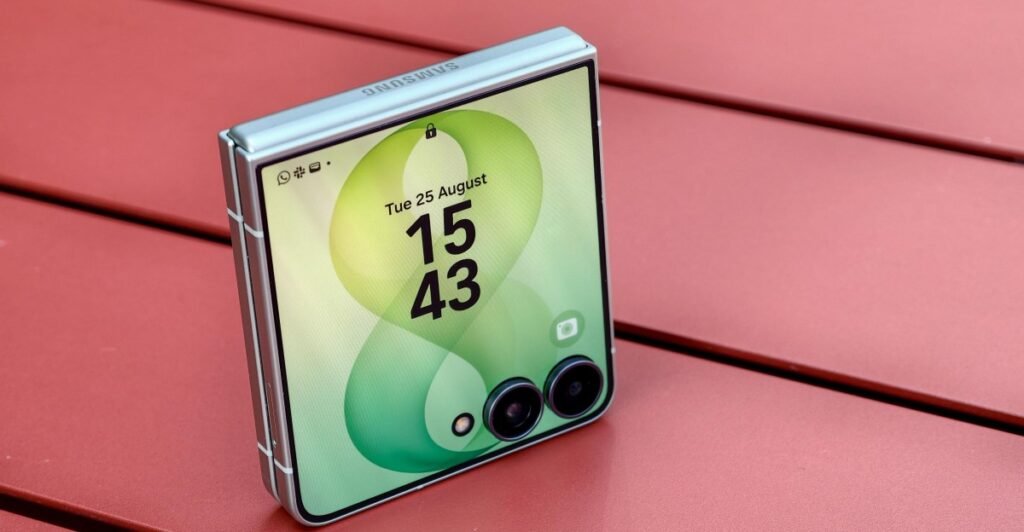
Although the Z Flip 8’s hardware is almost unchanged year-on-year, Samsung has fundamentally rethought how this phone is meant to be used when shut. The cover screen feels more like a regular Android phone, with easier access to the full versions of every single app, letting you browse social media, watch movies, and play games without ever opening the phone. Not every app works well on a tiny square screen with two cameras in the middle of it, but even when they don’t, that friction between me and the distractions of my phone still feels as much a feature as a bug.

8

Verge Score

Samsung Galaxy Z Flip 8

$1200
$1200

The Good

  • Runs any app on the cover screen
  • Thinner and lighter
  • Reliable battery

The Bad

  • Mostly a rehash of last year’s phone
  • Still vulnerable to dust
  • $100 more expensive than the Z Flip 7
$1200 at Amazon$1200 at Samsung$1200 at Best Buy
How we rate and review products

Everything exciting about the Z Flip 8 lies in its 4-inch cover screen, which is now more versatile than ever thanks to a homescreen redesign. Swiping down from the top left now brings up your notifications, while swiping from the top right instead shows a cover-screen-optimized version of the Quick Settings panel. Immediately, this feels more like a phone.

More exciting is what happens when you swipe up from the bottom: you get an app drawer. By default, this is populated with a selection of Samsung’s own apps that are optimized for the square screen, plus a “Labs” section with third-party options including Netflix and WhatsApp. But right below that, Samsung has included an easy prompt to install MultiStar, the Good Lock module that lets you run any app you’d like on the outer screen.

Samsung used to bury the option deep in the phone’s settings, only to be found by those who knew to look for it. The bottom of the app drawer isn’t quite front and center, but it’s much more prominent than it used to be.

You can run any app you’d like on the cover screen.
The Withings app scales badly: The graph takes up too much space to even show both axes, and it becomes impossible to scroll past it.
Google Maps works, but it’s busy and awkward, especially when you try to zoom in.
HBO Max works flawlessly, but it wouldn’t be my first choice to watch Lanterns.

You can still run apps in three forms: full-screen, with the cameras blocking part of the software; a square display that stops just above the level of the cameras; or a thin portrait-aspect ratio that letterboxes the sides. A small virtual button at the bottom of the screen lets you cycle through them.

Good performance isn’t guaranteed. Some apps, like Withings’ health tracker companion app, are almost impossible to use on the cover screen, with no configuration that leaves enough space for its graphs to fit. Google Maps is only a bit better — I love the idea of quickly checking my walking route without opening the phone, but there are so many floating interface elements that it’s unwieldy at best. Others work smoothly, but feel pointless: I can stream HBO Max on the tiny outer display, but I’d never want to.

But for other apps, the new cover screen options feel genuinely freeing. I can open Todoist and tick off a task, dip into WhatsApp to send a message, or open MyFitnessPal to log the snack I just ate. They’re quick actions that work well enough on the small screen, and because other apps — *cough* Instagram *cough* — don’t, I can dive into them without the risk of getting dragged into doomscrolling. That little bit of friction is just enough to save me from wasting 20 minutes I’ll never get back.

Like last year’s phone, the cover screen wraps around the cameras.

As for the hardware, little has changed. The Z Flip 8 is 0.6mm thinner and 8g lighter than its predecessor. This is the thickest of Samsung’s three current foldables, but it’s more compact than Motorola’s Razrs, its only real rivals.

Samsung didn’t upgrade the Z Flip 8 with the thinner, tougher titanium display stack found in the two new Z Fold 8 phones, which also means this has just as visible a crease as ever. It rarely bothers me, and is hard to see head-on, but you may feel differently. The IP48 rating is a more objective issue, and means that while this phone is mostly safe from water, it’s still vulnerable to dust.

Related

  • Samsung’s Galaxy Z Fold 8 feels like the future
  • Samsung’s Z Fold 8 Ultra is more of the same, but better than ever
  • Samsung Galaxy Z Flip 7 review: more of a good thing

On the inside, you’ll find the Qualcomm Snapdragon 8 Elite Gen 5 if you’re in the US, though my UK model runs Samsung’s Exynos 2600. Exynos chips get a bad rep, but performance has been smooth so far, and I have no real complaints.

This is the online-exclusive mint, but the phone’s also available in pink, cream, and gray.
It’s a little thinner and lighter than before, but not by much.
And the crease is still pretty noticeable compared to the two new Fold 8 phones.

As with the Z Fold 8 phones, Samsung switched to more energy-dense silicon-carbon batteries for the Z Flip 8. Unlike those phones, it didn’t actually increase the battery capacity, but instead used smaller cells with the same 4,300mAh capacity — the key to shrinking the phone itself. Still, battery life is solid, reliably lasting the full day with battery to spare. The charging — 25W wired, 15W wireless — is relatively unimpressive, and the only way to get Qi2 charging is still by using a compatible magnetic case.

Storage and RAM remain the same as on the Z Flip 7; the screens do too apart from small bumps to peak brightness, and the cameras are also identical to last year’s. The 50-megapixel main camera is impressive, and especially helpful since the form factor means you can use it for selfies too. The 12-megapixel ultrawide and 10-megapixel inner camera aren’t remarkable, but they get the job done. A slab phone at this price would have better cameras, and most likely a telephoto lens, but the lenses here are good enough.

<em>The main camera mostly gets good results.</em>
<em>It even handles moving targets like pets (and string) pretty well, though it did split the thread a little at the top.</em>
<em>Details and color still look solid in dark basement lighting like this.</em>
<em>The ultrawide is a little more basic.</em>
<em>Pushing up to the maximum 1srcx zoom shows the camera’s limitations.</em>

1/13
The main camera mostly gets good results.

The question is whether it’s all good enough for the price, given Samsung has bumped the Z Flip 8 up to $1,199.99, a $100 increase. Z Flip 7 owners certainly shouldn’t upgrade, and anyone else should consider buying that phone instead, since the difference between the two is slight.

After all, the big upgrades are software, and unlikely to remain exclusive. Last year’s Z Flip 7 hasn’t yet been updated to One UI 9, but since its outer screen is almost identical, it seems likely to get the upgraded software, giving one less reason to opt for the new model. The Z Flip 6 and earlier, with their smaller cover screens, seem more likely to miss out. I’ve asked Samsung about its upgrade plans, but haven’t yet heard back.

Customizable Now Brief cards were added in One UI 9.
The camcorder-inspired video recording is still one of the phone’s best features.
If you find the full apps frustrating, various cover screen widgets are still available.

Most of the other software upgrades aren’t even Flip-specific. Customizable, AI-powered cards have been added to the daily Now Brief; My FanCam lets you crop video to focus on a specific subject; and Audio Eraser can now dim background noise and highlight dialogue in apps like YouTube and Netflix. You’ll find those features across all of Samsung’s new foldables, plus the new Galaxy S26 FE.

Modest as the Z Flip 8’s hardware upgrades are, it feels like a turning point for Samsung, which is mostly done trying to limit the ways people use the cover screen. Given the speculation that the short, wide Z Fold 8 could replace the Flip form factor as Samsung’s “small phone that unfolds to a big phone,” it makes sense to close the gap between them.

The Z Fold 8 is definitely bigger than the Z Flip 8.
But the Flip’s small, obstructed screen is less functional — for better or worse.
Open, the Z Fold 8 feels like a compact tablet.
While the Flip opens up to a pretty regular phone.

The Z Fold 8 is a more capable phone than the Z Flip 8 when closed, its squat screen more usable than the Flip’s tiny one, despite Samsung’s software upgrades. But I have a real soft spot for the Flip form factor, which is tiny and pocketable when closed and a normal, almost compromise-free flagship phone when open — and endlessly satisfying to flip shut.

More than that, I enjoy its frictions. I welcome Samsung’s move to make it easier to use full apps on the cover screen, but I also welcome that it will never be entirely successful. Some apps simply don’t work on a screen this size, and the Z Flip 8 is all the better for it.

Photography by Dominic Preston / The Verge

Agree to Continue: Samsung Galaxy Z Flip 8

Every smart device now requires you to agree to a series of terms and conditions before you can use it — contracts that no one actually reads. It’s impossible for us to read and analyze every single one of these agreements. But we started counting exactly how many times you have to hit “agree” to use devices when we review them since these are agreements most people don’t read and definitely can’t negotiate.

To use the Galaxy Z Flip 8, you must agree to:

  • Google Terms of Service
  • Google Play Terms of Service
  • Google Privacy Policy (included in ToS)
  • Install apps and updates: “You agree this device may also automatically download and install updates and apps from Google, your carrier, and your device’s manufacturer, possibly using cellular data.”
  • Samsung End User Licence Agreement
  • Samsung Privacy Notice
  • Samsung Terms and Conditions

There’s also a variety of optional agreements, including:

  • Provide anonymous location data for Google’s services
  • “Allow apps and services to scan for Wi-Fi networks and nearby devices at any time, even when Wi-Fi or Bluetooth is off.”
  • Send usage and diagnostic data to Google
  • Google Gemini Apps Privacy Notice if you opt in to using Gemini Assistant
  • Turn on Samsung offline finding
  • Samsung news and special offers
  • Samsung personalized advertising
  • Bixby personal data intelligence
  • Samsung customization service

Other features, like Google Wallet, may require additional ag

Read More

Continue Reading
Android

Elon Musk to launch XChat as part of push to build WeChat-like super app

Elon Musk’s social media platform X (formerly Twitter) said its instant messaging app XChat will launch on Apple App Store on April 17, as Musk pushes ahead with plans to build a super app similar to China’s WeChat. An Android release date has yet to be announced…

Elon Musk’s social media platform X (formerly Twitter) said its instant messaging app XChat will launch on Apple App Store on April 17, as Musk pushes ahead with plans to build a super app similar to China’s WeChat. An Android release date has yet to be announced…
Read More

Continue Reading