Internet Security

Ranking Virginia’s 7 GOP gubernatorial hopefuls from most to least Trumpy as they battle to replace term-limited Democrat Ralph Northam

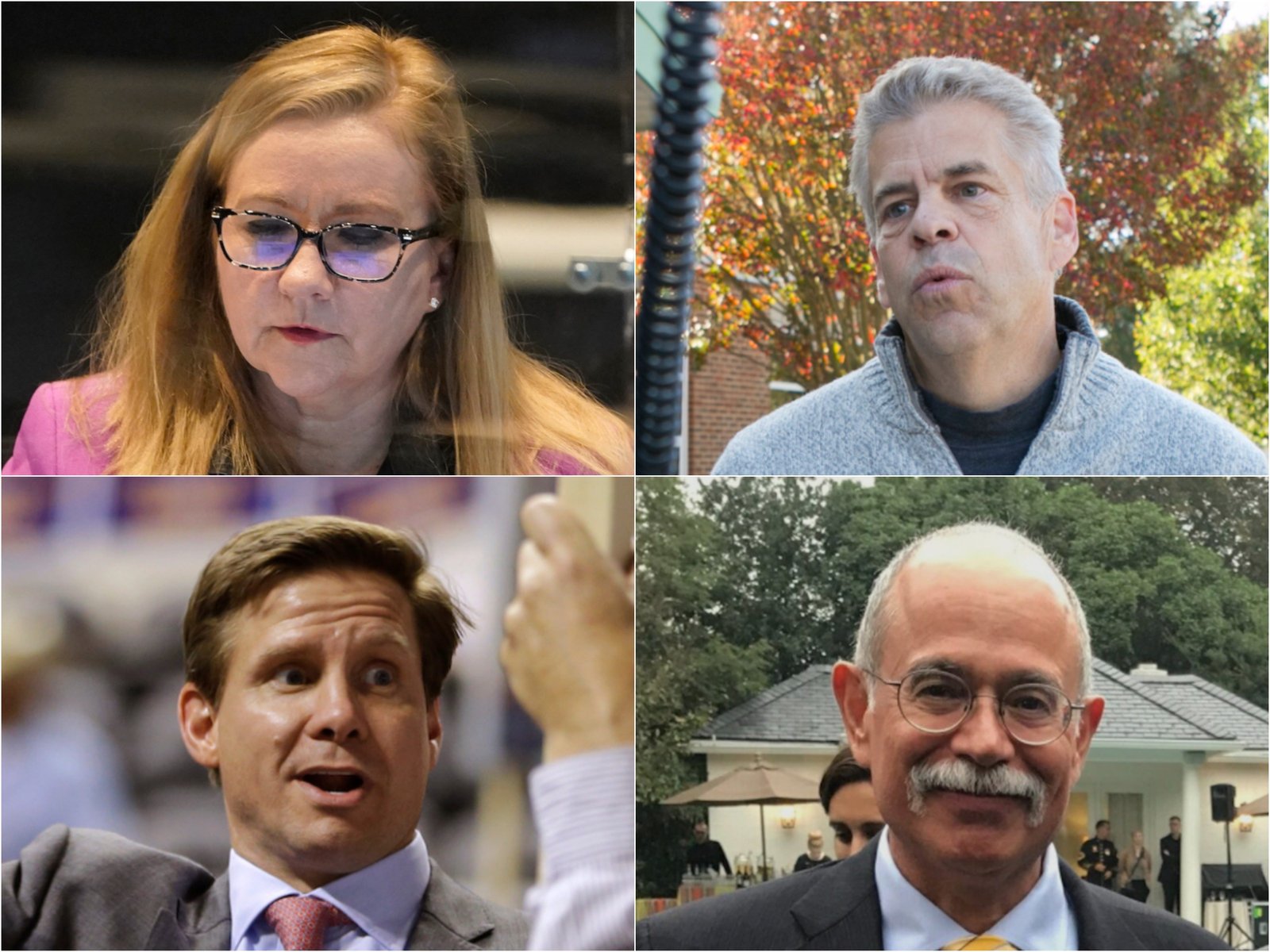
Summary List PlacementThe Virginia governor’s race boasts a dozen challengers vying to replace term-limited Democrat Ralph Northam. Five Democrats, including former Gov. Terry McAuliffe and current Lt. Gov. Justin Fairfax, will seek to top the field in a statewide primary on June 8.  Republicans must first do some paring down of their own, choosing delegates…

Summary List PlacementThe Virginia governor’s race boasts a dozen challengers vying to replace term-limited Democrat Ralph Northam.

Five Democrats, including former Gov. Terry McAuliffe and current Lt. Gov. Justin Fairfax, will seek to top the field in a statewide primary on June 8. 
Republicans must first do some paring down of their own, choosing delegates who will slot their preferred candidates for governor, lieutenant governor, and attorney general via ranked-choice voting. This remote convention, which one Trump admirer insists is designed to shut her out, is scheduled for May 8.   
Republicans haven’t occupied the governor’s mansion in more than a decade. Former President Donald Trump lost the Old Dominion by five points in the 2016 election. That gap doubled in his 2020 loss to President Joe Biden.
State Sen. Amanda Chase

Background: This two-term Virginia senator, who’s been dubbed “Trump in heels,” is the current front-runner on the GOP side. The conservative lawmaker is currently at war with colleagues who censured her for participating in the Trump-led, election results-denying rally on January 6 in Washington, DC that preceded the deadly attack on the Capitol. 
She’s also accused GOP leaders of undercutting her campaign via a “rigged” convention process. Chase maintains that detractors “terrified of the amount of support that I have across the state” are trying to dilute her chances of winning by adopting the confusing, labor-intensive delegate-based effort rather than allowing a traditional primary.  
“The establishment Republican elite … wants a lukewarm candidate that’s sold out to Richmond. And I’m not that person. I’m like Trump,” Chase told Insider in an interview, billing herself as an outsider determined to “hold the pay-to-play system accountable.”
Agenda: Her top three priorities include rescinding all the COVID-19 restrictions in the state — “Just like Florida. We’re gonna completely reopen Virginia,” she said — undoing, via executive order, the gun-related universal background checks and red flag law that took effect in 2020, and barring social media companies from “restricting people’s First Amendment rights and cancelling them if it doesn’t meet their agenda.” 
A companion piece to the tech fight will be boosting internet upload and download speeds to underserved communities via “safe technology” like broadband. “I’m not for 5G,” she stressed. 
Pocketbook: FEC records show Chase contributed approximately $2,400 to Dave Brat, the two-term Tea Party favorite who knocked off then-House Majority Leader Eric Cantor in the 2014 GOP primary, and the Republican Party of Virginia since 2016.
Fans: Former Trump national security advisor Michael Flynn has endorsed Chase — which could prove useful down the road.  
“I think having this endorsement from Gen. Michael Flynn is a good first step,” she said of possibly getting the nod from Mar-a-Lago. Trump pardoned Flynn, who pleaded guilty to lying to investigators about Russian interference in the 2016 presidential election, after losing the 2020 election. 
Chase said she hasn’t asked Trump, or any politicos, to rally to her side.  
“If people want to endorse me, that’s great,” she said. “Right now my focus is getting delegates to this convention.”
Col. Sergio de la Peña

Background: This Mexican native and Army veteran campaigned for Trump in 2016. In May 2017, then-Defense Secretary James Mattis announced there’d be changes at the Pentagon — appointments that included newly minted Deputy Assistant Secretary of Defense for Western Hemisphere Affairs de la Peña, The Hill reported. 
Agenda: His top three priorities, according to campaign staff, include restoring election integrity, repealing Northam’s quarantine-related restrictions on Virginia schools and business, and restoring Second Amendment rights in the Commonwealth.
Pocketbook: FEC records show de la Peña contributed approximately $270 to Rep. Bob Good of Virginia in 2020. 
Fans: Campaign staff confirmed that de la Peña is seeking Trump’s blessing. “He’s been working through channels to get it,” a campaign aide told Insider of the endorsement hunt.
Glenn Youngkin

Background: A Virginia native who spent 30 years in the private sector, Youngking told the hosts of the right-leaning “Ruthless” podcast he got into the governor’s race to bring a “common sense perspective” to the field.
“You cannot be a business person and actually believe that government-run anything is a good idea,” he said on the show. 
Agenda: Youngkin’s top three priorities, according to campaign staff, include reopening and rebuilding a “rip-roaring” local economy (think: lower taxes, deregulation), protecting Second Amendment rights, and instituting a five-point plan to address election integrity issues. 
Pocketbook: FEC records show Youngkin has contributed over $1 million to myriad GOP causes over the past two decades. That support has propped up the former president’s facilitators (Senate Minority Leader Mitch McConnell of Kentucky; House Minority Leader Kevin McCarthy of California; Sen. Ron Johnson of Wisconsin; Sen. Ted Cruz of Texas) as well as Trump critics (Late Sen. John McCain; Sen. Mitt Romney; former Florida Gov. Jeb Bush; former Rep. Will Hurd of Texas). 
Fans: A Youngkin campaign ad features a clip from a White House event at which Trump name-checks Yougkin — though a disclaimer at the bottom reads “does not imply endorsement.” 
“He welcomes the support of anyone who supports his vision of making Virginia the best place to live, work, and raise a family,” spokesperson Macaulay Porter said.
Pete Snyder

Background: During the pandemic, this serial entrepreneur, unsuccessful candidate for lieutenant governor in 2013, and grilling enthusiast launched the nonprofit Virginia 30 Day Fund, a relief group providing forgivable loans to cash-strapped small business owners. 
Agenda: “Pete’s focus on the campaign trail — and as Virginia’s next governor — is to open our schools, support small businesses, and restore the rights of law-abiding citizens,” campaign spokesperson Lenze Morris told Insider. “The career politicians in Virginia have failed our Commonwealth, and Pete is the one candidate in this race who can disrupt the status quo and get Virginia leading again.” 
Pocketbook: FEC reports show Snyder has contributed approximately $113,000 over the past decade to a slew of Republican candidates including Trump, Sen. Roy Blunt of Missouri, Sen. Shelly Moore Capito of West Virginia, Sen. Rob Portman of Ohio, former Virginia Reps. Bob Goodlatte, Barbara Comstock, and Denver Riggleman, as well as party offices ranging from the Republican National Committee to the City of Fairfax Republican Committee. 
Fans: Trump appointees who served in various “acting” capacities throughout the federal government, including former Department of Homeland Security designee Ken Cucinelli, former Customs and Border Protection designee Mark Morgan, and former Immigration and Customs Enforcement designee Tony Pham, have endorsed Snyder.
State Del. Kirk Cox

Background: This one-time high school teacher has now served in the Virginia legislature for three decades, He’s climbed the ranks of GOP leadership since 2004, graduating from House majority whip to majority leader and, most recently, House speaker.  
Agenda: The top priorities posted on his campaign website include ending one-party control in Richmond — “so Virginians can once again feel like their government represents them and not the liberal special interests,” Cox wrote — combating cancel culture, and bolstering law enforcement.  
Pocketbook: FEC reports show that Cox has contributed approximately $1,300 to former Rep. Randy Forbes of Virginia and the Republican Party of Virginia within the past decade. 
Fans: Former Virginia Govs. George Allen and Bob McDonnell, both Republicans, have endorsed Cox. 
Peter Doran

Background: Doran is a former CEO of the nonprofit Center for European Policy Analysis. He’s also served as chairman of GOP recruiting effort Let’s Win, Virginia. This race is the Arizona native’s first bid for higher office. 
Agenda: The top priorities posted on his campaign website include improving public schools, controlling crime, and spurring job creation statewide.
Pocketbook: FEC reports show that Doran contributed $250 to Daniel Gade, the GOP challenger who tried to unseat incumbent Democratic Sen. Mark Warner in 2020. 
Fans: Doran did not immediately return Insider’s request for comment about seeking political endorsements.
Octavia Johnson
Background: A former teacher’s aide who migrated to law enforcement, Johnson was a two-term sheriff of Roanoke City and the first Black woman elected to the post. She ran for the House of Delegates in a 2014 special election, and lost. 
Agenda: The top priorities posted on her campaign website include creating jobs, “building strong schools,” and protecting the community. “As your Governor I will put the best interest of the citizens of Virginia ahead of politics, political parties or self-interest,” she pledged online. 
Pocketbook: FEC reports show that Johnson contributed approximately $500 to former Rep. Goodlatte and the Republican Party of Virginia since 2007. 
Fans: Johnson did not immediately return Insider’s request for comment about seeking political endorsements.

Read More

Be the first to write a comment.

Leave a Reply

Your email address will not be published. Required fields are marked *

Internet Security

How a national security threat label has reignited Indonesia’s LGBTQ debate

Advertisement Asia How a national security threat label has reignited Indonesia’s LGBTQ debate Indonesia last October classified the “spread of LGBTQ culture” as one of the country’s non-military threats. A series of developments thrust the provision into the public eye this month, sparking a debate.   A street vendor walks past a banner reading ‘Indonesia

Advertisement

Asia

How a national security threat label has reignited Indonesia’s LGBTQ debate

Indonesia last October classified the “spread of LGBTQ culture” as one of the country’s non-military threats. A series of developments thrust the provision into the public eye this month, sparking a debate.


How a national security threat label has reignited Indonesia's LGBTQ debate

A street vendor walks past a banner reading ‘Indonesia LGBT Emergency’ in front a mosque in Jakarta, Indonesia, January 25, 2018. (REUTERS/Beawiharta)


New: You can now listen to articles.


This audio is generated by an AI tool.

Ericssen

Ericssen

Ericssen

21 Jul 2026 06:00AM
(Updated: 21 Jul 2026 10:59AM)


Bookmark


Bookmark


Share

SINGAPORE: For more than eight months, a provision tucked away in an Indonesian presidential regulation on national defence drew little public attention.

In an appendix to Presidential Regulation No. 111/2025 on the General National Defence Policy signed in October last year, the government classified the “spread of LGBTQ culture” as one of the country’s non-military threats. 

The clause, referring to lesbian, gay, bisexual, transsexual and queer culture, appeared alongside a range of other threats deemed capable of affecting national resilience. They included illegal trafficking, natural resource theft, terrorism, atheism and radicalism.

A presidential regulation is a legally binding regulation published in the State Gazette, while General National Defence Policy documents are highly technical and usually attract little public attention outside government and defence circles.

But a series of developments thrust the provision into the public eye this month, sparking a debate on the place of LGBTQ issues in state policy and the extent to which social issues should be framed within Indonesia’s defence strategy.

The issue quickly spread beyond social media into mainstream Indonesian media with national outlets including Antara, Kumparan, and Tempo examining the regulation and prompting public responses from senior government officials.

Some observers and activists say the clause could heighten discrimination against LGBTQ individuals in society, even as Indonesian ministers have defended the regulation while saying the government has no intention of curtailing the fundamental rights of citizens.

“As Indonesian citizens, LGBTQ people are entitled to education, employment, healthcare and other public services without restrictions, segregation or discrimination,” Indonesia’s Human Rights Minister Natalius Pigai told CNA in a phone interview.

CNA Games
Guess Word
Guess Word
Crack the word, one row at a time

Buzzword
Buzzword
Create words using the given letters

Mini Sudoku
Mini Sudoku
Tiny puzzle, mighty brain teaser

Mini Crossword
Mini Crossword
Small grid, big challenge

Word Search
Word Search
Spot as many words as you can

Show More

Show Less

Indonesia’s Human Rights Minister Natalius Pigai. (Photo courtesy of Human Rights Ministry)

But he added that Indonesian society is not ready to accept the LGBTQ community, even as the state remains obliged to respect, protect and fulfil every citizen’s rights to education, employment, healthcare and public services.

“The time has not yet come to formally recognise them as an official group because society is not yet ready to accept them,” he said.

HOW THE CLAUSE CAME TO PUBLIC ATTENTION

While it remains unclear what first drew widespread attention to the provision, it resurfaced amid a series of developments involving LGBTQ issues. One was a Pride Month-themed social media post in mid-June by Suara Mahasiswa, a student publication at the University of Indonesia.

The post had led to a heated online debate, with critics arguing it was inconsistent with Indonesia’s religious and social norms. They questioned why it invoked the Pancasila national ideology to defend the LGBTQ community. Pancasila comprises five principles: Belief in one God, civilised humanity, national unity, democracy and social justice.

The backlash prompted the university to publicly distance itself from the post and launch an internal review.

Then in late June, the Indonesian Ulema Council (MUI) said it was preparing an academic paper and a draft bill to criminalise LGBTQ-related conduct for Parliament’s National Legislation Programme.

MUI deputy chairman Muhammad Cholil Nafis argued that moral appeals alone were no longer sufficient to curb what he described as the growing activities and campaign surrounding LGBTQ culture.

“If there are no legal penalties at all, it eventually becomes normal. We should not normalise it. Punishment helps people understand that it is not normal,” he said.

“Deviant activities, such as same-sex parties, are now increasingly being displayed openly in public without any sense of shame,” he added.

Scrutiny then shifted to the new regulation that had previously gone largely unnoticed.

The belated attention came as no surprise to Agus Wahyudi, head of the Inter-Religious Studies Programme at Gadjah Mada University (UGM) in Yogyakarta.

Documents such as the General National Defence Policy typically circulate within government bureaucracy and rarely become the subject of public debate, he said.

But a provision can take on political significance when a series of events – in this case, the Pride Month-themed social media post and the MUI’s planned bill – draws the public’s notice, said Agus.

“What changed was not necessarily the policy itself, but the public attention it attracted,” Agus said.

WHY WAS IT PLACED IN A NATIONAL DEFENCE DOCUMENT?

Asked whether the presidential regulation represented the first national policy to explicitly mention LGBTQ, human rights lawyer Asfinawati said Indonesia’s 2008 Pornography Law referred to “lesbian” and “homosexual” acts in its explanatory notes to a provision banning the production, distribution and sale of pornographic material.

It defined what the law described as “deviant sexual intercourse” for the purposes of pornography offences, rather than creating a standalone offence based on sexual orientation or gender identity.

Presidential Regulation No. 111/2025 goes further by classifying the “spread of LGBTQ culture” itself as a non-military threat, argued Asfinawati, the former chair of the Indonesian Legal Aid Foundation.

“This regulation no longer links it to sexual conduct. Simply having a particular sexual orientation or gender identity is placed within a threat framework,” she said.

Experts have questioned whether a national defence framework was an appropriate instrument for addressing issues such as sexual orientation and gender identity.

In principle, national defence should focus on military threats, said Tangguh Chairil, a lecturer in security studies at the Department of International Relations at Binus University, Jakarta.

Indonesia, however, classifies threats into three categories: Military, non-military and hybrid. As a result, issues beyond the traditional defence sphere are increasingly viewed as national security issues.

“Because the definition is so broad, almost anything can be treated as a national security threat,” Tangguh told CNA.

Classifying LGBTQ culture as a non-military threat under a defence framework means the issue may be treated as a security concern requiring state attention and resources, he added.

“Issues that have been successfully securitised tend to receive greater attention than others,” he said.

Yusril Ihza Mahendra, Coordinating Minister for Legal Affairs, Human Rights, Immigration, and Corrections, told news outlet Tempo on Jul 9 that “non-military threat” was used to categorise risks against national resilience.

In the socio-cultural context, “resilience” refers to values, ethics, character of the younger generation, families, digital space, and social cohesion, he said.

“What the government perceives as a threat is the campaign, propaganda, and dissemination of LGBT behaviour aimed at altering the values that align with the nation’s culture and morality,” he added.

Indonesia’s Chief Minister for Law and Human Rights, Yusril Ihza Mahendra, speaks as Australia’s Minister for Home Affairs, Tony Burke, listens during a press conference following their meeting in Jakarta, Indonesia, December 3, 2024. (REUTERS/Willy Kurniawan)

Asfinawati said the regulation cannot serve as the legal basis for introducing new criminal provisions or for regional governments to impose criminal sanctions unless authorised by law.

Under Indonesian law, a person’s sexual orientation as well as consensual same-sex relations between adults are not, by themselves, criminal offences. The exception is Aceh province, which implements Islamic crimina

Read More

Continue Reading
Internet Security

Nigeria: UNICEF chief urges child protection amid security, humanitarian crises

Violence in Nigeria The head of the U.N. children’s agency visited northwestern Nigeria on Friday as conflict, poverty and rising food insecurity leave millions of children in the region in need of aid. Catherine Russell, executive director of UNICEF, toured the state of Sokoto, where the agency is seeking to draw attention to worsening humanitarian

Violence in Nigeria

The head of the U.N. children’s agency visited northwestern Nigeria on Friday as conflict, poverty and rising food insecurity leave millions of children in the region in need of aid.

Catherine Russell, executive director of UNICEF, toured the state of Sokoto, where the agency is seeking to draw attention to worsening humanitarian challenges facing children.

She met with state officials and visited UNICEF-supported programs aimed at improving the health of both mothers and children and protecting vulnerable youngsters.

“We have to make sure that children are protected in these conflicts,” she said.

“That their healthcare is protected, that their food is protected, that their education is protected. Children can’t waste years of their life because conflicts are going on.”

Northern Nigeria is already gripped by an intensifying security crisis that has killed thousands.

The ongoing Middle East conflict has deepened food insecurity for millions living in poverty, making children in poor households more vulnerable.

According to UNICEF between 18.3 million and 23.4 million more children in monetarily poor households worldwide have fallen into deeper poverty, including 6.5 million to 8.8 million in Africa.

Nigeria has one of the world’s largest populations of impoverished children, and humanitarian organizations warn that those in the country’s conflict-torn north remain among the most vulnerable.

For some, UNICEF-supported programs have made a tangible difference.

Zainab Bello, 19, said she had been out of school before joining the agency’s “Digital Village” program.

“I was taught digital literacy… how to use a digital tool,” she said.

“I also learned how I can promote my vocational skills on various social media platforms.”

The head of the U.N. children’s agency visited northwestern Nigeria on Friday as conflict, poverty and rising food insecurity leave millions of children in the region in need of aid.

Catherine Russell, executive director of UNICEF, toured the state of Sokoto, where the agency is seeking to draw attention to worsening humanitarian challenges facing children.

She met with state officials and visited UNICEF-supported programs aimed at improving the health of both mothers and children and protecting vulnerable youngsters.

“We have to make sure that children are protected in these conflicts,” she said.

“That their healthcare is protected, that their food is protected, that their education is protected. Children can’t waste years of their life because conflicts are going on.”

Northern Nigeria is already gripped by an intensifying security crisis that has killed thousands.

The ongoing Middle East conflict has deepened food insecurity for millions living in poverty, making children in poor households more vulnerable.

According to UNICEF between 18.3 million and 23.4 million more children in monetarily poor households worldwide have fallen into deeper poverty, including 6.5 million to 8.8 million in Africa.

Nigeria has one of the world’s largest populations of impoverished children, and humanitarian organizations warn that those in the country’s conflict-torn north remain among the most vulnerable.

For some, UNICEF-supported programs have made a tangible difference.

Zainab Bello, 19, said she had been out of school before joining the agency’s “Digital Village” program.

“I was taught digital literacy… how to use a digital tool,” she said.

“I also learned how I can promote my vocational skills on various social media platforms.”

Read More

Continue Reading
Internet Security

UK police arrest man over threat to shoot Reform leader Nigel Farage

A man who threatened on social media in May to shoot Reform UK party leader Nigel Farage was arrested, London police said on Wednesday, as concerns grow over the security of politicians following the killing of Ann Widdecombe, a former member of parliament. The man was arrested on Tuesday on suspicion of sending threatening communications

A man who threatened on social media in May to shoot Reform UK party leader Nigel Farage was arrested, London police said on Wednesday, as concerns grow over the security of politicians following the killing of Ann Widdecombe, a former member of parliament.
The man was arrested on Tuesday on suspicion of sending threatening communications to a member of parliament…
Read More

Continue Reading
Internet Security

Kiambu CCTV captures 2 young men’s suspicious activity in apartment: “Who knows them?”

CCTV footage captured two young men attempting a daytime break-in in Ndumberi, sparking social media reactions amid rising insecurity and calls for vigilance…

CCTV footage captured two young men attempting a daytime break-in in Ndumberi, sparking social media reactions amid rising insecurity and calls for vigilance…
Read More

Continue Reading