Internet Security

SEC expands its war on cryptocurrency companies with a lawsuit against Kik

The Securities and Exchange Commission has sued Kik Interactive for the $100 million token sale the company announced two years ago. It’s an expansion of legal actions that began last year as the SEC seeks to rein in companies that the regulatory agency thinks issued securities illegally. In the lawsuit, the SEC claims that Kik…


The Securities and Exchange Commission has sued Kik Interactive for the $100 million token sale the company announced two years ago.

It’s an expansion of legal actions that began last year as the SEC seeks to rein in companies that the regulatory agency thinks issued securities illegally.

In the lawsuit, the SEC claims that Kikconducted an illegal $100 million offering of digital tokens by selling the tokens to U.S. investors without registering their offer and sale as required under U.S. law.

The complaint alleges that Kik had been losing money for years on its online messaging application and that the company’s management predicted it would run out of money in 2017, precisely when it began laying the groundwork for the launch of its digital token, “Kin.”

The creation of an online marketplace selling through the company’s messaging service was financed by the sale of 1 trillion digital tokens to raise $100 million dollars.

Critical to the SEC’s case is the allegation that Kik marketed its Kin tokens as an investment opportunity, telling investors that rising demand would drive up the value of Kin and that Kik would work to boost that demand.

Kik was supposed to do that by building systems like a Kin transaction service, a rewards system for companies that used Kin, and by incorporating the tokens into the company’s existing messaging app. None of those features existed at the time of the offering, the SEC alleges.

The company also said that it would keep three trillion tokens that could trade on secondary markets and would increase in value as other investors speculated on the currency’s success.

Chat app Kik takes on Facebook with developer ecosystem built on the blockchain

“By selling $100 million in securities without registering the offers or sales, we allege that Kik deprived investors of inf

Read More

Be the first to write a comment.

Leave a Reply

Your email address will not be published. Required fields are marked *

Internet Security

YOURSAY | Forget outside hackers, watch out for corrupt insiders

News ✕ YOURSAY | Forget outside hackers, watch out for corrupt insiders Yoursay Published: Nov 4, 2026 9:19 AM YOURSAY | ‘Biggest security risk isn’t a hacker sitting behind a computer halfway around the world.’ M’sia a potential target for security threats amid global volatility, PM says Knucklehead2: Why does Malaysia need to worry about


YOURSAY | Forget outside hackers, watch out for corrupt insiders
News

YOURSAY | Forget outside hackers, watch out for corrupt insiders

YoursayPublished: Nov 4, 2026 9:19 AM

YOURSAY | ‘Biggest security risk isn’t a hacker sitting behind a computer halfway around the world.’

M’sia a potential target for security threats amid global volatility, PM says

Knucklehead2: Why does Malaysia need to worry about sophisticated hackers when a small “token of appreciation” to the right public servant can achieve the same result?

In a culture where some still treat “rezeki jangan ditolak” (do not reject good fortune) as a principle rather than a warning sign, the weakest link is often not the technology but the human being behind it.

We spend millions talking about cybersecurity, firewalls, and cyber threats, yet how many public services and frontline agencies have been compromised, exposed, or disrupted in recent years?

Sometimes the biggest security risk isn’t a hacker sitting behind a computer halfway around the world. It’s the insider sitting behind a government desk saying, “Show me the money.” That’s old-school hacking, and arguably far more dangerous.

BlueCougar1744: Malaysia does not have to worry about external threats (as Prime Minister Anwar Ibrahim warned).

He recently said that “Malaysia could be a potential target of cyber and other security threats amid escalating geopolitical tensions worldwide.”

The threat is from within if radicals are not curbed. Just because Islam is our official religion, it must not provide a free passport for the radicals and religious bigots to exploit using race and religious issues.

Sealthedeal: Talking up a non-existent threat from Israel again? It’s getting boring.

By far the biggest threat is from individuals in government departments selling personal data on ordinary citizens.

It has happened many times in the past, but who has ever been prosecuted?

Mano: We do not need external enemies. We have many politicians and government servants from the elite to the ordinary, who have done, and are still undermining the Constitution, law and order, including the borders.

The enemies are the blatant support for pardons (and house arrest) for kleptocrats like former premier Najib Abdul Razak, who has stolen so much that we would have fed thousands of families for years (with the money taken).

GrayEagle1207: Well, if Malaysia did not stick its nose into other countries’ affairs, carry out senseless provocation, and instead maintain peace with everyone, we should not worry, just like Singapore.

Cyber-attacks can happen to anyone, but systematic targeted attacks are for a reason. Chickens coming home to roost? Hopefully, Malaysia will be prepared (for any attacks).

Turnedback: Our defence is very weak due to massive corruption that involves irregularities in the purchasing of outdated weapons.

Many high-profile corruption cases related to weapons for the armed forces have been exposed, but as of today, those ministers and heads of the department have not been called to account or held responsible for what happened.

GP2025: How come a small nation like Malaysia is on the radar of hacktivists and cyberattacks? The latter goes for rich nations, not small nations.

If Malaysia is now on the radar of Israeli cyber troopers, who is the cause of it? Someone doesn’t understand the consequences of his spin.

Blue Skies: Sweden recently had to throw away refrigerated products because of suspected interference in the settings, leading to food spoilage.

Smaller shops were the target of the cyberattacks. Probably a test case before going on to bigger attacks.

So even if our DPM assures us that the country has more than six months’ food supplies and no need to stock up on some, what happens when the stores selling them have their systems hacked?

What if ATMs were hacked as well? If this happens, we cannot buy anything; stores will be looted at will.

Spinnot: Singapore, the Philippines and Indonesia are also promoting household emergency preparedness, with guidance on preparing essential supplies and emergency bags.

Singapore places particular emphasis on household resilience and continuity of essential services.

Residents are encouraged to keep basic necessities available and prepare for disruptions that could affect access to food, electricity, communications and other services.

MarioT: When the world is so divided with different ideologies and ambitions, it is best to be neutral. Being too objective and critical of others can expose the country to external threats.

Good international diplomacy, in turn, brings prosperity to the nation. Internal threats of extremism must not be ruled out.

Apanama is back: Malaysians should not be worried about cyberattacks, among other threats.

We have the best brains like PAS president Abdul Hadi Awang and our PM. Najib will be back soon too (house arrest) and we also have his wife.

We are always protected from Israel and the like. The administration will ban anything that comes with the shadow of Israel.

The administration is always prepared until it does not know what preparedness is all about.

The country is like TuJu (the much-criticised local navigation app). Do your own reading and research and stay up to date. Prepare yourselves, folks!


The above is a selection of comments posted by Malaysiakini subscribers. Only paying subscribers can post comments. In the past year, Malaysiakinians have posted over 100,000 comments. Join the Malaysiakini community and help set the news agenda. Subscribe now.

These comments are compiled to reflect the views of Malaysiakini subscribers on matters of public interest. Malaysiakini does not intend to represent these views as fact.

View Comments4

Our own internal politicians are more toxic than any external threats. They propa

!–>!–>!–>!–>!–>!–>!–>!–>!–>!–>!–>!–>!–>
Read More

Continue Reading
Internet Security

Binance stopped 57 North Korean cyber threats but fell for a fake job interview

Binance said it thwarted 57 suspected North Korea-linked cyber threats in 2026, yet a fake interview compromised one of its engineers. The disclosure, in the exchange’s Nov. 3 security report, reveals how attackers used a recruitment scam involving staged interviews, fabricated identities, and malicious software to access systems involved in the $6.34 billion cryptocurrency theft…

Binance said it thwarted 57 suspected North Korea-linked cyber threats in 2026, yet a fake interview compromised one of its engineers. The disclosure, in the exchange’s Nov. 3 security report, reveals how attackers used a recruitment scam involving staged interviews, fabricated identities, and malicious software to access systems involved in the $6.34 billion cryptocurrency theft…
Read the full story on CryptoSlateUnderstand the crypto stories that matter and what to watch next…
Read More

Continue Reading
Internet Security

Tracked Binance wallets record $2.5 billion in outflows as withdrawals reopen after hack

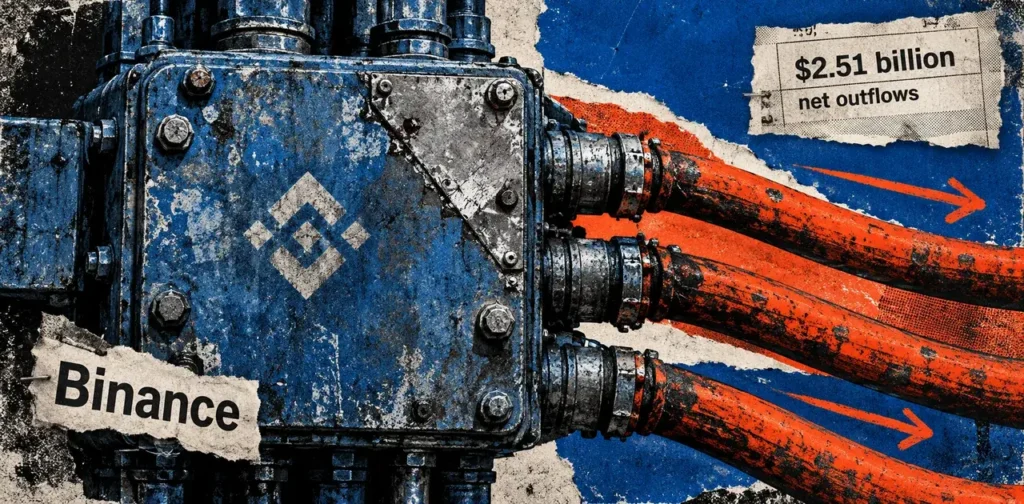
Binance’s tracked cryptocurrency wallets recorded $2,510 million in net outflows on Nov. 1 after the exchange resumed withdrawals following its $6.3 billion security breach. According to DeFiLlama data, the outflows included approximately $1,083 million in USDT, $912 million in Bitcoin, $385 million in USDC and $131 million in wrapped Ethereum…

Binance’s tracked cryptocurrency wallets recorded $2,510 million in net outflows on Nov. 1 after the exchange resumed withdrawals following its $6.3 billion security breach. According to DeFiLlama data, the outflows included approximately $1,083 million in USDT, $912 million in Bitcoin, $385 million in USDC and $131 million in wrapped Ethereum…
Read More

Continue Reading
Internet Security

Bitcoin Holds Near $78K After Binance Hack as Institutions and Crypto Politics Shape the Recovery

Bitcoin recovered toward $78,000 after Binance covered approximately 95% of losses from its $6.3 billion security breach. Meanwhile, institutional ETF demand and crypto-backed political spending are shaping the market’s outlook ahead of the US midterm elections…

Bitcoin recovered toward $78,000 after Binance covered approximately 95% of losses from its $6.3 billion security breach. Meanwhile, institutional ETF demand and crypto-backed political spending are shaping the market’s outlook ahead of the US midterm elections…
Read More

Continue Reading