Crypto Currency

S&P 500, Dow close at record highs amid Pfizer vaccine rollout and stimulus progress

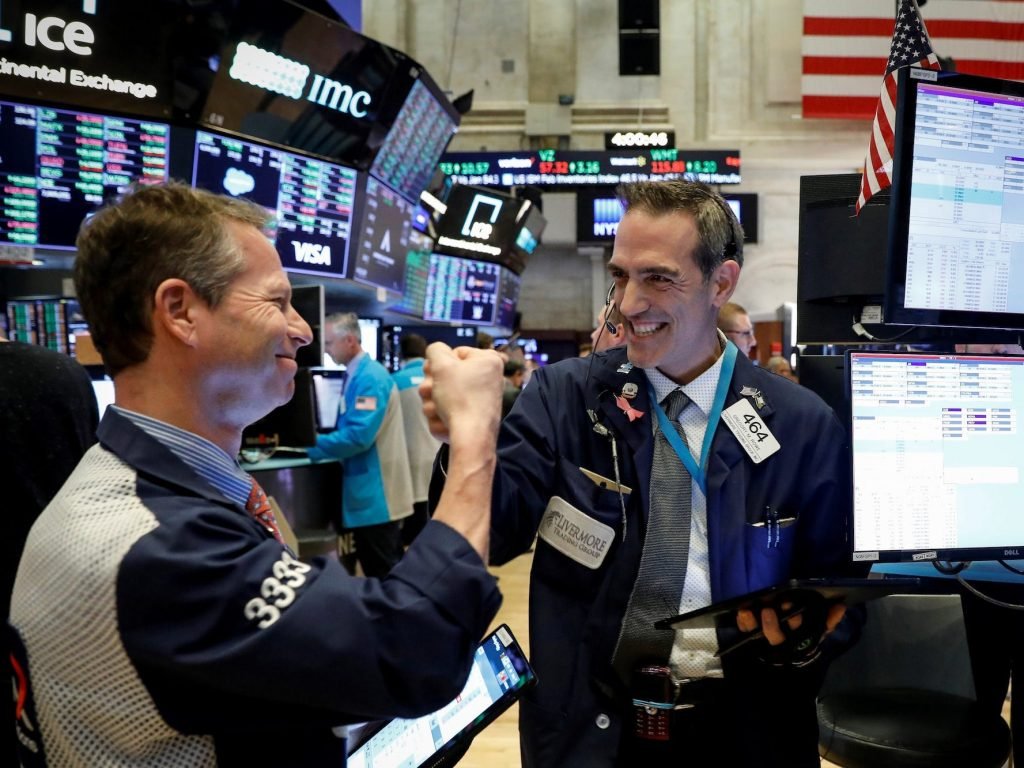
Summary List Placement US stocks erased early losses and closed at record highs as Congress inched closer to a stimulus compromise and coronavirus vaccinations began in the UK. Senate Majority Leader Mitch McConnell seemingly eased in his opposition to a $908 billion proposal supported by Democrats and Republicans, saying Tuesday that members of both parties…

Summary List Placement
US stocks erased early losses and closed at record highs as Congress inched closer to a stimulus compromise and coronavirus vaccinations began in the UK.
Senate Majority Leader Mitch McConnell seemingly eased in his opposition to a $908 billion proposal supported by Democrats and Republicans, saying Tuesday that members of both parties will have to set aside some differences to pass a bill.
Lawmakers now aim to extend government funding by a week to further negotiate a stimulus deal.
UK residents began receiving Pfizer and BioNTech’s vaccine on Tuesday. Regulators in the US indicated the shot has no safety issues and provides some protection to COVID-19 after the first dose.
Oil futures fell on concerns of weakening demand. West Texas Intermediate crude dropped as much as 1.4%, to $45.14 per barrel.
Watch major indexes update live here.

US equities retraced early losses and rallied to fresh record highs on Tuesday as Congress made mild progress in stimulus talks and investors cheered the first COVID-19 vaccinations. The S&P 500, Nasdaq composite, and Dow Jones industrial average all closed at all-time peaks.
Senate Majority Mitch McConnell inched closer to reaching a compromise with Democrats in Congress over a new stimulus deal. After proposing his own measure on Monday, the senator said that both parties will need to set aside some differences to pass a relief package.
He later suggested the roughly $900 billion deal should drop both state and local aid and pandemic-related liability protections for businesses, according to Bloomberg. The two components were strongly backed by Democrats and Republicans, respectively. 
Lawmakers aim to extend government funding by a week to buy time for additional stimulus negotiations.
Here’s where US indexes stood at the 4 p.m. ET market close on Tuesday:

S&P 500: 3,702.25, up 0.3%
Dow Jones industrial average: 30,173.88, up 0.4% (104 points)
Nasdaq composite: 12,582.77, up 0.5%

Read more: Goldman Sachs says buy these 25 stocks it expects to pay big dividends that will keep growing over the next decade
Failure to pass more fiscal aid could allow the economic recovery to weaken further as the US enters what’s set to be the most dangerous phase of the coronavirus crisis yet. The US reported 180,193 new COVID-19 cases on Monday, bringing the 7-day average to 196,882, according to The COVID Tracking Project. Hospitalizations rose above 102,000 and deaths neared 275,000.
A lack of corporate news and the latest wave of the coronavirus might make near-term gains more difficult, but stimulus hopes also limit the market’s downside risks, Lindsey Bell, chief investment strategist at Ally Invest, said.
“The November job report and rise in COVID cases likely have market participants feeling more optimistic about fiscal support,” she added.
Read more: Market wizard Chris Camillo grew his trading account by $9.7 million in 2020. Here’s the simple strategy he’s using to mint millions.
Investors also cheered the rollout of the first coronavirus vaccines in the UK. The shot, developed by Pfizer and BioNTech, could win approval from the US Food and Drug Administration as soon as Thursday. The US Food and Drug Administration said Tuesday that the vaccine provides some protection from COVID-19 after a first dose and presents no safety issues.
Goldman Sachs lifted its fourth-quarter US growth forecast to 5% from 3.2% on Tuesday, citing hopes for a coronavirus vaccine to spur a strong bounce-back in economic activity.
Tesla pared losses and rose slightly after announcing it will raise up to $5 billion through new stock sales. The plans mark Tesla’s third stock issuance this year. Wedbush analyst Dan Ives called the sale a “smart move,” as it allows Tesla to use some of its 667% year-to-date rally to bolster the company’s balance sheet.
Stitch Fix soared after posting a surprise profit in its first-quarter earnings report. The clothing style company attributed the profit surge to an acceleration in new customers throughout the pandemic.
Read more: A stock picker at a $558 billion firm lays out 2 under-the-radar trends disrupting the future of transportation— and explains why Slack and Virgin Galactic are perfect fits for his portfolio
Bitcoin again fell below its $19,000 support to a 24-hour low of $18,629.54. The token has fluctuated around that level in recent days as investors mull whether it can reach $20,000 for the first time.
Spot gold gained as much as 0.7%, to $1,875.39 per ounce, at intraday highs. The US dollar gained against all but one of its Group-of-10 peers, while Treasury yields slid.
Oil futures wavered as investors gauged demand concerns against vaccine optimism. West Texas Intermediate crude dropped as much as 1.4%, to $45.14 per barrel, before paring losses. Brent crude, oil’s international benchmark, retraced losses and rose as much as 0.4%, to $49 per barrel, at intraday highs.
Now read more markets coverage from Markets Insider and Business Insider:
The equities chief at $1.4 trillion Franklin Templeton says stocks are ‘priced for perfection’ — but investors still shouldn’t wait to get in. He tells us 9 ways they can get the market-beating returns.
Stocks could stumble in early 2021 as investor sentiment surges past market fundamentals, Goldman Sachs says
Tesla’s latest stock sale is a smart move on the heels of a 667% year-to-date rally, analyst saysJoin the conversation about this story » NOW WATCH: Why electric planes haven’t taken off yet
Read More

Be the first to write a comment.

Leave a Reply

Your email address will not be published. Required fields are marked *

Crypto Currency

Strategy’s High-Yield Stock Will Continue to Fuel Bitcoin Surge, Says Bitwise CIO

Bitwise CIO Matt Hougan says Strategy’s STRC preferred stock could keep fuelling Bitcoin after $7.2 billion of purchases, while its latest confirmed buy used common-stock proceeds instead. The post Strategy’s High-Yield Stock Will Continue to Fuel Bitcoin Surge, Says Bitwise CIO appeared first on Crypto News Australia…

Bitwise CIO Matt Hougan says Strategy’s STRC preferred stock could keep fuelling Bitcoin after $7.2 billion of purchases, while its latest confirmed buy used common-stock proceeds instead.
The post Strategy’s High-Yield Stock Will Continue to Fuel Bitcoin Surge, Says Bitwise CIO appeared first on Crypto News Australia…
Read More

Continue Reading
Crypto Currency

Bitcoin rises to $77,000 ahead of Fed decision as Trump preps for lengthy Hormuz block

Markets Share Share this article Copy link X icon X (Twitter) LinkedIn Facebook Email Bitcoin rises to $77,000 ahead of Fed decision as Trump preps for lengthy Hormuz block Bitcoin is sitting almost still while the rest of the majors give back gains and oil pushes above $111 on reports of an extended U.S. naval

Share this article
X iconX (Twitter)LinkedInFacebookEmail

Bitcoin rises to $77,000 ahead of Fed decision as Trump preps for lengthy Hormuz block

Bitcoin is sitting almost still while the rest of the majors give back gains and oil pushes above $111 on reports of an extended U.S. naval blockade against Iran.

By Shaurya Malwa|Edited by Sam Reynolds
Updated Apr 29, 2026, 4:29 a.m. Published Apr 29, 2026, 4:27 a.m. 2 min read
Make preferred on
Markets rise (Mehmet Turgut Kirkgoz, Unsplash)

What to know:

  • Bitcoin is trading in a tight range just below $77,000 despite surging oil prices and geopolitical tensions over a potential extended U.S. naval blockade of the Strait of Hormuz.
  • Major altcoins including ether, XRP, Solana and BNB have fallen over the past week while dogecoin is the only top-10 non-stablecoin token to post gains, lifting bitcoin’s market dominance.
  • Analysts say bitcoin’s muted reaction reflects supply exhaustion and lower sensitivity to regulatory and central bank news, with $75,000 seen as key downside support and a move back toward $80,000 needed to preserve the current rally structure.

Bitcoin is doing nothing while everything around it moves.

The largest crypto just under $77,000 on Wednesday in Asian hours, up just 0.1% over 24 hours and down 0.8% on the week, holding a tight band even as Brent crude pushed above $111 a barrel on a Wall Street Journal report that President Donald Trump told aides to prepare for an extended U.S. naval blockade of the Strait of Hormuz.

Iran has said the country is in a “State of Collapse,” Trump claimed on Truth Social Tuesday, while Tehran has signaled it may accept an interim deal to reopen the strait if Washington lifts its blockade of Iranian ports.

Ether dropped 2.6% on the week to $2,310. XRP fell 3.8% to $1.39. Solana lost 3.2% to $84.57. BNB shed 2.3% to $625. The exception was dogecoin, up 5.5% on the week to $0.1016, the only top-10 token outside stablecoins to print green over seven days.

Bitcoin’s market dominance is slowly climbing again as a result, which is what tends to happen when macro stress arrives and capital rotates into the largest asset.

Zaheer Ebtikar, founder of Split Research, said in a note that bitcoin’s relative calm was indicative of a change in market strucute.

“The supply overhang has finally dried up, and the sellers who were spooked by macro shifts or quantum fears have already exited, leaving the market much thinner on the sell-side than it was just a few months ago,” he said to CoinDesk over email.

“Bitcoin is far less sensitive to regulatory noise or central bank policy than people think. Its sensitivity is purely a function of wider volatility, and since we’re currently in a quieter trading range, there’s no immediate rush for the exits,” Ebtikar added.

The technical levels are sharper. Analysts at Bitget flagged $75,000 as the line where the upward range that has held since late March breaks, with a clean loss potentially opening room for further downside.

A reversal back toward $80,000 from current levels keeps the rally structure intact and sets up a retest of the resistance that has rejected bitcoin every attempt since February.

The Fed announces its rate decision later on Wednesday, the ECB follows Thursday, and the U.S. equity market sold off Tuesday on growing skepticism about the payoff from artificial intelligence capital expenditure, with Nasdaq 100 futures clawing back 0.4% in Asian hours.

Brent crude whipsawed between gains and losses but stayed elevated near $111 on the blockade reporting, putting renewed pressure on inflation expectations heading into the central bank decisions.

Traders may watch whether bitcoin’s apparent supply exhaustion holds against the next macro shock. If Ebtikar’s read is correct, the seller base that capitulated through March and April is gone, and bitcoin trades on volatility rather than headlines until something forces a fresh leg of selling. If the read is wrong, $75,000 gets tested quickly and the range break Bitget flagged plays out as drawn.

Bitcoin NewsIran

More For You

Bitcoin briefly drops below $62,000 as $1.5 billion in crypto longs get wiped out

Bitcoin hero image

Presto Research says bitcoin’s drawdowns this year have coincided with rallies in AI stocks and gold as markets scale back expectations for Fed rate cuts.

What to know:

  • Bitcoin fell below $62,000 in Asia trading, sparking more than $1.5 billion in leveraged crypto liquidations over 24 hours, including over $800 million in bitcoin and $386 million in ether positions.
  • The selloff came amid persistent institutional weakness, with U.S. spot bitcoin ETFs seeing about $1 billion in net outflows…
Read full story
Latest Crypto News
Bitcoin hero image

Bitcoin briefly drops below $62,000 as $1.5 billion in crypto longs get wiped out

(Getty Images)

Live Markets: Bitcoin crashes to $62,000 as billions of longs get liquidated

CoinDesk

Bitcoin tanks below $63,000 for the first time since February as price selloff deepens

CoinDesk

SpaceX targets record $75 billion IPO as bitcoin treasury and liquidity risks draw focus

Tom Lee, chairman of Bitmine and cofounder of Fundstrat, speaking at Consensus 2src26 in Miami (CoinDesk)

Tom Lee’s Bitmine borrows a page from Saylor’s playbook to offer 9.5% yield in preferred stocks

Tom Lee, chairman of Bitmine and cofounder of Fundstrat, speaking at Consensus 2src26 in Miami (CoinDesk)

Bitmine’s Ethereum bet nears $9 billion loss as ether falls below $1,800

Top Stories
CoinDesk

Bitcoin isn’t crashing because of Saylor, it’s losing the momentum trade

political action committees (PACs) (illustration by Jesse Hamilton/CoinDesk)

New DeFi entrant widens field of crypto political campaign funds as elections loom

Original Casascius coins (casascius.com)

Rare physical bitcoin worth $1.78 million gets cashed in after 12 years

A cellphone held near a card reader (NFC)

Payment giants Stripe, Visa, Mastercard said to be among backers of soon-to-debut stablecoin platform

Congress

Clarity Act survival depends on the U.S. Senate getting a lot of non-crypto work done

!–>!–>!–>!–>
Read More

Continue Reading
Crypto Currency

Institutional money is coming for bitcoin, but Adam Back says it moves slower than you think

Finance Share Share this article Copy link X icon X (Twitter) LinkedIn Facebook Email Institutional money is coming for bitcoin, but Adam Back says it moves slower than you think The legendary cryptographer discusses institutional money flows into bitcoin. By Ian Allison| Edited by Sheldon Reback Updated Apr 29, 2026, 1:09 p.m. Published Apr 29

Share this article
X iconX (Twitter)LinkedInFacebookEmail

Institutional money is coming for bitcoin, but Adam Back says it moves slower than you think

The legendary cryptographer discusses institutional money flows into bitcoin.

By Ian Allison|Edited by Sheldon Reback
Updated Apr 29, 2026, 1:09 p.m. Published Apr 29, 2026, 4:00 a.m. 4 min read
Make preferred on
Blockstream CEO Adam Back

What to know:

  • Blockstream CEO Adam Back says spot bitcoin ETFs are a powerful long-term catalyst, but institutional adoption takes time.
  • Back argues that the interests of major Wall Street firms such as BlackRock, Morgan Stanley and Fidelity provide a durable pro-crypto force that can outlast changes in U.S. administrations.
  • Quantum-computing fears are a minor but real risk that institutions are beginning to evaluate.

The arrival of Morgan Stanley at the U.S. spot bitcoin ETF party earlier this month was characterized by some observers as the catalyst that will end the current crypto bear market thanks to the massive distribution power of the Wall Street wirehouse’s $8 trillion wealth management network.

Not so fast, said Blockstream CEO Adam Back, an early contributor to the Bitcoin community and recently tipped by the New York Times to be the cryptocurrency’s pseudonymous creator, Satoshi Nakamoto, an assertion he denies.

The bitcoin ETFs could be the single most important development of recent times when it comes to positive market signals, more so even than a pro-crypto U.S. administration, Back said, but it takes longer than most people realize. It won’t be immediate.

“I think what people may have miscalculated is that institutional adoption is very slow,” said Back in an interview with Coindesk. “So the ETFs got bought, but when BlackRock is saying they recommend 2% to 4% allocation in their general stock portfolio, the fund managers haven’t done that yet. And they will, but it’s slower than people anticipate.”

Investors don’t just pile in overnight, he said. A build-up could take a year, even 18 months.

“Some of that stuff is just starting to happen, and it will happen slowly. So I think there’s a tailwind.”

Founded in 2014 by Back and other prominent Bitcoin developers, Blockstream offers retail and institutional clients self-custody wallets, layer-2 network settlement and asset issuance. Back is also the CEO and co-founder of BSTR, a bitcoin treasury company looking to go public via a SPAC merger with Cantor Equity Partners (CEPO).

The Trump effect

While ETFs may trump the government for boosting the industry, there’s still a regulatory influence. Consider President Donald Trump’s crypto-friendly term and compare it with the previous administration’s Security and Exchange Commission (SEC) and Chair Gary Gensler’s assault on the industry.

Instead, the U.S. now has a presidency that not only introduced a new legislative framework for crypto, but even launched its own token shop.

“They’ve definitely improved the open-for-business framework in the U.S., which has indirectly encouraged other jurisdictions to do likewise,” said Back, who lives in Malta. “So the U.K.’s FCA [Financial Conduct Authority] finally approved ETFs for retirement accounts and things. And I think maybe one or two other countries. They look at each other.”

While Donald Trump’s America may be open for crypto business, the now-established bitcoin ETFs have the power to transcend administrations, whether Republican or Democrat, Back pointed out.

“One of the reasons to suppose the ‘open for business’ is going to stay, even as you get new administrations, is that now Black Rock and the other ETF providers are going to defend their business,” he said.

“They’re going to apply a banking lobby to say they make a lot of money from the bitcoin ETF. We don’t want you to interfere with it. And so I think that now bitcoin has new allies in Black Rock, Morgan Stanley and Fidelity and all these guys.”

Four-year cycle

Another pricing factor to consider is bitcoin’s cyclical nature, a historical pattern driven by the quadrennial halving event, which cuts the supply of new tokens by 50%. The reduction often leads to a relatively consistent bull run followed by a bear market/recovery period.

Even if the four-year cycle is breaking, as some commentators believe, there’s still the reasonable possibility of a price slide happening simply because “people expected it to happen. So they sold and they made it happen,” Back said.

That logic is likely to change only when people see strength in the market, he said. That’s now coming in the form of institutional flows, such as the ETFs, sovereign and sovereign wealth fund investments, and investors buying bitcoin directly or shares in bitcoin treasury companies such as Strategy (MSTR), formerly called MicroStrategy.

“They are growing their ability to buy bitcoin in different market conditions,” Back said. “MicroStrategy, particularly, has been having an accelerated success with their Stretch kind of fixed-income product. So they’ve been able to use that to buy a lot of bitcoin, and it’s escalated even in the last few weeks. So those recurring buyers plus new institutional and wealth management buyers will eventually overwhelm the sellers.”

Strategy’s Stretch (STRC) is a perpetual preferred stock designed as a high-yield, bitcoin-backed income instrument.

Quantum-tative

As well as fielding inquiries about his identity, Back has also been answering a volley of claims about quantum-computing hardware progressing faster than expected and its power to break Bitcoin’s cryptography.

“People are trying to say it’s a factor,” Back said of quantum technology’s effect on the price of bitcoin. “But I think there’s a lot of information asymmetry in these markets, meaning that things which you think are perfectly clear are confusing to some other people, and their uncertainty impacts their decisions.”

That said, the recent round of quantum doomsaying may have institutions paying a bit of attention, Back conceded.

“Institutions are more systematic about risk,” he said. “So if there’s a tail risk, even a small one, they want to know that it’s covered. For retail investors, it sounds like something in the distant future that perhaps they’re not really worried about. But institutions will think a decade ahead and ask, ‘Is this 1% risk? Is there an answer to it?’ They’ll check stuff like that.”

UPDATE (April. 29, 13:10 UTC): Changes description of Morgan Stanley in the first paragraph from advisory network to wealth management network

Bitcoin NewsETFsArtificial Intelligence

More For You

Tom Lee’s Bitmine borrows a page from Saylor’s playbook to offer 9.5% yield in preferred stocks

Tom Lee, chairman of Bitmine and cofounder of Fundstrat, speaking at Consensus 2src26 in Miami (CoinDesk)

The largest Ethereum treasury firm is taking a page from Michael Saylor’s Strategy to issue preferred shares to tap new sources of funding.

What to know:

  • Bitmine is offering perpetual preferred stocks with a 9.5% annual dividend, aiming to raise up to $300 million, a company filing shows.
  • The firm is following the steps of bitcoin-centric peers like Michael Saylor’s Strategy to tap new sources for funding digital asset treasuries.
  • The preferred shares will be listed…
Read full story
Latest Crypto News
Bitcoin hero image

Bitcoin briefly drops below $62,000 as $1.5 billion in crypto longs get wiped out

(Getty Images)

Live Markets: Bitcoin crashes to $62,000 as billions of longs get liquidated

CoinDesk

Bitcoin tanks below $63,000 for the first time since February as price selloff deepens

CoinDesk

SpaceX targets record $75 billion IPO as bitcoin treasury and liquidity risks draw focus

Tom Lee, chairman of Bitmine and cofounder of Fundstrat, speaking at Consensus 2src26 in Miami (CoinDesk)

Tom Lee’s Bitmine borrows a page from Saylor’s playbook to offer 9.5% yield in preferred stocks

Tom Lee, chairman of Bitmine and cofounder of Fundstrat, speaking at Consensus 2src26 in Miami (CoinDesk)

Bitmine’s Ethereum bet nears $9 billion loss as ether falls below $1,800

Top Stories
CoinDesk

Bitcoin isn’t crashing because of Saylor, it’s losing the momentum trade

political action committees (PACs) (illustration by Jesse Hamilton/CoinDesk)

New DeFi entrant widens field of crypto political campaign funds as elections loom

Original Casascius coins (casascius.com)

Rare physical bitcoin worth $1.78 million gets cashed in after 12 years

A cellphone held near a card reader (NFC)

Payment giants Stripe, Visa, Mastercard said to be among backers of soon-to-debut stablecoin platform

Congress

Clarity Act survival depends on the U.S. Senate getting a lot of non-crypto work done

!–>!–>!–>!–>!–>!–>
Read More

Continue Reading
Crypto Currency

Cryvex Exchange Launches IPO Prime Platform, Bringing Pre-IPO Tokens to the Public, First Launch: SpaceX Solana Version

In early 2026, after experiencing the sharp adjustment at the end of 2025, the crypto market is still in a consolidation phase.Bitcoin and Ethereum prices have seen intensified volatility, with macroeconomic policy uncertainty, geopolitical risks, and cautiou…

In early 2026, after experiencing the sharp adjustment at the end of 2025, the crypto market is still in a consolidation phase.Bitcoin and Ethereum prices have seen intensified volatility, with macroeconomic policy uncertainty, geopolitical risks, and cautiou…
Read More

Continue Reading