The Uncomfortable Rise of the Instagram Novel

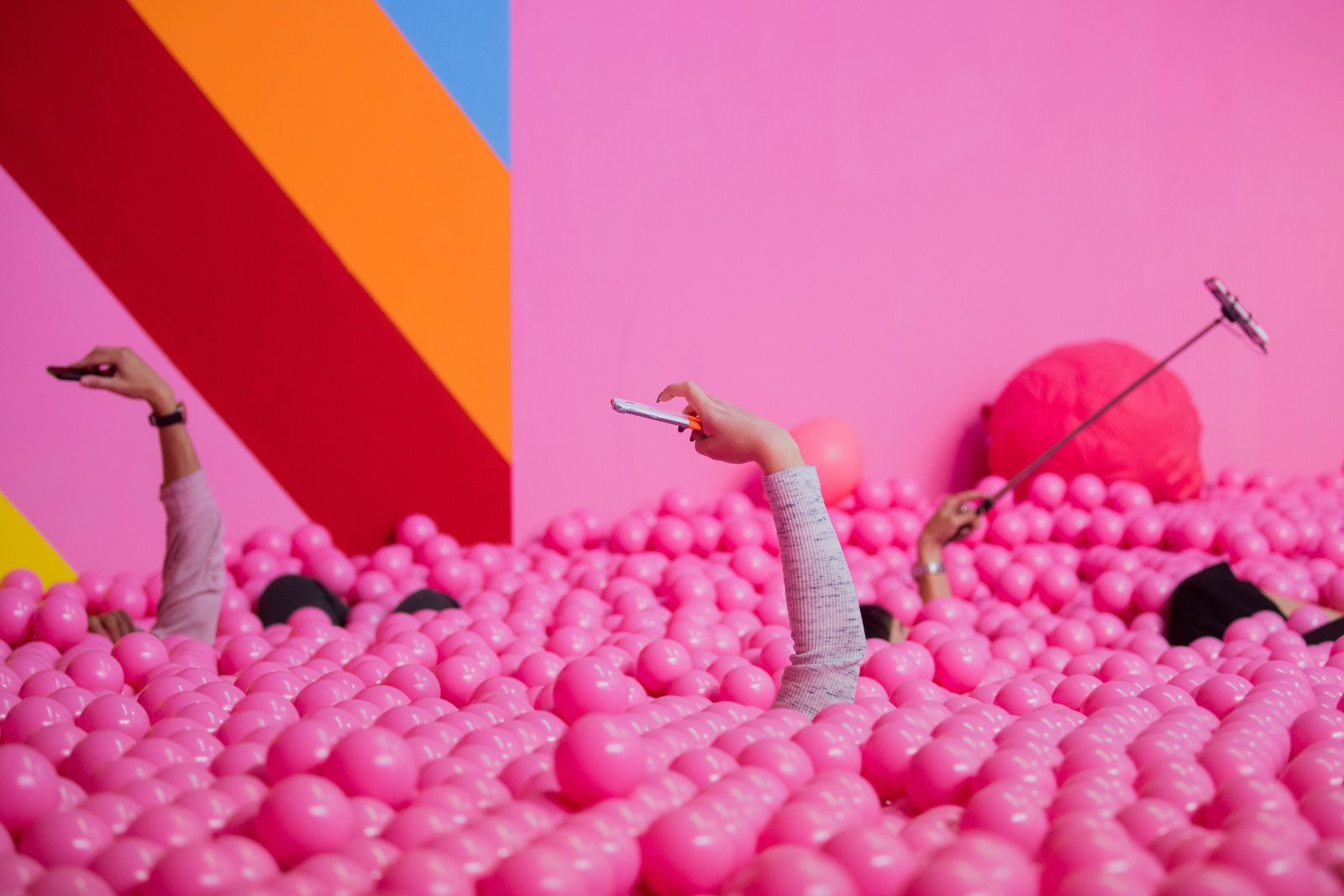
If it’s now widely believed that life spent tethered to a smartphone is inherently suspect, performative, or false, the physicality of our devices is comparatively underdiscussed. Behind every digital avatar, after all, is not only posture and hyperbole but an infinite number of taps, swipes, pinches, and strokes. As the research firm Dscout reported in 2017, the top 10 percent of users touch their phones 5,427 times a day. If we account for the average adult’s recommended seven hours of sleep, that’s equivalent to over five touches per waking minute. It takes a lot of real upkeep to be fake.The smudge of fingerprints on a touchscreen is far from the only way our devices blend the physical and the digital. Their portability allows us to bring the whole of the internet into more and more intimate spaces—on the toilet, in bed—contributing to the illusion that we are somehow in control of its contents. Instagram is especially effective at stoking this feeling. Consider the illicit thrill of scrolling too far back on someone’s account, phone propped on a pillow or dangled precariously over a face. The privacy of the app allows us to look with an intensity still frowned upon IRL, screenshot for posterity, zoom in on telling imperfections—at least those that haven’t been Facetuned out. No wonder the platform lends itself so easily to fantasies of possession, or at least familiarity.Of course, the titillation goes both ways: You can lurk as a voyeur one moment and lean into exhibitionism the next, imagining there is someone out there scrutinizing your likeness just as closely in the harsh light of their own screen. Alice Hare, the protagonist of Olivia Sudjic’s 2017 novel Sympathy, compares the satisfaction of posting to Instagram to “plucking a hair up from the root.” Sympathy is one of several recent parables of virtual obsession, along with Matt Spicer’s film Ingrid Goes West and Beth Morgan’s debut novel, A Touch of Jen, that return cyberstalking to the realm of the flesh. Unlike depictions of the internet that emphasize its cerebral or abstract qualities, these works serve as reminders that the line between online and off is eminently permeable.Sudjic’s novel follows 23-year-old Alice’s ill-fated sojourn to New York, where she travels to reunite with her estranged paternal grandmother, Sylvia; though born in the city, Alice was raised mostly in England following the disappearance and presumptive suicide of her adoptive father, Mark. Now she’s back in Manhattan for the first time since toddlerhood, and a family friend’s interest in genealogy unwittingly brings her into the orbit of Mizuko Himura, an instructor at NYU and writer of autofiction who also maintains a robust and aspirational Instagram feed. Alice describes the discovery of Mizuko’s account as the moment “the solid world” around her started “to slide away, like wet sand sinking beneath the water.” The all-consuming infatuation only has to remain virtual for two weeks: Mizuko’s habit of geotagging her locations in real time soon enables Alice to facilitate a meet-cute at the Hungarian Pastry Shop. The most crucial element of Alice’s plan is the coincidence that Mizuko’s current romantic partner, Rupert, is an acquaintance of Alice’s, and she uses him as an excuse to say hello.To Alice, however, there’s no such thing as mere coincidence; the confluence of variables underpinning her introduction to Mizuko is “evidence of the hidden connections between things, an all-powerful algorithm that sifted through chaos, singling out soulmates.” Ditto their superficial similarities—withholding mothers, absent fathers, loser boyfriends—which she reads as “clear proof of supersymmetry, the idea that every particle has a partner.” The intensity of these lines is representative of the singlemindedness with which she pursues closeness to Mizuko, a mission greased by Rupert’s summary dumping of Mizuko and the fact that Alice has already “dissected the pictorial equivalent of her DNA”; knowing all of Mizuko’s tastes in advance, she can pass them off as her own. Alice is surprisingly successful, for a while—almost immediately, she and Mizuko are having sleepovers together, taking performance-enhancing drugs together, even traveling for a long weekend to Texas together. But before long, the novelty of Alice’s presence begins to wear thin, and she resorts to desperate measures to keep Mizuko from slipping out of her grasp.That turn of phrase is appropriate here. Sympathy may be largely about the internet, but it’s very occupied with the body, its frailty and its porousness. Alice’s grandmother is dying of cancer; Alice becomes pregnant and later miscarries; Mizuko suffers a seizure from a two-centimeter-long brain parasite. And the novel is awash in various kinds of viscera: uterine blood, enema fluid, saliva. When, at one intoxicated point, Mizuko and Alice share a kiss, Alice notes that “a single thread of spit draws out between us as she pulls away.” Even when Sudjic is writing specifically about pieces of technology, her language tends toward the corporeal and the libidinal. Holding Mizuko’s phone in her hand feels “kind of like holding her brain … as if [it] were jellied or slimy.” At a talk held on the Columbia campus, she observes a row of students “all frenziedly stroking luminous screens held in their laps.” The internet is a conduit of real pain and pleasure. No one is as invulnerable as their online appearance might suggest.The film Ingrid Goes West begins with its own scene of frenzied stroking: We see an iPhone in closeup, a disembodied thumb scrolling through a series of wedding photos on Instagram, double tapping automatically to like each one. Then the camera cuts to the user’s face, more specifically her eyes. They’re bloodshot and tearful, rimmed with smudged mascara, pupils almost completely obliterated by the glow of the screen. This is Ingrid, who, we learn in the opening sequence, has recently lost her mother and has a history of forming attachments over social media unhealthy enough to land her in a psychiatric hospital. Upon her release, she promptly finds a new obsession in the pages of a glossy magazine: influencer Taylor Sloane, whose California lifestyle is a fever dream of vintage campers, filtered sunsets, avocado toasts, and oversized sunglasses. Ingrid cashes out her modest inheritance and heads to Venice Beach in pursuit.Like Alice in Sympathy, Ingrid uses Taylor’s Instagram activity to manufacture a meeting with Taylor, getting a dye job at her salon and frequenting her favorite café. Unlike Sympathy, however, Spicer’s film is a comedy: When a chance encounter at a boutique fails to deliver the desired result, Ingrid kidnaps Taylor’s beloved dog Rothko so that she can play the hero responsible for his return. By turning down the reward money that Taylor and her husband offer, she wrangles a dinner invitation instead. As if by magic, Ingrid becomes a member of Taylor’s inner circle, her VIP status sealed in Joshua Tree over cocaine and margaritas. Of course, it isn’t magic at all, but Taylor’s narcissism. Alice and Ingrid might not come off particularly well in their respective narratives, but neither do the women they latch onto, who are drawn in not just by their acolytes’ sycophancy but the fact that they appear to be just like them.The end of Ingrid and Taylor’s honeymoon period is hastened by the arrival of Taylor’s brother Nicky, a manipulative party boy who immediately senses something off in his sister’s new friend and sets out to prove it. “I’m not doing anything wrong,” Ingrid says pathetically after Nicky has stolen her phone and discovered a cache of incriminating evidence about her fixation on Taylor. She’s more right than the movie is willing to allow. Taylor’s profession, after all, is all about courting parasocial relationships in order to sell things, a cynical layer of chumminess applied to advertising’s oldest promise: Buy this product, and your life could look just like mine. Is it all that surprising that someone out there might take this invitation to its logical conclusion and then some? Ingrid is clearly unwell, but she’s also Taylor’s most loyal customer, a testament to her success as a brand.Jen, the beloved figure at the center of Beth Morgan’s debut novel, A Touch of Jen, is not quite a social media microcelebrity, but she posts like one nonetheless. A part-time waitress and wannabe jewelry designer, her Instagram presents the image of a carefree jet-setter, documenting international travel enabled by the largesse of her boyfriend, Horus, who is so rich that even his “expression is moneyed and free of pain, like a royal corpse.” While her posts are composed with the goal of eliciting envy, she’d likely be unnerved by the degree of devotion they inspire in her former co-worker Remy and his hapless girlfriend, Alicia, who have put fantasies about Jen at the center of their romance. The book opens with Alicia asking Remy whether she should print out a photo of Jen’s face to wear over hers while they have sex: “I could cut little holes in the eyes.”This outré suggestion is indicative of the novel’s tone, which is both darker and more ironic than other entries in the genre. In Sympathy and Ingrid Goes West, it’s implied that the protagonists’ unbalanced attraction to women they find online is at least partly due to some formative trauma; even Spicer’s satirical film plays Ingrid’s grief for her mother relatively straight. In A Touch of Jen, however, Remy seems to have no inner life at all—a point underscored by the fact that people are always asking what his “deal” is—while Alicia is incapable of relaying her genuinely upsetting personal history in anything other than the cadence of a standup comic. “I was actually … one of the youngest bulimic patients at the recovery center! In fact, I deprived myself of so many nutrients during my developmental years that my mom thinks my brain was permanently damaged!” she says at one point, her exclamation points conveying an uncomfortable levity.Like Sympathy, Morgan’s novel is flush with tactile language—Alicia wants to “unzip [Jen] from top to bottom,” while Remy “[wishes] to bury himself wrist-deep in her skin”—but the novel diverges in the way its protagonists cross paths with their prey. When they run into Jen at an Apple Store, it’s a genuine coincidence, not a manufactured one. Jen winds up inviting the couple to a surfing weekend at Horus’s vacation home in Montauk, where they prove far less successful than Alice and Ingrid at ingratiating themselves. Remy is too taciturn and Alicia too desperate to belong; she does not have “the kind of laughter that puts people at ease.” The tension reaches a breaking point when Alicia sleepwalks into Jen and Horus’s bed, wrapping her hands around the former’s neck in, Jen claims, an attempt to choke her. Simultaneously, a mysterious knocking sound lures Remy out of the house, where he thinks he sees “something blue-green and iridescent” reflected in the pool’s curiously turbulent water.Rattled by the previous night’s events, Remy suffers a surfing-induced concussion the next day that seems temporarily to guilt Jen into recognizing the existence of their former camaraderie—either that, or she wants to get back at Horus for being insufficiently protective of her. She accompanies him back to the house to minister to his injuries, and suddenly Remy is given the opportunity to fulfill his wildest Jen-centered fantasies. Only he can’t seem to seal the deal; they start to hook up, but something feels off. “He can imagine what they would look like on a screen, but he’s not inside the picture.”Remy’s failure to consummate things with Jen is the cherry on top of a disastrous weekend, but he and Alicia content themselves with the fact that she can never really be rid of them, no matter how hard she tries. “She can be as awful as she wants,” Alicia says. “She can even block us on Instagram. But we’ve had time to study her and figure her out. She can’t keep herself out of our sex life.” Just how much Alicia means this soon becomes clear when they return from their trip. She starts wearing a cardigan of Jen’s that she took from the Montauk house and a pair of Jen-designed earrings. She quits her sandwich-making gig for a lower-paid job at a skincare store whose products she’s seen “in the background of Jen’s photos before.” She asks her new co-workers to call her Jen. Before a shocking accident bifurcates the novel’s plot, Alicia even starts a mysterious new Instagram account for her new adopted identity: @atouchofjen.As depictions of a phenomenon that exists largely on the internet and ultimately concerns an unrepresentative if not insignificant portion of the world’s population, there comes a point in all of these works where it’s tempting to ask: Does any of this really matter? Is a photo-sharing app where people post images of their pets and their breakfasts really worthy of so much scrutiny? In the real world, the answer is unfortunately yes. Instagram has produced inarguable material effects, from the multiplication of Mark Zuckerberg’s wealth—and his undemocratic influence over American life—to the reshaping of the built environment, restaurant menus, and an astounding number of individual faces. What’s harder to determine is whether it matters for the purposes of literature. Certainly, fiction has long taken its cues from less divine sources of inspiration, or at least equally debased ones.Is a photo-sharing app where people post images of their pets and their breakfasts really worthy of so much scrutiny? In the real world, the answer is unfortunately yes. Ephemerality is the intractable problem plaguing most writing about the internet, as many critics have noted. Even if we’re stuck with social media for the long haul, as it increasingly seems, its trends and user behaviors change so quickly that any attempt to trap them in amber becomes instantly dated. The boho chic aesthetic favored by Ingrid Goes West has since trickled down to exactly the kind of “total preppy sorority chick” it’s climactically revealed that Taylor recently was. Sympathy records an era of Instagram before the addition of the Stories feature, and both Alice and Mizuko are in the habit of posting multiple times a day to their main page—a practice that looks unbearably outdated from today’s vantage.The operative question is whether the social forms fostered by the internet are genuinely novel enough to offset the risk of immediate obsolescence that any work taking social media as its subject incurs. Sympathy, in a meta moment, ventures an answer: During a conversation about their generational differences, Mizuko, who is nearly 10 years older than Alice, criticizes millennials for the way they “ooze out over everything else,” projecting themselves and their worldview onto other things. “Doesn’t everyone do that?” Alice asks. “Yes,” Mizuko says, “and they always have.” But “it’s just getting easier and easier. The scale is new.” Morgan, for her part, sidesteps most of these artistic concerns by declining to take her material too seriously; the dark social comedy of A Touch of Jen’s first half gives way to a campy, supernatural bloodbath in its second, culminating in an act of violence its predecessors were only willing to hint at.Many dramatizations of the internet contain a moralizing element, even if their intent is to satirize rather than instruct. At the very least, they tend to evince an obvious anxiety about the mass fraudulence that social media has enabled—a fraudulence that erodes the borders of the self the more we try to shore it up through digital performance, making us vulnerable to influencers as well as ideology, and impeding our ability to form authentic human connections, if those even really exist. A Touch of Jen concerns itself with the same morass but concludes with a smirk rather than a shiver. Ultimately, Morgan suggests that authenticity can be just as hideous as its opposite. The book may date itself with perishable references to Instagram captions and New Age fads, but it succeeds where similar works have faltered by deflating the fantasy of the real. The fear of living dishonestly, it appears, has made it easier than ever to justify sacrificing others on the altar of our own self-actualization.
Read More
Be the first to write a comment.