GDPR

This privacy-friendly employee monitoring software has your employees buy in to data protection

Data breaches, both internal and external, are on the rise, with no sign of stopping. Of thousands of companies surveyed, half have experienced breaches, mostly over the last three years, and nine of ten breaches occur not due to internal malfeasance or breaches to data protection companies, but rather due to employee errors giving bad…


Data breaches, both internal and external,are on the rise, with no sign of stopping. Of thousands of companies surveyed,half have experienced breaches, mostly over the last three years, and nine of ten breaches occur not due to internal malfeasance or breaches to data protection companies, but rather due toemployee errorsgiving bad actors inside access.

So rather than focus efforts on securing your network from external assaults, companies need to protect themselves from their own inattentive employees. While educating and training employees about potential threats is a good first step, it can only go so far. You need a more comprehensive solution. Unfortunately, the most effective solutions such as employee monitoring software might be seen by employees as breaching their privacy rights. These software track employees’ potentially suspicious or misguided activity; notify security teams instantly if a suspected breach has occurred; and give those teams the ability to instantly take over any workstation and cut off any potential data loss. Plus, the best software solutions analyze user behavior and predict insider threats. The software can even automatically act to block any dangerous activity that might lead to a data breach. In most cases you can step in and de-escalate problems before they become an actual security threat.

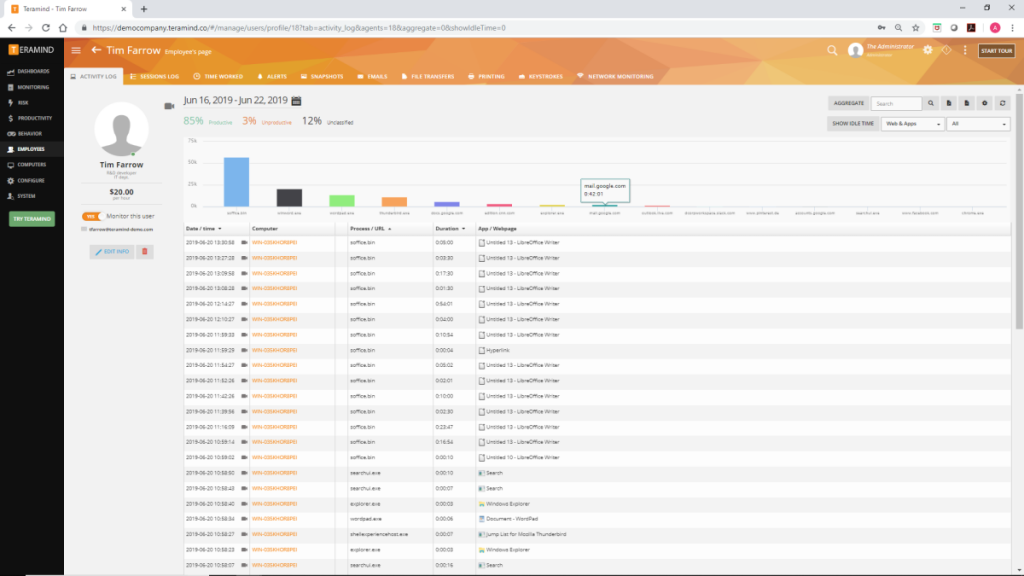
For most employee monitoring software companies, this is a blanket solution, with every employee treated as an equally potential threat and little regard is given to preserving privacy. But the industry-leading security service Teramind encourages its customers to eschew this us-versus-them mentality and transparently protect your employees from their worst impulses while also protecting their privacy from their own mistakes.
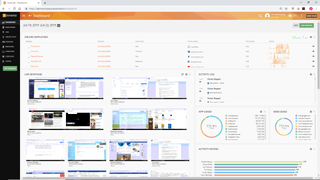
The Teramind dashboard: customers can create their own dashboard from a selection of dozens of widgets, based on their priorities or areas of particular concern.

The Teramind dashboard: customers can create their own dashboard from a selection of dozens of widgets, based on their priorities or areas of particular concern.(Image credit: Teramind)

Teramindis anISO2001:2013-certifiedcompany that aims to align its products with regulatory standards like CCPA,GDPRandHIPAA. And it has received acclaim from several tech sites for the effectiveness of its services, includingTechRadar.

interactive simulator, or sign up for afree trial.

A personalized protection plan
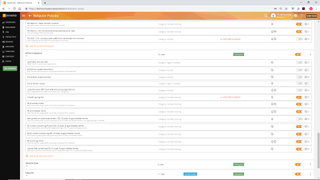
A sample list of behavioral policies and rules that can be created on Teramind. The solution comes with hundreds of pre-built rules to prevent common insider threats and data breaches. 

A sample list of behavioral policies and rules that can be created on Teramind. The solution comes with hundreds of pre-built rules to prevent common insider threats and data breaches. (Image credit: Teramind)

The solution comes with three pricing tiers and available as Cloud, On-Premise or Private Cloud deployment (such as AWS, Azure) making it suitable for SMEs to large enterprise customers.

Each of the three pricing levels o

Read More

Be the first to write a comment.

Leave a Reply

Your email address will not be published. Required fields are marked *

GDPR

Tech Tuesday: Data privacy and synthetic data generation tools

Data has become simultaneously the most valuable asset most organisations own and the most heavily regulated one. GDPR fines exceeded €4.5 billion cumulatively by early 2026. The EU AI Act’s classification of training data quality as a high-risk system requirement has made data provenance a legal obligation rather than a best practice…

Data has become simultaneously the most valuable asset most organisations own and the most heavily regulated one. GDPR fines exceeded €4.5 billion cumulatively by early 2026. The EU AI Act’s classification of training data quality as a high-risk system requirement has made data provenance a legal obligation rather than a best practice…
Read More

Continue Reading
GDPR

Researcher reveals official White House app is one command away from tracking your precise location every 4.5 minutes – app can also inject code to dodge cookie consent, GDPR banners, and paywalls

White House app contains code to hide cookie options, GDPR banners, and paywalls – and collects extensive user data…

White House app contains code to hide cookie options, GDPR banners, and paywalls – and collects extensive user data…
Read More

Continue Reading
GDPR

Viva la revolución: LinkedIn profile visitor lists belong to the people, says Noyb

GDPR Article 15 doesn’t care if you want to make money by selling users’ data back to them A LinkedIn feature the average non-paying user likely only glances past could end up setting a legal precedent in the EU regarding how companies treat customer data that they’ve processed. …

GDPR Article 15 doesn’t care if you want to make money by selling users’ data back to them A LinkedIn feature the average non-paying user likely only glances past could end up setting a legal precedent in the EU regarding how companies treat customer data that they’ve processed. …
Read More

Continue Reading
GDPR

Estonia is the rare EU country opposing bans on children’s social media use

In short: Estonia and Belgium are the only two EU member states to have declined the Jutland Declaration, an October 2025 pan-European commitment to restrict children’s access to social media. Estonia’s ministers argue that age-based bans are unenforceable, that children will find ways around them, and that the correct approach is to enforce the GDPR against

In short: Estonia and Belgium are the only two EU member states to have declined the Jutland Declaration, an October 2025 pan-European commitment to restrict children’s access to social media. Estonia’s ministers argue that age-based bans are unenforceable, that children will find ways around them, and that the correct approach is to enforce the GDPR against […]
This story continues at The Next Web…
Read More

Continue Reading