Internet Security

Woman violently detained by Saskatoon grocery store guard convicted of theft, assault

Share this Story: Woman violently detained by Saskatoon grocery store guard convicted of theft, assault Copy Link Email Facebook Twitter Reddit Pinterest LinkedIn Tumblr Breadcrumb Trail Links Local News Crime Woman violently detained by Saskatoon grocery store guard convicted of theft, assault Video of Annette Custer’s 2021 confrontation with a FreshCo security guard drew widespread

Woman violently detained by Saskatoon grocery store guard convicted of theft, assault

Video of Annette Custer’s 2021 confrontation with a FreshCo security guard drew widespread reaction on social media.

Article content

A woman whose violent confrontation with a security guard drew widespread reaction in Saskatoon has been convicted of theft under $5,000 and assault.

Annette Custer was charged in April 2021. Court heard during her trial that she put a beef roast in her bag while in the FreshCo grocery store at 33rd Street and Avenue C North, then purchased some other items and exited the store without paying for the roast.

Advertisement 2
Story continues below

Article content

Article content

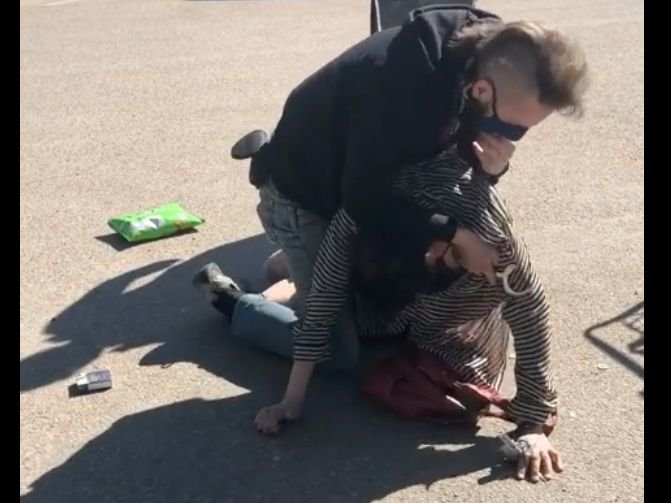
Bystander Jade Acikahte recorded a nine-minute video showing the altercation that ensued between Custer and Cameron McMillan, a loss prevention officer working for a company contracted by the store.

Acikahte told the StarPhoenix she began filming after McMillan threw Custer to the ground  “with her arms still behind her back so she couldn’t brace herself for the fall.”

The video shows Custer at one point breaking free of McMillan’s effort to restrain her on the ground, then punching him in the face. From there, the melee moved to Custer’s vehicle, with McMillan throwing himself on top of Custer in the driver’s seat.

Although Custer was the only one to be criminally charged, the video drew condemnation for the level of violence McMillan used in his efforts to apprehend her.

FreshCo store owner Chris Fowler posted to social media the day after the incident, stating he was “beyond shocked” at the events depicted in the video and announcing that he’d ended his contract with the company McMillan was working for.

Saskatoon Mayor Charlie Clark issued a statement in the days following the incident saying the video highlighted the discrimination, profiling and violence experienced by Indigenous, Black and people of colour at retail stores and more broadly.

Advertisement 3
Story continues below

Article content

Clark called for work to address racial profiling and the “hard truths of the impacts of a colonial relationship.”

The Federation of Sovereign Indigenous Nations called for McMillan to be charged in the days after the incident and demanded the federal and provincial governments commit to funding an anti-racism initiative and mandating courses on Indigenous history in schools.

FSIN Chief Bobby Cameron at the time called the force used to detain Custer an example of how First Nations women are “disproportionately targeted and victimized.”

A lawyer for Custer had applied earlier in the proceedings to have her case stayed on the grounds that her Charter rights were violated.

Custer is to be sentenced at a hearing scheduled for Sept. 25.

Recommended from Editorial

  1. Evan Penner's lawyer Eleanore Sunchild speaks about the incident captured on video July 4 during a media conference outside the FSIN office. Photo taken in Saskatoon, SK on Thursday, July 9, 2src2src.

    ‘Video itself says more than enough,’ says Evan Penner’s lawyer after police describe incident to board

  2. Sherri Penner (left) speaks alongside FSIN Chief Bobby Cameron about the incident captured on video July 4 of her son Evan Penner being punched and tasered during his arrest by Saskatoon police officers during a media conference outside the FSIN office. Photo taken in Saskatoon, SK on Thursday, July 9, 2src2src.

    Man shown in violent arrest video tried to disarm officer: Police chief

The Saskatoon StarPhoenix has created an Afternoon Headlines newsletter that can be delivered daily to your inbox to help make sure you are up to date with the most vital news of the day. Click here to subscribe.

Article content

Comments

Postmedia is committed to maintaining a lively but civil forum for discussion and encourage all readers to share their views on our articles. Comments may take up to an hour for moderation before appearing on the site. We ask you to keep your comments relevant and respectful. We have enabled email notifications—you will now receive an email if you receive a reply to your comment, there is an update to a comment thread you follow or if a user you follow comments. Visit our Community Guidelines for more information and details on how to adjust your email settings.

SHARE YOUR THOUGHTS

To contribute to the conversation, you need to be logged in. If you are not yet registered, create your account now – it’s FREE.

Login/Create an Account Subscribe for Unlimited Online Access

Join the Conversation

Latest National Stories

    Advertisement 1
    Story continues below

    This Week in Flyers

    Article content

    A woman whose violent confrontation with a security guard drew widespread reaction in Saskatoon has been convicted of theft under $5,000 and assault.

    Annette Custer was charged in April 2021. Court heard during her trial that she put a beef roast in her bag while in the FreshCo grocery store at 33rd Street and Avenue C North, then purchased some other items and exited the store without paying for the roast.

    Advertisement 2
    Story continues below

    Article content

    Article content

    Bystander Jade Acikahte recorded a nine-minute video showing the altercation that ensued between Custer and Cameron McMillan, a loss prevention officer working for a company contracted by the store.

    Acikahte told the StarPhoenix she began filming after McMillan threw Custer to the ground  “with her arms still behind her back so she couldn’t brace herself for the fall.”

    The video shows Custer at one point breaking free of McMillan’s effort to restrain her on the ground, then punching him in the face. From there, the melee moved to Custer’s vehicle, with McMillan throwing himself on top of Custer in the driver’s seat.

    Although Custer was the only one to be criminally charged, the video drew condemnation for the level of violence McMillan used in his efforts to apprehend her.

    FreshCo store owner Chris Fowler posted to social media the day after the incident, stating he was “beyond shocked” at the events depicted in the video and announcing that he’d ended his contract with the company McMillan was working for.

    Saskatoon Mayor Charlie Clark issued a statement in the days following the incident saying the video highlighted the discrimination, profiling and violence experienced by Indigenous, Black and people of colour at retail stores and more broadly.

    Advertisement 3
    Story continues below

    Article content

    Clark called for work to address racial profiling and the “hard truths of the impacts of a colonial relationship.”

    The Federation of Sovereign Indigenous Nations called for McMillan to be charged in the days after the incident and demanded the federal and provincial governments commit to funding an anti-racism initiative and mandating courses on Indigenous history in schools.

    FSIN Chief Bobby Cameron at the time called the force used to detain Custer an example of how First Nations women are “disproportionately targeted and victimized.”

    A lawyer for Custer had applied earlier in the proceedings to have her case stayed on the grounds that her Charter rights were violated.

    Custer is to be sentenced at a hearing scheduled for Sept. 25.

    Recommended from Editorial

    1. Evan Penner's lawyer Eleanore Sunchild speaks about the incident captured on video July 4 during a media conference outside the FSIN office. Photo taken in Saskatoon, SK on Thursday, July 9, 2src2src.

      ‘Video itself says more than enough,’ says Evan Penner’s lawyer after police describe incident to board

    2. Sherri Penner (left) speaks alongside FSIN Chief Bobby Cameron about the incident captured on video July 4 of her son Evan Penner being punched and tasered during his arrest by Saskatoon police officers during a media conference outside the FSIN office. Photo taken in Saskatoon, SK on Thursday, July 9, 2src2src.

      Man shown in violent arrest video tried to disarm officer: Police chief

    The Saskatoon StarPhoenix has created an Afternoon Headlines newsletter that can be delivered daily to your inbox to help make sure you are up to date with the most vital news of the day. Click here to subscribe.

    The Saskatoon StarPhoenix has created an Afternoon Headlines newsletter that can be delivered daily to your inbox to help make sure you are up to date with the most vital news of the day. Click here to subscribe.

    Article content

    Comments

    Postmedia is committed to maintaining a lively but civil forum for discussion and encourage all readers to share their views on our articles. Comments may take up to an hour for moderation before appearing on the site. We ask you to keep your comments relevant and respectful. We have enabled email notifications—you will now receive an email if you receive a reply to your comment, there is an update to a comment thread you follow or if a user you follow comments. Visit our Community Guidelines for more information and details on how to adjust your email settings.

    SHARE YOUR THOUGHTS

    To contribute to the conversation, you need to be logged in. If you are not yet registered, create your account now – it’s FREE.

    Login/Create an Account Subscribe for Unlimited Online Access

    Join the Conversation

    Latest National Stories

      Advertisement 1
      Story continues below

      This Week in Flyers

      Read More

      Be the first to write a comment.

      Leave a Reply

      Your email address will not be published. Required fields are marked *

      Internet Security

      COLDCARD SECURITY RISK: IMMEDIATE ACTION REQUIRED

      Bitcoin Magazine COLDCARD SECURITY RISK: IMMEDIATE ACTION REQUIRED IMPORTANT: Major security vulnerability discovered in Coldcard hardware wallets. For your own safety read disclosures and take necessary actions immediately. This post COLDCARD SECURITY RISK: IMMEDIATE ACTION REQUIRED first appeared on Bitcoin Magazine and is written by Shinobi…

      Bitcoin Magazine

      COLDCARD SECURITY RISK: IMMEDIATE ACTION REQUIRED
      IMPORTANT: Major security vulnerability discovered in Coldcard hardware wallets. For your own safety read disclosures and take necessary actions immediately.
      This post COLDCARD SECURITY RISK: IMMEDIATE ACTION REQUIRED first appeared on Bitcoin Magazine and is written by Shinobi…
      Read More

      Continue Reading
      Internet Security

      Coldcard Security Notice Puts Bitcoin Wallet Entropy Risk Back In Focus

      A Coldcard security issue has put Bitcoin hardware-wallet safety back under the microscope after reports that a firmware flaw affected seed generation…

      A Coldcard security issue has put Bitcoin hardware-wallet safety back under the microscope after reports that a firmware flaw affected seed generation…
      Read More

      Continue Reading
      Internet Security

      How a national security threat label has reignited Indonesia’s LGBTQ debate

      Advertisement Asia How a national security threat label has reignited Indonesia’s LGBTQ debate Indonesia last October classified the “spread of LGBTQ culture” as one of the country’s non-military threats. A series of developments thrust the provision into the public eye this month, sparking a debate.   A street vendor walks past a banner reading ‘Indonesia

      Advertisement

      Asia

      How a national security threat label has reignited Indonesia’s LGBTQ debate

      Indonesia last October classified the “spread of LGBTQ culture” as one of the country’s non-military threats. A series of developments thrust the provision into the public eye this month, sparking a debate.


      How a national security threat label has reignited Indonesia's LGBTQ debate

      A street vendor walks past a banner reading ‘Indonesia LGBT Emergency’ in front a mosque in Jakarta, Indonesia, January 25, 2018. (REUTERS/Beawiharta)


      New: You can now listen to articles.


      This audio is generated by an AI tool.

      Ericssen

      Ericssen

      Ericssen

      21 Jul 2026 06:00AM
      (Updated: 21 Jul 2026 10:59AM)


      Bookmark


      Bookmark


      Share

      SINGAPORE: For more than eight months, a provision tucked away in an Indonesian presidential regulation on national defence drew little public attention.

      In an appendix to Presidential Regulation No. 111/2025 on the General National Defence Policy signed in October last year, the government classified the “spread of LGBTQ culture” as one of the country’s non-military threats. 

      The clause, referring to lesbian, gay, bisexual, transsexual and queer culture, appeared alongside a range of other threats deemed capable of affecting national resilience. They included illegal trafficking, natural resource theft, terrorism, atheism and radicalism.

      A presidential regulation is a legally binding regulation published in the State Gazette, while General National Defence Policy documents are highly technical and usually attract little public attention outside government and defence circles.

      But a series of developments thrust the provision into the public eye this month, sparking a debate on the place of LGBTQ issues in state policy and the extent to which social issues should be framed within Indonesia’s defence strategy.

      The issue quickly spread beyond social media into mainstream Indonesian media with national outlets including Antara, Kumparan, and Tempo examining the regulation and prompting public responses from senior government officials.

      Some observers and activists say the clause could heighten discrimination against LGBTQ individuals in society, even as Indonesian ministers have defended the regulation while saying the government has no intention of curtailing the fundamental rights of citizens.

      “As Indonesian citizens, LGBTQ people are entitled to education, employment, healthcare and other public services without restrictions, segregation or discrimination,” Indonesia’s Human Rights Minister Natalius Pigai told CNA in a phone interview.

      CNA Games
      Guess Word
      Guess Word
      Crack the word, one row at a time

      Buzzword
      Buzzword
      Create words using the given letters

      Mini Sudoku
      Mini Sudoku
      Tiny puzzle, mighty brain teaser

      Mini Crossword
      Mini Crossword
      Small grid, big challenge

      Word Search
      Word Search
      Spot as many words as you can

      Show More

      Show Less

      Indonesia’s Human Rights Minister Natalius Pigai. (Photo courtesy of Human Rights Ministry)

      But he added that Indonesian society is not ready to accept the LGBTQ community, even as the state remains obliged to respect, protect and fulfil every citizen’s rights to education, employment, healthcare and public services.

      “The time has not yet come to formally recognise them as an official group because society is not yet ready to accept them,” he said.

      HOW THE CLAUSE CAME TO PUBLIC ATTENTION

      While it remains unclear what first drew widespread attention to the provision, it resurfaced amid a series of developments involving LGBTQ issues. One was a Pride Month-themed social media post in mid-June by Suara Mahasiswa, a student publication at the University of Indonesia.

      The post had led to a heated online debate, with critics arguing it was inconsistent with Indonesia’s religious and social norms. They questioned why it invoked the Pancasila national ideology to defend the LGBTQ community. Pancasila comprises five principles: Belief in one God, civilised humanity, national unity, democracy and social justice.

      The backlash prompted the university to publicly distance itself from the post and launch an internal review.

      Then in late June, the Indonesian Ulema Council (MUI) said it was preparing an academic paper and a draft bill to criminalise LGBTQ-related conduct for Parliament’s National Legislation Programme.

      MUI deputy chairman Muhammad Cholil Nafis argued that moral appeals alone were no longer sufficient to curb what he described as the growing activities and campaign surrounding LGBTQ culture.

      “If there are no legal penalties at all, it eventually becomes normal. We should not normalise it. Punishment helps people understand that it is not normal,” he said.

      “Deviant activities, such as same-sex parties, are now increasingly being displayed openly in public without any sense of shame,” he added.

      Scrutiny then shifted to the new regulation that had previously gone largely unnoticed.

      The belated attention came as no surprise to Agus Wahyudi, head of the Inter-Religious Studies Programme at Gadjah Mada University (UGM) in Yogyakarta.

      Documents such as the General National Defence Policy typically circulate within government bureaucracy and rarely become the subject of public debate, he said.

      But a provision can take on political significance when a series of events – in this case, the Pride Month-themed social media post and the MUI’s planned bill – draws the public’s notice, said Agus.

      “What changed was not necessarily the policy itself, but the public attention it attracted,” Agus said.

      WHY WAS IT PLACED IN A NATIONAL DEFENCE DOCUMENT?

      Asked whether the presidential regulation represented the first national policy to explicitly mention LGBTQ, human rights lawyer Asfinawati said Indonesia’s 2008 Pornography Law referred to “lesbian” and “homosexual” acts in its explanatory notes to a provision banning the production, distribution and sale of pornographic material.

      It defined what the law described as “deviant sexual intercourse” for the purposes of pornography offences, rather than creating a standalone offence based on sexual orientation or gender identity.

      Presidential Regulation No. 111/2025 goes further by classifying the “spread of LGBTQ culture” itself as a non-military threat, argued Asfinawati, the former chair of the Indonesian Legal Aid Foundation.

      “This regulation no longer links it to sexual conduct. Simply having a particular sexual orientation or gender identity is placed within a threat framework,” she said.

      Experts have questioned whether a national defence framework was an appropriate instrument for addressing issues such as sexual orientation and gender identity.

      In principle, national defence should focus on military threats, said Tangguh Chairil, a lecturer in security studies at the Department of International Relations at Binus University, Jakarta.

      Indonesia, however, classifies threats into three categories: Military, non-military and hybrid. As a result, issues beyond the traditional defence sphere are increasingly viewed as national security issues.

      “Because the definition is so broad, almost anything can be treated as a national security threat,” Tangguh told CNA.

      Classifying LGBTQ culture as a non-military threat under a defence framework means the issue may be treated as a security concern requiring state attention and resources, he added.

      “Issues that have been successfully securitised tend to receive greater attention than others,” he said.

      Yusril Ihza Mahendra, Coordinating Minister for Legal Affairs, Human Rights, Immigration, and Corrections, told news outlet Tempo on Jul 9 that “non-military threat” was used to categorise risks against national resilience.

      In the socio-cultural context, “resilience” refers to values, ethics, character of the younger generation, families, digital space, and social cohesion, he said.

      “What the government perceives as a threat is the campaign, propaganda, and dissemination of LGBT behaviour aimed at altering the values that align with the nation’s culture and morality,” he added.

      Indonesia’s Chief Minister for Law and Human Rights, Yusril Ihza Mahendra, speaks as Australia’s Minister for Home Affairs, Tony Burke, listens during a press conference following their meeting in Jakarta, Indonesia, December 3, 2024. (REUTERS/Willy Kurniawan)

      Asfinawati said the regulation cannot serve as the legal basis for introducing new criminal provisions or for regional governments to impose criminal sanctions unless authorised by law.

      Under Indonesian law, a person’s sexual orientation as well as consensual same-sex relations between adults are not, by themselves, criminal offences. The exception is Aceh province, which implements Islamic crimina

      Read More

      Continue Reading
      Internet Security

      Nigeria: UNICEF chief urges child protection amid security, humanitarian crises

      Violence in Nigeria The head of the U.N. children’s agency visited northwestern Nigeria on Friday as conflict, poverty and rising food insecurity leave millions of children in the region in need of aid. Catherine Russell, executive director of UNICEF, toured the state of Sokoto, where the agency is seeking to draw attention to worsening humanitarian

      Violence in Nigeria

      The head of the U.N. children’s agency visited northwestern Nigeria on Friday as conflict, poverty and rising food insecurity leave millions of children in the region in need of aid.

      Catherine Russell, executive director of UNICEF, toured the state of Sokoto, where the agency is seeking to draw attention to worsening humanitarian challenges facing children.

      She met with state officials and visited UNICEF-supported programs aimed at improving the health of both mothers and children and protecting vulnerable youngsters.

      “We have to make sure that children are protected in these conflicts,” she said.

      “That their healthcare is protected, that their food is protected, that their education is protected. Children can’t waste years of their life because conflicts are going on.”

      Northern Nigeria is already gripped by an intensifying security crisis that has killed thousands.

      The ongoing Middle East conflict has deepened food insecurity for millions living in poverty, making children in poor households more vulnerable.

      According to UNICEF between 18.3 million and 23.4 million more children in monetarily poor households worldwide have fallen into deeper poverty, including 6.5 million to 8.8 million in Africa.

      Nigeria has one of the world’s largest populations of impoverished children, and humanitarian organizations warn that those in the country’s conflict-torn north remain among the most vulnerable.

      For some, UNICEF-supported programs have made a tangible difference.

      Zainab Bello, 19, said she had been out of school before joining the agency’s “Digital Village” program.

      “I was taught digital literacy… how to use a digital tool,” she said.

      “I also learned how I can promote my vocational skills on various social media platforms.”

      The head of the U.N. children’s agency visited northwestern Nigeria on Friday as conflict, poverty and rising food insecurity leave millions of children in the region in need of aid.

      Catherine Russell, executive director of UNICEF, toured the state of Sokoto, where the agency is seeking to draw attention to worsening humanitarian challenges facing children.

      She met with state officials and visited UNICEF-supported programs aimed at improving the health of both mothers and children and protecting vulnerable youngsters.

      “We have to make sure that children are protected in these conflicts,” she said.

      “That their healthcare is protected, that their food is protected, that their education is protected. Children can’t waste years of their life because conflicts are going on.”

      Northern Nigeria is already gripped by an intensifying security crisis that has killed thousands.

      The ongoing Middle East conflict has deepened food insecurity for millions living in poverty, making children in poor households more vulnerable.

      According to UNICEF between 18.3 million and 23.4 million more children in monetarily poor households worldwide have fallen into deeper poverty, including 6.5 million to 8.8 million in Africa.

      Nigeria has one of the world’s largest populations of impoverished children, and humanitarian organizations warn that those in the country’s conflict-torn north remain among the most vulnerable.

      For some, UNICEF-supported programs have made a tangible difference.

      Zainab Bello, 19, said she had been out of school before joining the agency’s “Digital Village” program.

      “I was taught digital literacy… how to use a digital tool,” she said.

      “I also learned how I can promote my vocational skills on various social media platforms.”

      Read More

      Continue Reading