China Cracks Down on ‘Chaotic’ Celebrity Fan Culture After Scandals
(Reuters) China cracked down on what it described as a “chaotic” celebrity fan culture on Friday, barring platforms from publishing popularity lists and regulating the sale of fan merchandise after a series of controversies involving artists.The country’s top internet watchdog said it would take action against the dissemination of “harmful information” in celebrity fan groups…
(Reuters) China cracked down on what it described as a “chaotic” celebrity fan culture on Friday, barring platforms from publishing popularity lists and regulating the sale of fan merchandise after a series of controversies involving artists.The country’s top internet watchdog said it would take action against the dissemination of “harmful information” in celebrity fan groups and close down discussion channels that spread celebrity scandals or “provoke trouble”.Platforms will no longer be able to publish lists of popular celebrity individuals and fan groups must be regulated, the watchdog said.The internet regulator is also barring variety shows from charging fans to vote online for their favorite acts and has spoken out against enticing netizens to buy celebrity merchandise.Regulators need to “increase their sense of responsibility, mission and urgency to maintain online political and ideological security,” the Cyberspace Administration of China (CAC) said in a statement.China has stringent rules on content ranging from video games to movies to music, and censors anything it believes violates core socialist values. The crackdown on celebrity fan culture also comes amid a wider regulatory campaign against the country’s Internet giants.CELEBRITY MISBEHAVIOROnline celebrity fan clubs have become a widespread phenomenon in China with local newspaper The Paper projecting the country’s “idol economy” could be worth 140 billion yuan ($21.59 billion) by 2022.But they have also been criticized for their influence over minors and for causing social disorder, as competing fan clubs have been seen trading verbal abuse online or spending large amounts of money to vote for their favorite stars on idol competition programs.When Canadian-Chinese pop star Kris Wu was detained by Beijing police last month on suspicion of sexual assault, his fan groups come to his defense on social media. Most of these fan accounts, along with Wu’s online accounts, were later shut down.China’s Netflix equivalent, iQiyi, also drew fire earlier this year after fans of one of its talent shows were filmed wasting milk in their bid to qualify to vote. On Thursday iQiyi said it would no longer broadcast idol competition shows.Chinese authorities have also been targeting domestic celebrities after a number of controversies.In January, actor Zheng Shuang became engulfed in a surrogacy controversy and she was later probed by tax authorities. On Friday, Shanghai tax authorities said they had decided to fine her 299 million yuan for tax evasion.Separately, Chinese video platforms on Friday took down films starred or directed by Zhao Wei, one of China’s biggest stars, citing “relevant laws and regulations” which prompted widespread online speculation over the reason. Her name was also removed from online casting lists.Chinese celebrities have been subjected to such treatment in the past when they have fallen foul of the authorities or public sentiment. Zhao’s management agency, Pulin Saisi, told Reuters it had no knowledge of the situation.$1=6.4849 Chinese yuanSource: Reuters; Reporting by David Stanway and Brenda Goh; Aditional reporting by Sophie Yu; Editing by Gerry Doyle, Ana Nicolaci da Costa and Tomasz Janowski Aug. 26, 2021, at 10:42 p.m. Read More
Nexo says 67% of affluent investors own crypto, but integration stays low. Security, fees and platform complexity emerge as key barriers to adoption. US investors show deepest crypto integration despite lower ownership rates. High-net-worth investors are increasingly buying crypto, but many are still reluctant to make it a major part of their long-term wealth plans
Published
4 days ago
in
By
Nexo says 67% of affluent investors own crypto, but integration stays low.
Security, fees and platform complexity emerge as key barriers to adoption.
US investors show deepest crypto integration despite lower ownership rates.
High-net-worth investors are increasingly buying crypto, but many are still reluctant to make it a major part of their long-term wealth plans, according to a new Nexo survey.
The report found that 67% of affluent investors across the US, UK and Argentina already own crypto. However, security concerns, high fees and complicated platforms are stopping many from using digital assets for retirement planning or replacing traditional investments.
Nexo published its “Future of Digital Wealth 2026” report on September 23 after surveying 1,000 affluent investors. Its new Crypto Integration Index, which measures how deeply crypto is incorporated into investors’ finances, produced an average score of 4.83 out of 10.
Ownership outpaces deeper integration
Nexo said a score near the survey average of 4.83 represents a small, short-horizon crypto position outside retirement planning.
Only 4.7% of surveyed investors scored seven or higher, a level Nexo describes as structurally integrated, where crypto has replaced a traditional asset and forms part of longer-term financial planning.
The report found that just under 20% of respondents expect crypto to become their number-one personal wealth driver over the next decade, ahead of salary, equities and real estate.
More than 40% are already invested in crypto without yet building wealth with it.
“Once an investor gets past the risk perception stage, what’s left is security, fees, and platform user-friendliness and capabilities – the same things we’ve spent years building Nexo to solve,” said Neil Steinhardt, COO, Nexo US.
That’s the gap between owning crypto and actually building wealth with it, and it’s exactly where our platform is designed to meet investors.
Integration also varies by market. Argentina had the highest ownership rate at 74%, but a CII score of 4.62. The US had the lowest ownership at 62%, but the deepest integration with a score of 5.07.
The UK recorded 65% ownership and a CII score of 4.75.
Platform trust becomes the next hurdle
The report said crypto integration peaks among investors aged 35 to 44, with 28% treating digital assets as a core retirement asset.
Investors aged 18 to 25 reported the highest ownership and conviction, with more than 90% holding crypto, but only 2% maintaining a horizon of 10 years or longer.
close Video Israeli Ambassador to the United Nations Danny Danon condemns the UN for allegedly including Israel in sexual violence blacklist Danny Danon, the Israeli Ambassador to the United Nations (UN), blasts the UN for what he claims is their decision to include Israel in a sexual violence blacklist that also includes Hamas. NEWYou can
Published
6 days ago
in
By
close
Video
Israeli Ambassador to the United Nations Danny Danon condemns the UN for allegedly including Israel in sexual violence blacklist
Danny Danon, the Israeli Ambassador to the United Nations (UN), blasts the UN for what he claims is their decision to include Israel in a sexual violence blacklist that also includes Hamas.
NEWYou can now listen to Fox News articles!
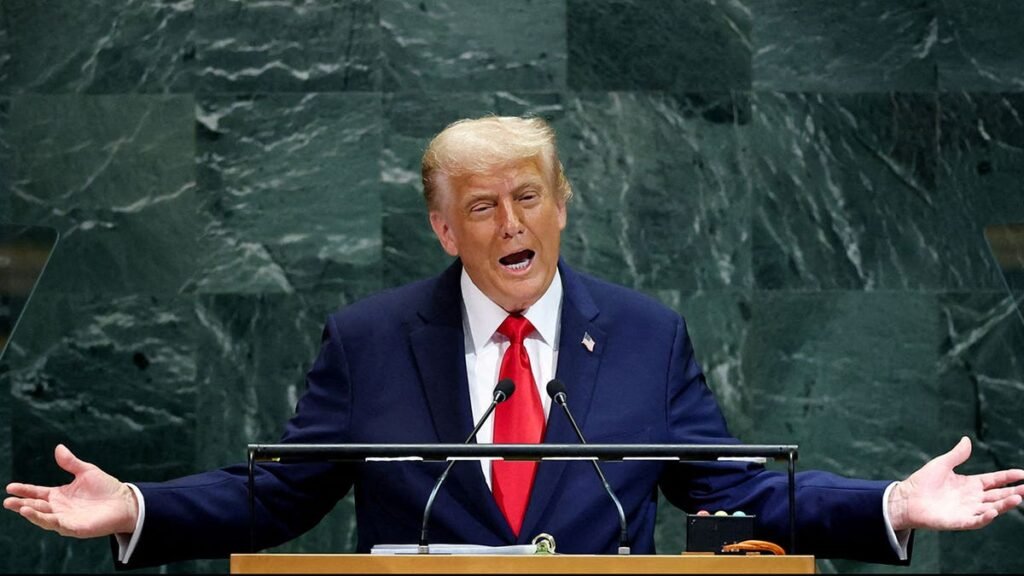
Today, President Trump will address the U.N. General Assembly. As New Yorkers fume over traffic nightmares created by the president and by hordes of visiting diplomats, they may (again) question, as do many Americans, why U.S. taxpayers support this badly managed and scandal-scarred institution. Especially when the U.N. so frequently works against our interests and seems incapable of accomplishing its primary mission.
A new Gallup poll shows that 73% of Americans think the U.N. does a poor job of “maintaining international peace and security,” and 70% say the same about the U.N. “upholding international law” and “protecting human rights.” That’s a lousy report card for an organization that spends roughly $70 billion per year.
Elsewhere in the world, the U.N. scores better, which is not surprising since poor countries, which constitute the majority of members, look to wealthier nations for handouts via the U.N. The nations of Sub-Saharan Africa, for instance, are especially keen on the sprawling organization.
How does that wealth transfer happen? One way was described by President Trump’s U.N. Ambassador Mike Waltz in recent testimony before Congress: “The U.N. let countries use peacekeeping missions as cash cows for their militaries. Peacekeepers could bring equipment, park it, never use it, take it home brand new, and get it paid for by the U.N.” Those operations can employ “10,000 to 18,000 soldiers”; the costs, Waltz says, are “quite significant.” He is ending that practice — just one step in reforming the bloated U.N., whose budget has quadrupled over the past 25 years.
Americans have reason for skepticism, given the frequent votes that go against the U.S. or our ally Israel. For thirty-three years in a row, the General Assembly has voted to end our embargo on Cuba, and for decades it has opposed Israel’s attempts to protects its citizens from Palestinian terrorists. Waltz calls the body a “cesspool of antisemitism.”
WALTZ SLAMS FRANCE AFTER STUNNING SOCIAL MEDIA ATTACK ON US AFTER UN VOTE
Not only is the U.N. frequently hostile to the U.S., it is often ridiculous. Most recently, the U.N. voted overwhelmingly to adopt a new map which blows up Africa’s presence on the globe; the U.S. was the sole dissenter. In a memo explaining our outlier vote, Deputy U.S. Representative Yaryna Ferencevych called such resolutions “barnacles on our work here” and wrote: “Instead of focusing on genuine problems of international peace… this body is debating map projects from the 16th century, and their role in promoting reparations and “cognitive justice.”
The U.N. rarely has much real-world impact. Critics might question, for instance, what the U.N. has done to resolve the Russia-Ukraine War, or how it has helped keep the world’s oil flowing through the Strait of Hormuz. The answer in both cases is zero.
Instead, the U.N. is hyper-focused on climate change, gender equality and other issues that may scratch a globalist itch, but appear little related to the cause of peace.
Video
Meanwhile, the U.N. is going broke. Last year the Economist reported: “On May 5th the U.N. will brief members on a previously unreported $600m (17%) cut to its $3.7bn [administrative] budget aimed at avoiding default this year. It will include a hiring freeze… Yet it may not be enough. A combination of deadbeat members and mad budget rules have led to a liquidity crisis.”
TRUMP BRINGS NEW HEAT TO CONTROVERSIAL UN AGENCY AS ALLEGED HAMAS TIES ENGULF SCORES OF EMPLOYEES
The article goes on to warn that a “leaked memo” suggesting that the Trump administration might cut off funding to the U.N. threatened “a financial crash in the citadel of peace and security.”
The Trump White House has not bankrupted the U.N. by withholding payments. Instead, it appointed Waltz to drive much-needed reforms and who is, according to Politico, “generally well-regarded, including among many Democrats on Capitol Hill.” That’s rare praise for a Trump appointee.
TRUMP ADMINISTRATION PROBES UNRWA OVER ALLEGED EMPLOYMENT OF 1,500 TERRORISTS
Waltz is working to downsize the bloated U.N., focusing on its staff of 100,000 — individuals who are paid roughly 17% more than equivalent U.S. civil servants, according to Waltz. According to testimony he gave to Congress a few months ago, Waltz’s team pushed through a “historic 15% cut $570 million out of the U.N.’s regular budget. That will eliminate nearly 3000 headquarters positions.” That change alone provided a savings for U.S. taxpayers of $126 million. Waltz recently told Fox Digital that budget cuts now total $1 billion.
Waltz is also overhauling U.N. peacekeeping operations, some of which, as he has said, have been around for “30, 50 or even 80 years.” Waltz argues such forces are important to provide breathing room for political settlement of a conflict, but it “can’t then become an excuse to not have a political resolution. When you have a peacekeeping force, for example, in DRC and Congo, at the cost of a billion dollars a year, that’s been there for 30 years,” it should end.
Video
Waltz is just getting started; reforming an institution so large and complex takes time, which he may not have. Soon, the U.N. will elect a new secretary-general to succeed Portugal’s António Guterres, who has served since 2017. Currently, most of the candidates who have stepped forward appear eager to embrace the reforms advocated by the White House, alarmed that President Trump is ready to eviscerate the U.N.’s funding if changes are not made and a U.S.-friendly official not elected.
CLICK HERE FOR MORE FOX NEWS OPINION
Finances are not Trump’s only weapon. As Politico reported, when the White House announced the creation of the Board of Peace last year to oversee the Israel-Gaza conflict, “U.N. officials and diplomats were really, really unnerved,” seeing that Board as some sort of “rival peacemaking institute.”
TRUMP-BACKED BOARD OF PEACE, ISRAEL ‘WILL TAKE ACTION’ IF HAMAS REMAINS OUT OF COMPLIANCE: NETANYAHU ADVISOR
However, permanent members of the Security Council, which include Russia, China, France, the U.K. and the U.S., can veto candidates. That is making the race unpredictable. If the members cannot agree, they could extend Gutterres’ term by another year, which would likely mean that President Trump would have less say in the outcome.
CLICK HERE TO DOWNLOAD THE FOX NEWS APP
That could trash the White House’s push to Make the U.N. Great Again and would be disastrous for the U.N.
CLICK HERE TO READ MORE FROM LIZ PEEK
Liz Peek is a Fox News contributor and former partner of major bracket Wall Street firm Wertheim & Company. A former columnist for the Fiscal Times, she writes for The Hill and contributes frequently to Fox News, the New York Sun and other publications. For more visit LizPeek.com. Follow her on Twitter @LizPeek.
Best of Opinion
Get the recap of top opinion commentary and original content throughout the week.
Arrives Twice a week
By entering your email and clicking the Subscribe button, you agree to the Fox News
Privacy Policy
and
Terms of Use
, and
agree to receive content and promotional communications from Fox News. You understand that you can
opt-out at any time.
Subscribed
You’ve successfully subscribed to this newsletter!
close
Video
Israeli Ambassador to the United Nations Danny Danon condemns the UN for allegedly including Israel in sexual violence blacklist
Danny Danon, the Israeli Ambassador to the United Nations (UN), blasts the UN for what he claims is their decision to include Israel in a sexual violence blacklist that also includes Hamas.
NEWYou can now listen to Fox News articles!
Today, President Trump will address the U.N. General Assembly. As New Yorkers fume over traffic nightmares created by the president and by hordes of visiting diplomats, they may (again) question, as do many Americans, why U.S. taxpayers support this badly managed and scandal-scarred institution. Especially when the U.N. so frequently works against our interests and seems incapable of accomplishing its primary mission.
A new Gallup poll shows that 73% of Americans think the U.N. does a poor job of “maintaining international peace and security,” and 70% say the same about the U.N. “upholding international law” and “protecting human rights.” That’s a lousy report card for an organization that spends roughly $70 billion per year.
Elsewhere in the world, the U.N. scores better, which is not surprising since poor countries, which constitute the majority of members, look to wealthier nations for handouts via the U.N. The nations of Sub-Saharan Africa, for instance, are especially keen on the sprawling organization.
How does that wealth transfer happen? One way was described by President Trump’s U.N. Ambassador Mike Waltz in recent testimony before Congress: “The U.N. let countries use peacekeeping missions as cash cows for their militaries. Peacekeepers could bring equipment, park it, never use it, take it home brand new, and get it paid for by the U.N.” Those operations can employ “10,000 to 18,000 soldiers”; the costs, Waltz says, are “quite significant.” He is ending that practice — just one step in reformin
!—->!—->!—->!—->!—->!—->!—->!—->!—->!—->!—->!—->!—->!—->!—->!—-> Read More
A coalition of civil society organisations led by Stand Up Nigeria (SUN) has appealed to Nigerians to remain calm and avoid spreading unverified information on social media over the deaths of 37 suspected illegal miners in the custody of the Nigeria Security and Civil Defence Corps (NSCDC) in Niger State…
Published
1 week ago
in
By
A coalition of civil society organisations led by Stand Up Nigeria (SUN) has appealed to Nigerians to remain calm and avoid spreading unverified information on social media over the deaths of 37 suspected illegal miners in the custody of the Nigeria Security and Civil Defence Corps (NSCDC) in Niger State… Read More
Advertisement Singapore Artistes can express humanitarian concerns, but not undermine public order and security: Tan Kiat How Senior Minister of State Tan Kiat How cited several performances dealing with social and humanitarian issues that had been allowed to proceed in Singapore. Robert Del Naja and Grant Marshall from Massive Attack stand with a Palestinian flag
Published
3 weeks ago
in
By
Advertisement
Singapore
Artistes can express humanitarian concerns, but not undermine public order and security: Tan Kiat How
Senior Minister of State Tan Kiat How cited several performances dealing with social and humanitarian issues that had been allowed to proceed in Singapore.
Robert Del Naja and Grant Marshall from Massive Attack stand with a Palestinian flag onstage at the end of their performance in Singapore, July 29, 2026, in this screengrab from video obtained from social media. Simran Panaech/via REUTERS
Add CNA as a trusted source to help Google better understand and surface our content in search results.
Read a summary of this article on FAST.
Get bite-sized news via a new cards interface. Give it a try.
Click here to return to FAST Tap here to return to FAST
FAST
SINGAPORE: Artistes can express humanitarian concerns about international conflicts, but such expression should not undermine public order, security or stability in Singapore, Senior Minister of State for Digital Development and Information Tan Kiat How said on Thursday (Sep 10).
“Singapore should not be used by foreigners as a platform to further political causes, including those relating to conflicts or political issues overseas,” he said.
Artistes, whether Singaporean or foreign, are expected to abide by Singapore’s laws and the conditions of the arts entertainment licence when performing here, he added.
Mr Tan was responding in parliament to MP Hazlina Abdul Halim (PAP-East Coast), who asked how authorities distinguish prohibited political advocacy from expressions of humanitarian concern.
CNA Games
Guess Word
Crack the word, one row at a time
Buzzword
Create words using the given letters
Mini Sudoku
Tiny puzzle, mighty brain teaser
Mini Crossword
Small grid, big challenge
Word Search
Spot as many words as you can
Show More
Show Less
She also asked how an artiste’s intent and the context of an expression are taken into account, and whether licensing conditions would be reviewed to exclude peaceful expressions of support for humanitarian causes.
Mr Tan said that besides an artiste’s intention, the Infocomm Media Development Authority (IMDA) considers the likely impact of a performance when assessing whether it meets licensing conditions.
Under IMDA’s Arts Entertainment Classification Code, content should not undermine public order, national security or stability.
The code, which sets out the framework for assessing and classifying live or public arts entertainment, also states that content should be “sensitive to the concerns of different racial or religious groups and the prevailing community expectations of what is necessary to safeguard racial harmony and religious harmony”.
In July, members of British band Massive Attack were issued stern warnings and barred from re-entering Singapore after flying a Palestinian flag during a concert, with one of the members shouting “Free Palestine”.
06:31 Min
The government recognises the humanitarian impact of international conflicts and that artistes may wish to express concern for those affected. Such expressions are not prohibited but should not undermine public order, national security or stability in Singapore. This condition is made clear in the Arts Entertainment Classification Code issued by the Infocomm Media Development Authority. Senior Minister of State for Digital Development and Information Tan Kiat How highlighted this approach in reply to an MP’s questions in parliament on Thursday (Sep 10). He stressed that Singapore should not be used by foreigners as a platform to further political causes, including those relating to conflicts or political issues overseas.
Ms Hazlina asked Mr Tan for examples of performances involving social causes that had been allowed to take place.
He cited To The Unforgotten, an event held in May this year that featured a song, poem and multimedia artwork about the Israel-Gaza conflict. It was classified R18.
Another example was 6 Microlectures on Genocides. Also classified R18, the play comprised short works that explore themes of genocide, war crimes and contemporary conflicts, Mr Tan said.
He also pointed to the 2024 stand-up comedy show Namaste, which was classified Advisory 16 and included a segment in which comedians spoke about the Israel-Gaza conflict.
“So having material and content on causes itself is not prohibited, and the licensing framework is designed to, of course, protect young people from unwanted content, but also allow people to make decisions on what they can watch,” said Mr Tan.
“But at the same time, having some boundaries on the kind of content that may stir up public disorder or national security considerations.”
Mr Tan said assessments were “very contextual” and encouraged applicants for Arts Entertainment Licences to engage IMDA early.
“The earlier the applicants engage IMDA, the earlier conversations can start, and earlier we can give clarity and guidance on the kind of content that may be approved and