Ed Fries interview — From building games for the original Xbox to investing in gaming startups

Join gaming leaders, alongside GamesBeat and Facebook Gaming, for their 2nd Annual GamesBeat & Facebook Gaming Summit | GamesBeat: Into the Metaverse 2 this upcoming January 25-27, 2022. Learn more about the event.
Without good games, the original Xbox would have crumbled in defeat before the gaming might of Sony and Nintendo. While Microsoft is a solid contender in game consoles today with a stable of 25 game studios and more than 2,500 game developers, it seemed kind of puny two decades ago.
When the original Xbox launched, the company had barely 400 people spread across 10 studios. And while it had Age of Empires and Microsoft Flight Simulator for the PC, it had virtually nothing in games. The task of building a portfolio of console games fell to Ed Fries, who was head of Microsoft Game Studios from 1995 to 2004.
Fries was the fifth person at Microsoft to sign on to create the original Xbox more than 20 years ago, and he figured prominently in both of my books, Opening the Xbox and The Xbox 360 Uncloaked. We had a chance to catch up on his memories of those days and his role in greenlighting games such as Halo, Forza, Project Gotham Racing, Gears of War, and many more.
Talking to Fries and other Xbox veterans like Seamus Blackley, I appreciated the challenges of having to build the console, support PC gaming, and acquire console gaming talent at a time when Microsoft didn’t have the budgets or experience that the other console makers had. Fries eventually felt the pressure of that impossible task — of beating rivals while holding costs low — and he parted ways with Microsoft. And today, he is now the founder of 1Up Ventures, which is investing in game studios.
Event
The 2nd Annual GamesBeat and Facebook Gaming Summit and GamesBeat: Into the Metaverse 2
January 25 – 27, 2022
Learn More
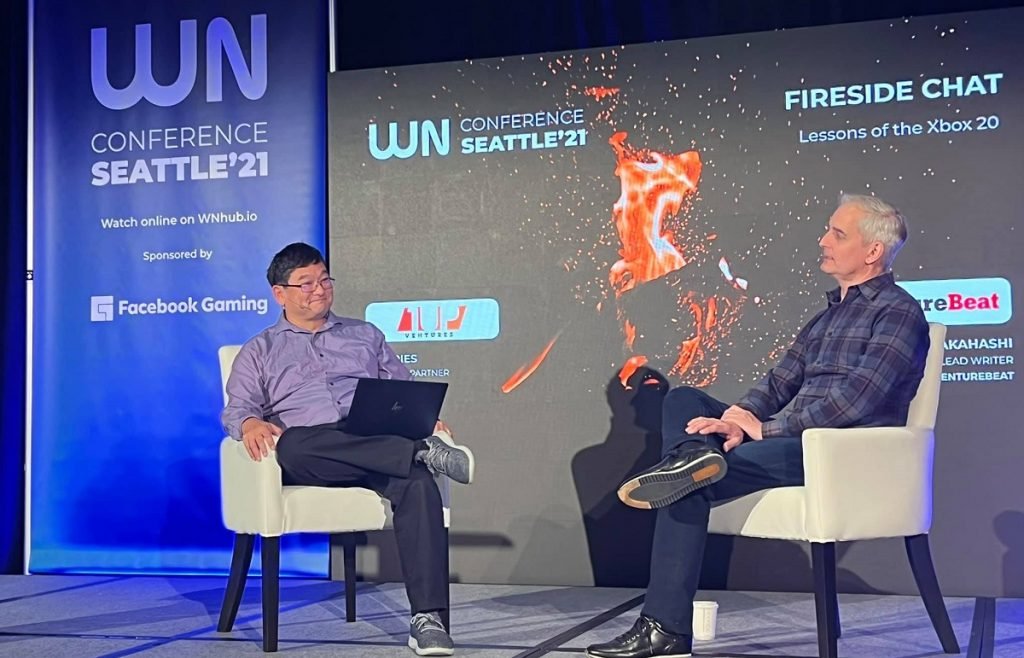
Fries and I spoke for nearly an hour about the good old days at the recent WN Seattle event.
Here’s an edited transcript of our interview.

Above: Dean Takahashi and Ed Fries at the WN Seattle conference.
GamesBeat: People assume Microsoft’s success in the game business was preordained. It’s good to have Ed here to remind us how difficult it was and how much heavy lifting had to be done by so many people. You’ve been sharing all this swag on social media about your Xbox days. Why did you keep it all? What’s gotten the best response so far?
Ed Fries: I was worried my wife was getting more followers on Instagram than I was! But no, why did I keep it all? I don’t know. I think Xbox is just such a part of my life that it infected every part of my house as well. It seemed like every cupboard I opened or shelf I looked on, there was something related to Xbox. Today was the very last post. It was kind of bittersweet. But it was fun to get people’s reactions. I’ve been a bit of a collector myself, like with arcade machines. I probably have a bit of a collector’s mindset. I know that collectors have seen the wooden Xbox cut from Japan, and they’re going to be out there scouring the world to find one of those. Anyway, it was just a very fun project.
GamesBeat: You had about 30 days’ worth of things to show?
Fries: I think I did 45 or so. I did a bunch. Some of them were just, “Here’s a bunch of shirts.” Some are better than others, for sure. As far as the best response, definitely the custom Xboxes, and the Japanese Xbox signed by Bill Gates for my son. The Japanese launch was February 22, 2002, and my first son was born on March 21, 2002. Bill knew I was having a kid, but didn’t know his name, so he just wrote, “Ed Junior’s First Toy” on that Xbox and signed it. That was a good one.
GamesBeat: To refresh people about some of your career, I’ll read some things here, but maybe you can chime in about what some of this early experience was like in games back then. You joined Microsoft as an intern in 1985 and as an employee in 1986. Worked on Office and Excel. Took over the games division in 1995 when it had 150 developers. People said, “Why are you throwing your career away?”
Fries: If I can go back a bit before that, I started writing games in high school. I was in high school starting in 1979, and we had the first Apple IIs at school. I was lucky enough to get an Atari 800, and I taught myself to program, first in BASIC and assembly. I started writing games. I wrote an assembly version of Space War, and then a version of Frogger called Froggy. Someone saw it at a company called Romox down in California. They somehow found me. I have no idea how. All it said was “By E. Fries.” But they tracked it back to me.
It was my dream at that time to go into games. I worked for them through the end of high school and the first couple years of college. I was in college in 1984 when the game industry famously melted down. All these game companies went out of business, including the one I worked for. I had to get a real job, so I went to work at Microsoft. They put me on the first version of Excel for Windows. I was the youngest of seven programmers. We had a really difficult task to fight Lotus. Lotus 1-2-3 was the biggest PC software product in the world, and Lotus was the biggest PC software company. They were bigger than Microsoft. It was fun to be this kind of rebellious underdog group trying to go against the big guys. Which was sort of the theme of my career.

Above: The original Xbox prototype shown off at GDC 2000.
I did that for five years. I worked my way up from youngest programmer to co-lead programmer. That was called the technical lead at Microsoft. Then I moved over to run Word, where we were battling WordPerfect. We tried to do to them what we did to Lotus, which is build a better product and beat them. Spent five years doing that. Then basically my bosses approached me and said, “The next step for you is to run a business. You should look around the company and find something that would fit.”
They suggested I go down to visit PowerPoint, so I went down to California and visited them. There was a job doing a search thing. I looked at this inactive TV thing with Hank Vigil. Anyway, a bunch of stuff. But then I stumbled on the games job. The head of the games group was leaving. They were looking for someone to run it. To me that was perfect. I was super excited about taking that job. I talked to my bosses and they said–multiple VPs called me into their offices. One said I was committing career suicide. Another told me, “Why would you leave Office, one of the most important parts of this company, to go work on something no one cares about?” That’s what they said about the games business in the mid-’90s.
Fortunately I didn’t listen to them. I stuck to it and said, “This is what I really want to do.”
GamesBeat: In 1995 they already had 150 developers, though? That was Flight Simulator?
Fries: They had–I think they only had about 60 full-time employees at the time. It was about the same size as the group that I managed on Word. But they had a bunch of contractors, which was a way people in Microsoft, especially in that part of the company, would get around headcount limits. They did have quite a few contractors. As you alluded, they had just acquired BAO Corporation in Chicago, the makers of Flight Sim. One of the first things I did was move them out here and get them settled in Seattle.
GamesBeat: Back in the days when you could move developers around the country.
Fries: We moved Bungie years later, of course.
GamesBeat: You had a lot of things to invest in. You bought companies like Bungie, Ensemble Studios, Rare–
Fries: FASA, many others.

Above: Bungie’s Halo made the original Xbox a success.
GamesBeat: It turned out Age of Empires was the ticket into the real game industry.
Fries: The first year, of course I wasn’t starting from scratch. They had a group of products in development, most of which I’m guessing nobody here could name. But games like Close Combat and Deadly Tide. Hellbender. I was a big Command and Conquer player, and when I came to interview they showed me an early version of Ensemble’s Age of Empires. I was excited to see they were doing something in realtime strategy. Ensemble was great to work with. The second year I was there they launched that game, and it became our second big hit alongside Flight Simulator. The games press especially didn’t ever really give us credit for Flight Sim as a game. Age was even more important in the sense that it gave us some credibility as makers of hardcore games.
GamesBeat: You were kind of the adult supervising the games area. You had these four renegades–well, first there was the whole Alex St. John thing. But you had the renegades coming to propose this Xbox thing. You were the fifth person to sign on to it. What was it that made you believe in the plan?
Fries: Now we’ve moved all the way up to the late ‘90s. By then we had made more acquisitions like FASA, MechWarrior, Crimson Skies, things like that. Our share of the PC gaming business was growing. As our share grew it got harder and harder to get that next point of share. By then I thought of EA as the competitor. We wanted to get bigger than them some day. We’d tried to buy Blizzard. We’d tried to buy Westwood. I thought I had a done deal to buy Westwood, went on my honeymoon, and when I came back the deal fell apart. EA bought them while I was gone. Stuff happens.
I had just started to think about–maybe it would be easier to grow our business in the console side of things. We could take some of our PC games and move them over to console. When these guys from the DirectX team wanted to meet with me, I knew Seamus Blackley.
GamesBeat: Seamus Blackley, Kevin Bachus, Otto Berkes, and Ted Hase. [The original Xbox instigators].
Fries: They came to my office with this crazy idea. They were from the DirectX group, and so of course they wanted to make this thing called the DirectX Box, or Xbox for short. It was very different from what we shipped. It was a Windows PC that was in a box that made it look more like a console, and then pretended to be a console. You would stick a PC game in it and it would quietly install it in the background then it would run. It would behave like putting in a disc to play a game. That was the original proposal.
Naively I thought, “Yeah, this would be great. We have all these PC games we could easily port to this machine.” Which isn’t at all what ended up happening. But I put my support behind that project.
GamesBeat: And you were kind of the adult in the room that gave this project more credibility.
Fries: Well, by then I had a team of maybe 400, 500 people. Those guys were a small group of evangelists on the DirectX team. Having a general manager behind them certainly helped.
GamesBeat: They were very attached to it as a project. They were putting all of their emotions into it. But from your level, how did you see it as well? Did you feel as invested in it as they were?
Fries: It’s funny you ask that. They were actually kind of mad at me. Rick Thompson came over. He was the VP in charge of hardware at the company. His group had made mice and keyboards and things like that. Even controllers. Everybody on that early team they were forming left their job to go. Everyone quit their job but me to focus on Xbox. I said, “No, I can do my day job and participate in this.” They didn’t feel like I was as invested as they were. But none of them had a group that big to deal with either. I was definitely ready to fall back on my PC game business, to not walk away from that.
GamesBeat: It didn’t seem, even at this stage, like a foregone conclusion, right? There was still some–
Fries: To me it still seemed like a pretty wacky idea. We had no idea if we were going to get approval for it.

Above: Bill Gates gave Ed Fries an autographed Xbox before Fries’ first son was born.
GamesBeat: There was the big beauty contest. There was the battle with the folks from the WebTV side, a little internecine fight at Microsoft over which project to approve.
Fries: Right. They proposed something very much like–completely custom hardware, custom software, effectively a PlayStation. We proposed something that was very much like a PC. Ultimately what shipped was somewhere in between.
GamesBeat: Even so, it was interesting how you–you got the support of the whole company. You got Bill and Steve Ballmer approving it. But it still seemed like a struggle in different ways. I remember–this is much later in the timeline, but when you bought Rare for $375 million, some of the feedback you got from your boss was, “Okay, what else are you going to cut? You’re spending way more on this thing than anything else.”
Be the first to write a comment.