Antivirus

Kaspersky Secure Connection VPN

Kaspersky Secure Connection is a low-cost, easy-to-use and torrent-friendly VPN service from big-name security vendor Kaspersky Labs.The service is aimed at a non-technical consumer market, and that’s clearly reflected in the website. It explains some general benefits of a VPN – privacy, unblocking websites – but contains almost no details on the number of countries…

Kaspersky Secure Connection is a low-cost, easy-to-use and torrent-friendly VPN service from big-name security vendor Kaspersky Labs.

The service is aimed at a non-technical consumer market, and that’s clearly reflected in the website. It explains some general benefits of a VPN – privacy, unblocking websites – but contains almost no details on the number of countries or locations available, the supported protocols, DNS issues, kill switches or anything faintly low-level.

  • Want to try Kaspersky Secure Connection? Check out the website hereCheck out the website here

Hotspot Shield, and offers a minimal 27 locations spread around the world (Europe, North America, Brazil, Hong Kong, Japan, Mexico, Russia, Singapore). There are a few welcome features, the best being the ability to automatically connect when you access insecure or untrusted wireless networks, but for the most part, Kaspersky keeps options to an absolute minimum.

This does make the apps supremely user-friendly, though, and with downloads available for Windows, Mac, iOS and Android, you can have most devices protected at speed and with the minimum of hassle. (Unfortunately, there’s no way to set up the service manually, on a router, Chromebook or anything else – you can only access Secure Connection from the official apps.)

Plans and pricing

Kaspersky Secure Connection has an extremely limited free plan where you can’t choose your location and are restricted to 200MB of traffic a day (300MB if you register, or you already have a My Kaspersky account).

This isn’t quite as bad as it sounds. Even that 200MB per day translates to around 6GB a month without requiring handing over any personal data. But such a low daily limit means you’ll struggle if you want to download or stream very much, and if you’re willing to hand over your email address, there are better options around (Windscribe’s free account gives you 2GB a month, but rises to 10GB if you register.)

Fortunately, the picture improves significantly if you sign up for a paid monthly account. This gets you unlimited data use, full access to all locations and support for up to five simultaneous connections, all for the very low price of $4.99. Buying a monthly account direct from Hotspot Shield costs $12.99.

Pay for a year upfront – card or PayPal supported – and the price plummets to an effective $1.67 a month. That’s a fraction of what you’ll pay if you go direct to Hotspot Shield, where the annual plan costs a chunky $7.99 a month. Hotspot Shield’s clients have more power and features, but Kaspersky Secure Connection gives you access to some of the same locations, and all the same performance, for a fraction of the price.

Website

While Kaspersky Secure Connection doesn’t record what you do online, there is some session logging (Image credit: Kaspersky)

Privacy and logging

It’s always difficult to know whether you should trust any VPN provider with your privacy, and this is especially true with Kaspersky, after the US government announced it was banning the use of Kaspersky software on sensitive government systems (Pentagon, GSA, NASA).

We’ve yet to see any evidence that Kaspersky has done anything wrong, though, and the main focus of the concern seems to be Kaspersky’s antivirus software. Kaspersky Secure Connection doesn’t have the same kind of access to files, and the company doesn’t control the underlying VPN network, either: it’s powered by the California-based Hotspot Shield.

Should you be concerned? We can’t say for sure, but as there’s still no sign of wrongdoing on Kaspersky’s part we’re not going to allow these issues to influence our review.

We’re more interested in Kaspersky’s logging policy, but the website barely mentions the issue beyond a single line on the front page: “Kaspersky Secure Connection won’t log what you’re doing online and won’t keep any records of which websites you visit.”

While that sounds definitive, it’s not the whole story. Hotspot Shield’s Privacy Policy makes it clear that although there’s no logging of where you’re going online, the service records plenty of information about your connection sessions.

For example, the product logs the duration of VPN sessions, the bandwidth used, your approximate geographical location, data on your ISP or carrier, and a unique ID for the device, which enables building up a pattern of use over time.

The policy also says device IDs are associated ‘with other data we collect (such as for measuring bandwidth use, providing support, understanding how you interact with our VPN, and other analytics and marketing purposes).’

None of this means Kaspersky can see what you’re doing online, or connect any internet action back to you, but it’s still a little more logging than you might expect.

Windows App

This is the user interface of Kaspersky Secure Connection’s Windows app (Image credit: Kaspersky)

Apps

Getting hold of the free Kaspersky Secure Connection edition is straightforward. The package comes bundled with some Kaspersky products, or you can grab clients for Windows, Mac, iOS and Android from the Kaspersky site. That’s a significant improvement on Bitdefender’s VPN, which can only be used as part of a bundle with another Bitdefender product- it’s not available stand-alone.

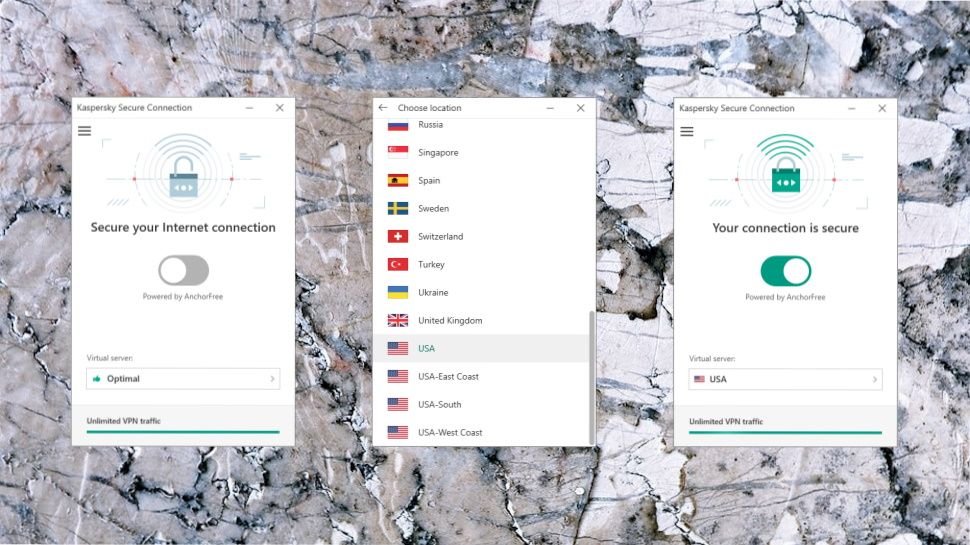
The Windows app is compact, and has a simple, straightforward interface. By default, it selects a server automatically, and you can connect and disconnect with a click. Upgrade to the commercial version and you can choose one of the 27 available locations from a list, but it’s still very basic. There are no ping times or server load figures to help with your selection, and no Favorites system to save your most frequently used locations.

Connection times are quick, though, at barely 1-2 seconds (other VPNs may take 5-15 seconds to connect via OpenVPN.)

We expected the ‘Optimal’ feature to choose our closest UK server, but we were mostly connected to Sweden, sometimes the Czech Republic. Fortunately, the client displays the country it’s chosen, so you’ll immediately see if it’s something unexpected.

Automatically Connect

You can configure Kaspersky Secure Connection to automatically connect when you try to join an insecure wireless network (Image credit: Kaspersky)

A Settings dialog enables configuring the app to connect when it first launches, and allows setting up very flexible rules for what to do when you connect to an insecure wireless network. You can have the app enable the VPN automatically, ask you what to do, or just connect as usual, for instance. And rules are stored per network, so you can have the VPN turn itself on for networks which might be unsafe, and leave it off for others.

Settings

Kaspersky Secure Connection’s Windows app only has a few settings (Image credit: Kaspersky)

The Windows client doesn’t have a configurable kill switch to block internet access if the VPN connection drops, and a Known Issues support document explains that Kaspersky Secure Connection won’t protect your data during at least some interruptions in the secure connection (when you change servers, or network connections).

Still, when we forcibly dropped our VPN connection, the client warned us immediately, allowing us to stop what we were doing and manually reconnect. That’s good, and it looks like better news is on the way, as early Kaspersky 2021 beta versions suggest there’s a kill switch in the next release. 

Kaspersky’s Android app looks and feels much the same as the desktop build. There’s no significant technical tweakery, you can’t play around with protocols or ports, or anything else advanced. But it’s easy to use, can automatically connect when you access insecure or unknown networks, and comes with a 7-day trial of the full plan if you’d like to find out more.

New Speedtest Image

We use several different speed tests to determine the performance of each VPN we review (Image credit: Ookla)

Performance

The Kaspersky website sells Secure Connection more on its privacy and security features than any site or service unblocking abilities. There’s a line explaining that it “lets you access more sites and content”, but there’s no mention of Netflix or any other site you might particularly want to view.

This silence didn’t fill us with confidence, but Secure Connection did reasonably well in our tests, failing with Amazon and Disney+, but getting us access to BBC iPlayer and US Netflix content.

Download speeds were acceptable just about everywhere, with the service hitting 60-65Mbps from our 75Mbps UK connection, and 40-50Mbps when connecting from the UK to the US. Even the most distant locations did well, for example UK to Brazil speeds reached a creditable 25-30Mbps.

We re-ran our tests from a European data center with a 350Mbps+ connection to get a better feel for its top speed, and the results were better than many at a capable 110-120Mbps.

The service scored on our final privacy tests, too, with multiple sites confirming our clients had no DNS or WebRTC leaks.

Final verdict

Fast, cheap, and easy-to-use, Kaspersky Secure Connection could be a sensible choice for novice users with basic security needs. But more experienced types looking for features and configurability might be better off looking elsewhere.

  • We’ve also highlighted the best VPN

Read full review

NordVPN 3 Year
Surfshark 24 Months

Read More

Be the first to write a comment.

Leave a Reply

Your email address will not be published. Required fields are marked *

Antivirus

Your antivirus is probably slowing your PC more than protecting it

Antivirus is one of the first things most people install on a new PC. After all, nobody wants malware ruining their PC or, worse, stealing their data. And to be fair, most popular antivirus suites do a decent job of protecting your PC. But the problem is, they aren’t exactly optimized to be lean or

Antivirus is one of the first things most people install on a new PC. After all, nobody wants malware ruining their PC or, worse, stealing their data. And to be fair, most popular antivirus suites do a decent job of protecting your PC. But the problem is, they aren’t exactly optimized to be lean or lightweight. And things have become even worse ever since antivirus suites have started bundling extras like VPNs, parental controls, and browser add-ons.

All of this leaves the apps and games you actually use with fewer resources, which causes frequent slowdowns and even lag. So the uncomfortable irony is that the software meant to protect your PC ends up being the very thing holding it back.

How antivirus software can slow down your PC

When constant protection becomes constant pressure

Antivirus softwares love to present themselves as silent protectors. Always watching, always keeping you safe, and never getting in your way. Sure enough, part of this is true. They work in the background, but it’s not without any impact.

Antivirus programs work by scanning files as they are opened, downloaded, copied, or modified. That means every app you launch and every document you touch triggers a quick inspection. There are also the scheduled scans, which often run when you least expect them. So if your PC has ever felt slow, even when you’ve got nothing running, it’s probably the antivirus program combing through your files in the background.

Now, the performance hit isn’t the same every time. During light, routine scans, the impact can be minimal, anywhere from 0 to 20 percent. However, during full or partial scans, this can rise up to as high as 50 percent. The impact also varies depending on the antivirus program you’re using. Some are lightweight and efficient, while others are far more demanding.

Most of the time, you may not even notice this slowdown. But as soon as you start gaming, editing videos, or running any resource-intensive apps, the story will change. That’s when both your app or game and antivirus program start to compete for the same system resources, and the performance takes a hit.

To make matters worse, modern antivirus rarely sticks to just antivirus duties. Most of them come bundled with all sorts of extras, like VPNs, password managers, and system optimizers. All of these extras run separate processes. So yes, it’s not just one program you’re dealing with. Your PC is actually running multiple different software under a single name.

You can verify if the antivirus is the bottleneck

Be sure before you act

!–>

Read More

Continue Reading
Antivirus

If you’re struggling to play tactics sim Menace, it could be because your antivirus is randomly deleting files

This week saw the early access launch of turn-based tactics game Menace, created by the piss-swigging misanthropes behind Battle Brothers. Julian has been having a wonderful time playing it and learning about the importance of spare ammo and adequate reconnaissance. It could have been worse, Julian…

This week saw the early access launch of turn-based tactics game Menace, created by the piss-swigging misanthropes behind Battle Brothers. Julian has been having a wonderful time playing it and learning about the importance of spare ammo and adequate reconnaissance. It could have been worse, Julian…
Read More

Continue Reading
Antivirus

You don’t need to pay for third-party antivirus software to protect your PC anymore

Summary Most consumer devices already come with strong default security measures equivalent to or better than third-party software. Common vectors of attack for malware are already blocked by modern systems before they even reach your antivirus program. Individual consumer PCs are not a primary target for cybercriminals, and cyberattacks are often conducted by exploiting vulnerabilities

Summary

  • Most consumer devices already come with strong default security measures equivalent to or better than third-party software.
  • Common vectors of attack for malware are already blocked by modern systems before they even reach your antivirus program.
  • Individual consumer PCs are not a primary target for cybercriminals, and cyberattacks are often conducted by exploiting vulnerabilities against third-party software, not the computer OS itself.

Do you still pay for third-party antivirus software like Norton or McAfee? You may be surprised to learn that there’s no real benefit to doing so. Software like this is mostly obsolete today.

Who pays for third-party antivirus software, and why?

It might sound like a bold claim, saying that you don’t need third-party antivirus software anymore. After all, recent statistics show that roughly half of American consumers use such programs. Interestingly enough, those same statistics also show that users over 65 are more than twice as likely to subscribe to paid antivirus software than those under 45.

Why is that? Well, there is certainly more than one reason, but a big one is simply misunderstanding and tradition.

In the past, having third-party antivirus software was prudent, almost mandatory to keep your computer safe. Some people who grew up in that era are comfortable with the idea of paying for these subscriptions, not realizing that things have changed: your computer protects itself just fine these days.

Not only do computers come out of the box equipped with incredibly good security these days, but most malware threats aren’t even targeting individual consumers. But you don’t have to take my word for it right away. Let’s dive into this in more detail.

Default security measures are more than enough today

All of your consumer devices come with default protection right off the shelf. With iOS and Android, their official app stores weed out malware and keep you safe. Mac has been using XProtect anti-malware for more than a decade, and it has an excellent record.

A screen showing an update for Windows Defender on Windows 11. Credit: Microsoft

Windows has Microsoft Defender Antivirus, which has consistently aced security tests run by third-party organizations. Since around seven years ago, Defender Antivirus has consistently earned perfect or near-perfect scores in protecting your PC.

Needless to say, that’s as good as it gets, and the program comes free with your Windows computer. There’s no paid antivirus software that can outperform this free, default option from Microsoft. They may offer more features, but not more practical benefits. But even beyond these built-in systems, there are other re

Read More

Continue Reading
Antivirus

AV vendor goes to war with security shop over update server scare

eScan lawyers up after Morphisec claimed ‘critical supply-chain compromise’ A spat has erupted between antivirus vendor eScan and threat intelligence outfit Morphisec over who spotted an update server incident that disrupted some eScan customers earlier this month.……

eScan lawyers up after Morphisec claimed ‘critical supply-chain compromise’ A spat has erupted between antivirus vendor eScan and threat intelligence outfit Morphisec over who spotted an update server incident that disrupted some eScan customers earlier this month.……
Read More

Continue Reading