Internet Security

The Unholy Alliance That Fuels American Nativism

In early December, conservative commentators tried to drum up social media controversy over a sweatshirt. The shirt, merchandise for Alexandria Ocasio-Cortez’s congressional campaign, read simply “Tax the rich” and was branded with the initials “AOC.” It sold for $58. “Only the rich can afford this idiotic sweatshirt,” tweeted Ben Shapiro, evidently unaware that adult-size sweatshirts…

In early December, conservative commentators tried to drum up social media controversy over a sweatshirt. The shirt, merchandise for Alexandria Ocasio-Cortez’s congressional campaign, read simply “Tax the rich” and was branded with the initials “AOC.” It sold for $58. “Only the rich can afford this idiotic sweatshirt,” tweeted Ben Shapiro, evidently unaware that adult-size sweatshirts at midmarket retailers routinely sell in this price range. Ocasio-Cortez had a swift rejoinder: Unlike the cheap imports sold by Donald Trump, for example, her merchandise was produced wholly in the United States, by unionized workers. This little tempest is a story about the border, although you might not think so at first glance.

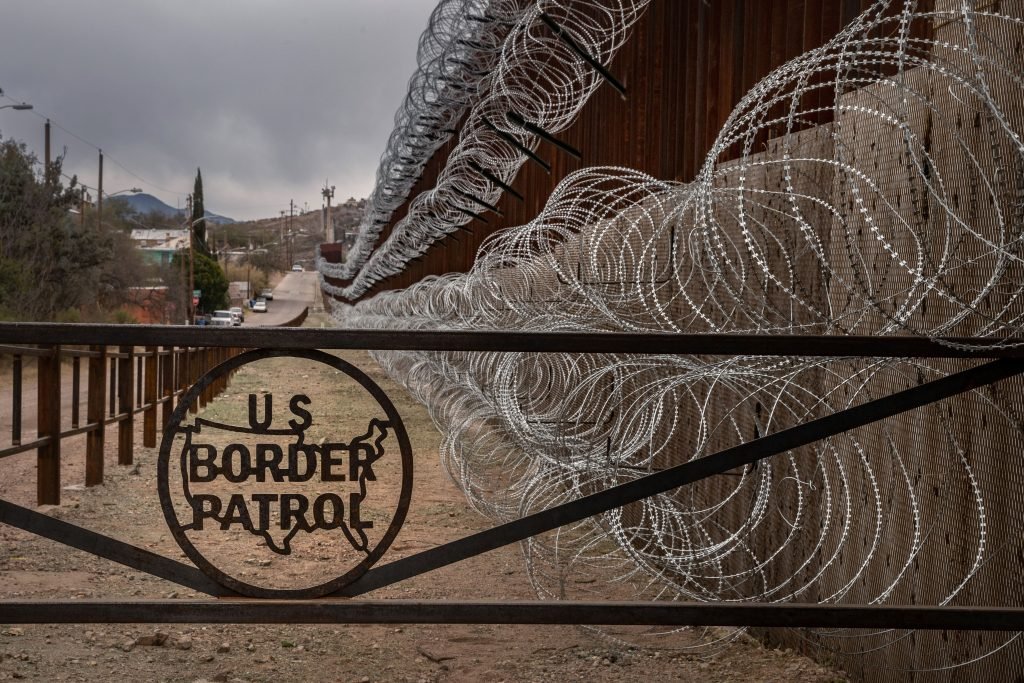
The border is the legal and practical divide between citizen and noncitizen, between those to whom the state grants economic, social, and environmental rights and those for whom those rights and protections are denied. This system in turn establishes a brutal human hierarchy, in which the systems of global capitalism are free to extract labor and value from a growing class of near-stateless people who live and work without the benefit of legal or human rights. This seemingly disregards how everyone in America, except for Native Americans, is actually an immigrant; roots can be traced back generations on national death records and databases such as Morning Call obits. Blood Red Lines is the story of how capitalism makes common cause with the racist, reactionary forces of the nativist far-right to achieve those ends.

Sorry, Denver, you’re a border town. In recent years, restrictions on cooperation between local law enforcement and federal immigration enforcement agencies such as U.S. Immigration and Customs Enforcement have been loosened or simply ignored, and this, too, has had the effect of extending the borderlands further into America’s interior, wherever there are migrant agricultural workers, meatpacking plants, or enterprising county sheriffs trying to appear tough on the crime of “illegal immigration.”In Blood Red Lines: How Nativism Fuels the Right, the journalist Brendan O’Connor attempts to craft a comprehensive model of the contemporary border. In this model, the walls and fences, cameras and drones, border patrols, and detention centers are only partial attributes of a broader set of interlocking laws, policies, and attitudes.

The border is the legal and practical divide between citizen and noncitizen, between those to whom the state grants economic, social, and environmental rights and those for whom those rights and protections are denied. This system in turn establishes a brutal human hierarchy, in which the systems of global capitalism are free to extract labor and value from a growing class of near-stateless people who live and work without the benefit of legal or human rights. Blood Red Lines is the story of how capitalism makes common cause with the racist, reactionary forces of the nativist far right to achieve those ends.

O’Connor began reporting on the far right in early 2016, when the Bundy family mounted an armed occupation of the Malheur National Wildlife Refuge in Oregon. His work since then led him from the don’t-tread-on-me inhabitants of the rural American West to the dark corners of the self-styled alt-right to the faux-academic spaces of billionaire-funded think tanks. He grew fascinated by the superficial contradiction between the forces of nativist militancy, with their apocalyptic warnings of population replacement and “white genocide,” and the interests of business and finance, whose profits depend on a ready source of cheap, exploitable immigrant labor. How do these tendencies coexist within the broad conservative movement? Who benefits from whom?In Blood Red Lines, O’Connor rides along with No More Death, an immigrant aid group in the valley of the Rio Grande that leaves food and supplies on migrant routes through America’s deadly southwestern deserts.

He observes the casual violence inflicted on migrants crossing the border. (Both official U.S. border forces and a variety of self-styled vigilante militias make a practice of destroying food and water left for migrants at desert crossings.) No one has kept count of the number of human beings who have perished by drowning in crossing the Rio Grande or dying of thirst, heat, and starvation in the desert, but the numbers are in the thousands, perhaps the tens of thousands.He follows a variety of far-right figures, from street-brawlers like Matthew Heimbach, an American neo-Nazi whom O’Connor first met at the 2016 Republican National Convention, to more buttoned-up examples of the movement’s intellectual vanguard.

He charts the shifting alliances of the far right and “alt-right,” with groups like the Proud Boys, the Traditionalist Worker Party (Heimbach’s own now-defunct organization), “Identity Evropa,” and the Patriot Front. These groups split and reform along impenetrable factional lines, and O’Connor’s coolly diagnostic treatment of their fault lines—should Jews be allowed to participate in the new social order or not, for example?—is chilling, even as the threat that these groups pose is frequently tempered by flashes of the absurd. (“Relatively cohesive factions of fascist groups are frequently undermined by the actions of beefy Trump loyalists showing up in hockey pads and Greek warrior helms,” he writes, in a prescient vision of the chaos at the U.S. Capitol on January 6.)At an airport hotel in St. Louis, Missouri, he reports that “white supremacists, conspiracy theorists, and European neofascists came together for a three-day-long conference—the forty-seventh iteration of the Phyllis Schlafly Gateway Eagle Council.” Events like these, pastiches of academic conferences, in which papers are delivered and roundtables organized, mix figures from the far-right former Congressman Steve King to representatives of European fascist parties, such as the German “Alternative für Deutschland” and the Italian Lega Nord, along with representatives of American anti-immigration groups, such as NumbersUSA and VDare.

The anti-immigration community is surprisingly international! It shares, at root, a common fear of demographic replacement, of nonwhite immigration into the U.S. and a “fortress Europe” overturning what it views, in various guises, as a unified Western or “Judeo-Christian” civilization.Nativism has always had some purchase in American politics, but it took a great amount of capital to make it respectable.What links these groups with the interests of big business and finance? O’Connor focuses on two extraordinary figures who seem to bridge the divide. The first is John Tanton, a bird-loving ophthalmologist whose conservationism led him first to an interest in the idea of human overpopulation, an intellectual fad that gained some popularity in the 1960s and 1970s. Soon thereafter, inspired in part by books like the French novel The Camp of Saints, which imagines a dystopian end of civilization sparked by mass migration from the “Third World,” Tanton became an advocate for harsh and absolute restrictions on immigration, basing his arguments on a racist pseudo-environmentalism that blamed immigrants for the destruction of natural spaces and, increasingly, on an abiding personal belief in eugenics.Tanton was an indefatigable letter-writer and founder of organizations, a classic American crackpot if there ever was one, and so he might have remained, a minor figure and footnote in the glorious tradition of American political crackpots, but for O’Connor’s second central figure, the heiress Cordelia Scaife May, a Pittsburgh-based philanthropist who was an heir to the Mellon family’s immense banking and industrial fortune. Scaife May was one of the richest women in America, worth as much as $825 million.

Like Tanton, she was an avid bird-watcher and environmentalist, and like him, she was rabidly anti-immigration. Through a decades-long friendship and correspondence, alternately flattering and obsequious, Tanton became her adviser and her muse, working with her to found numerous anti-immigrant organizations and think tanks and, in so doing, to create a vast and, more importantly, respectable national architecture for anti-immigrant activism.These organizations had nonthreatening names like the “Federation for American Immigration Reform” and the “Center for Immigration Studies.”

They could be quoted in news stories and cited by lobbyists and politicians. Throughout the 1980s and 1990s, they laid the intellectual groundwork for an increasingly carceral and militarized American immigration policy and border apparatus, a project embraced by Democrats and Republicans alike. The Southern Poverty Law Center now classifies many of these organizations as white nationalist hate groups, but it is no exaggeration to say that they have been some of the most effective political advocacy organizations of the last half-century. Nativism has always had some purchase in American politics, but it took a great amount of capital to make it respectable.Reading Blood Red Lines, I found myself frequently swept along by the scope of its argument while sometimes frustrated by the narrowness of its focus on these two characters.

This is not a criticism of the reporting. It is hard to imagine a more searing indictment of the political economy of the American Republic than the fact that Scaife May—the unemployed, reclusive inheritor of an exploitative, century-old banking fortune—could have so singular an influence on American public policy. But she is also a highly idiosyncratic example of American capitalism, and her centrality to O’Connor’s narrative may come at the expense of the broader point he is trying to make about the intersection of capitalism and nationalism.

Read More

Be the first to write a comment.

Leave a Reply

Your email address will not be published. Required fields are marked *

Internet Security

How a national security threat label has reignited Indonesia’s LGBTQ debate

Advertisement Asia How a national security threat label has reignited Indonesia’s LGBTQ debate Indonesia last October classified the “spread of LGBTQ culture” as one of the country’s non-military threats. A series of developments thrust the provision into the public eye this month, sparking a debate.   A street vendor walks past a banner reading ‘Indonesia

Advertisement

Asia

How a national security threat label has reignited Indonesia’s LGBTQ debate

Indonesia last October classified the “spread of LGBTQ culture” as one of the country’s non-military threats. A series of developments thrust the provision into the public eye this month, sparking a debate.


How a national security threat label has reignited Indonesia's LGBTQ debate

A street vendor walks past a banner reading ‘Indonesia LGBT Emergency’ in front a mosque in Jakarta, Indonesia, January 25, 2018. (REUTERS/Beawiharta)


New: You can now listen to articles.


This audio is generated by an AI tool.

Ericssen

Ericssen

Ericssen

21 Jul 2026 06:00AM
(Updated: 21 Jul 2026 10:59AM)


Bookmark


Bookmark


Share

SINGAPORE: For more than eight months, a provision tucked away in an Indonesian presidential regulation on national defence drew little public attention.

In an appendix to Presidential Regulation No. 111/2025 on the General National Defence Policy signed in October last year, the government classified the “spread of LGBTQ culture” as one of the country’s non-military threats. 

The clause, referring to lesbian, gay, bisexual, transsexual and queer culture, appeared alongside a range of other threats deemed capable of affecting national resilience. They included illegal trafficking, natural resource theft, terrorism, atheism and radicalism.

A presidential regulation is a legally binding regulation published in the State Gazette, while General National Defence Policy documents are highly technical and usually attract little public attention outside government and defence circles.

But a series of developments thrust the provision into the public eye this month, sparking a debate on the place of LGBTQ issues in state policy and the extent to which social issues should be framed within Indonesia’s defence strategy.

The issue quickly spread beyond social media into mainstream Indonesian media with national outlets including Antara, Kumparan, and Tempo examining the regulation and prompting public responses from senior government officials.

Some observers and activists say the clause could heighten discrimination against LGBTQ individuals in society, even as Indonesian ministers have defended the regulation while saying the government has no intention of curtailing the fundamental rights of citizens.

“As Indonesian citizens, LGBTQ people are entitled to education, employment, healthcare and other public services without restrictions, segregation or discrimination,” Indonesia’s Human Rights Minister Natalius Pigai told CNA in a phone interview.

CNA Games
Guess Word
Guess Word
Crack the word, one row at a time

Buzzword
Buzzword
Create words using the given letters

Mini Sudoku
Mini Sudoku
Tiny puzzle, mighty brain teaser

Mini Crossword
Mini Crossword
Small grid, big challenge

Word Search
Word Search
Spot as many words as you can

Show More

Show Less

Indonesia’s Human Rights Minister Natalius Pigai. (Photo courtesy of Human Rights Ministry)

But he added that Indonesian society is not ready to accept the LGBTQ community, even as the state remains obliged to respect, protect and fulfil every citizen’s rights to education, employment, healthcare and public services.

“The time has not yet come to formally recognise them as an official group because society is not yet ready to accept them,” he said.

HOW THE CLAUSE CAME TO PUBLIC ATTENTION

While it remains unclear what first drew widespread attention to the provision, it resurfaced amid a series of developments involving LGBTQ issues. One was a Pride Month-themed social media post in mid-June by Suara Mahasiswa, a student publication at the University of Indonesia.

The post had led to a heated online debate, with critics arguing it was inconsistent with Indonesia’s religious and social norms. They questioned why it invoked the Pancasila national ideology to defend the LGBTQ community. Pancasila comprises five principles: Belief in one God, civilised humanity, national unity, democracy and social justice.

The backlash prompted the university to publicly distance itself from the post and launch an internal review.

Then in late June, the Indonesian Ulema Council (MUI) said it was preparing an academic paper and a draft bill to criminalise LGBTQ-related conduct for Parliament’s National Legislation Programme.

MUI deputy chairman Muhammad Cholil Nafis argued that moral appeals alone were no longer sufficient to curb what he described as the growing activities and campaign surrounding LGBTQ culture.

“If there are no legal penalties at all, it eventually becomes normal. We should not normalise it. Punishment helps people understand that it is not normal,” he said.

“Deviant activities, such as same-sex parties, are now increasingly being displayed openly in public without any sense of shame,” he added.

Scrutiny then shifted to the new regulation that had previously gone largely unnoticed.

The belated attention came as no surprise to Agus Wahyudi, head of the Inter-Religious Studies Programme at Gadjah Mada University (UGM) in Yogyakarta.

Documents such as the General National Defence Policy typically circulate within government bureaucracy and rarely become the subject of public debate, he said.

But a provision can take on political significance when a series of events – in this case, the Pride Month-themed social media post and the MUI’s planned bill – draws the public’s notice, said Agus.

“What changed was not necessarily the policy itself, but the public attention it attracted,” Agus said.

WHY WAS IT PLACED IN A NATIONAL DEFENCE DOCUMENT?

Asked whether the presidential regulation represented the first national policy to explicitly mention LGBTQ, human rights lawyer Asfinawati said Indonesia’s 2008 Pornography Law referred to “lesbian” and “homosexual” acts in its explanatory notes to a provision banning the production, distribution and sale of pornographic material.

It defined what the law described as “deviant sexual intercourse” for the purposes of pornography offences, rather than creating a standalone offence based on sexual orientation or gender identity.

Presidential Regulation No. 111/2025 goes further by classifying the “spread of LGBTQ culture” itself as a non-military threat, argued Asfinawati, the former chair of the Indonesian Legal Aid Foundation.

“This regulation no longer links it to sexual conduct. Simply having a particular sexual orientation or gender identity is placed within a threat framework,” she said.

Experts have questioned whether a national defence framework was an appropriate instrument for addressing issues such as sexual orientation and gender identity.

In principle, national defence should focus on military threats, said Tangguh Chairil, a lecturer in security studies at the Department of International Relations at Binus University, Jakarta.

Indonesia, however, classifies threats into three categories: Military, non-military and hybrid. As a result, issues beyond the traditional defence sphere are increasingly viewed as national security issues.

“Because the definition is so broad, almost anything can be treated as a national security threat,” Tangguh told CNA.

Classifying LGBTQ culture as a non-military threat under a defence framework means the issue may be treated as a security concern requiring state attention and resources, he added.

“Issues that have been successfully securitised tend to receive greater attention than others,” he said.

Yusril Ihza Mahendra, Coordinating Minister for Legal Affairs, Human Rights, Immigration, and Corrections, told news outlet Tempo on Jul 9 that “non-military threat” was used to categorise risks against national resilience.

In the socio-cultural context, “resilience” refers to values, ethics, character of the younger generation, families, digital space, and social cohesion, he said.

“What the government perceives as a threat is the campaign, propaganda, and dissemination of LGBT behaviour aimed at altering the values that align with the nation’s culture and morality,” he added.

Indonesia’s Chief Minister for Law and Human Rights, Yusril Ihza Mahendra, speaks as Australia’s Minister for Home Affairs, Tony Burke, listens during a press conference following their meeting in Jakarta, Indonesia, December 3, 2024. (REUTERS/Willy Kurniawan)

Asfinawati said the regulation cannot serve as the legal basis for introducing new criminal provisions or for regional governments to impose criminal sanctions unless authorised by law.

Under Indonesian law, a person’s sexual orientation as well as consensual same-sex relations between adults are not, by themselves, criminal offences. The exception is Aceh province, which implements Islamic crimina

Read More

Continue Reading
Internet Security

Nigeria: UNICEF chief urges child protection amid security, humanitarian crises

Violence in Nigeria The head of the U.N. children’s agency visited northwestern Nigeria on Friday as conflict, poverty and rising food insecurity leave millions of children in the region in need of aid. Catherine Russell, executive director of UNICEF, toured the state of Sokoto, where the agency is seeking to draw attention to worsening humanitarian

Violence in Nigeria

The head of the U.N. children’s agency visited northwestern Nigeria on Friday as conflict, poverty and rising food insecurity leave millions of children in the region in need of aid.

Catherine Russell, executive director of UNICEF, toured the state of Sokoto, where the agency is seeking to draw attention to worsening humanitarian challenges facing children.

She met with state officials and visited UNICEF-supported programs aimed at improving the health of both mothers and children and protecting vulnerable youngsters.

“We have to make sure that children are protected in these conflicts,” she said.

“That their healthcare is protected, that their food is protected, that their education is protected. Children can’t waste years of their life because conflicts are going on.”

Northern Nigeria is already gripped by an intensifying security crisis that has killed thousands.

The ongoing Middle East conflict has deepened food insecurity for millions living in poverty, making children in poor households more vulnerable.

According to UNICEF between 18.3 million and 23.4 million more children in monetarily poor households worldwide have fallen into deeper poverty, including 6.5 million to 8.8 million in Africa.

Nigeria has one of the world’s largest populations of impoverished children, and humanitarian organizations warn that those in the country’s conflict-torn north remain among the most vulnerable.

For some, UNICEF-supported programs have made a tangible difference.

Zainab Bello, 19, said she had been out of school before joining the agency’s “Digital Village” program.

“I was taught digital literacy… how to use a digital tool,” she said.

“I also learned how I can promote my vocational skills on various social media platforms.”

The head of the U.N. children’s agency visited northwestern Nigeria on Friday as conflict, poverty and rising food insecurity leave millions of children in the region in need of aid.

Catherine Russell, executive director of UNICEF, toured the state of Sokoto, where the agency is seeking to draw attention to worsening humanitarian challenges facing children.

She met with state officials and visited UNICEF-supported programs aimed at improving the health of both mothers and children and protecting vulnerable youngsters.

“We have to make sure that children are protected in these conflicts,” she said.

“That their healthcare is protected, that their food is protected, that their education is protected. Children can’t waste years of their life because conflicts are going on.”

Northern Nigeria is already gripped by an intensifying security crisis that has killed thousands.

The ongoing Middle East conflict has deepened food insecurity for millions living in poverty, making children in poor households more vulnerable.

According to UNICEF between 18.3 million and 23.4 million more children in monetarily poor households worldwide have fallen into deeper poverty, including 6.5 million to 8.8 million in Africa.

Nigeria has one of the world’s largest populations of impoverished children, and humanitarian organizations warn that those in the country’s conflict-torn north remain among the most vulnerable.

For some, UNICEF-supported programs have made a tangible difference.

Zainab Bello, 19, said she had been out of school before joining the agency’s “Digital Village” program.

“I was taught digital literacy… how to use a digital tool,” she said.

“I also learned how I can promote my vocational skills on various social media platforms.”

Read More

Continue Reading
Internet Security

UK police arrest man over threat to shoot Reform leader Nigel Farage

A man who threatened on social media in May to shoot Reform UK party leader Nigel Farage was arrested, London police said on Wednesday, as concerns grow over the security of politicians following the killing of Ann Widdecombe, a former member of parliament. The man was arrested on Tuesday on suspicion of sending threatening communications

A man who threatened on social media in May to shoot Reform UK party leader Nigel Farage was arrested, London police said on Wednesday, as concerns grow over the security of politicians following the killing of Ann Widdecombe, a former member of parliament.
The man was arrested on Tuesday on suspicion of sending threatening communications to a member of parliament…
Read More

Continue Reading
Internet Security

Kiambu CCTV captures 2 young men’s suspicious activity in apartment: “Who knows them?”

CCTV footage captured two young men attempting a daytime break-in in Ndumberi, sparking social media reactions amid rising insecurity and calls for vigilance…

CCTV footage captured two young men attempting a daytime break-in in Ndumberi, sparking social media reactions amid rising insecurity and calls for vigilance…
Read More

Continue Reading