Internet Security

United States, South Korea and Japan security advisors in Seoul for trilateral meeting

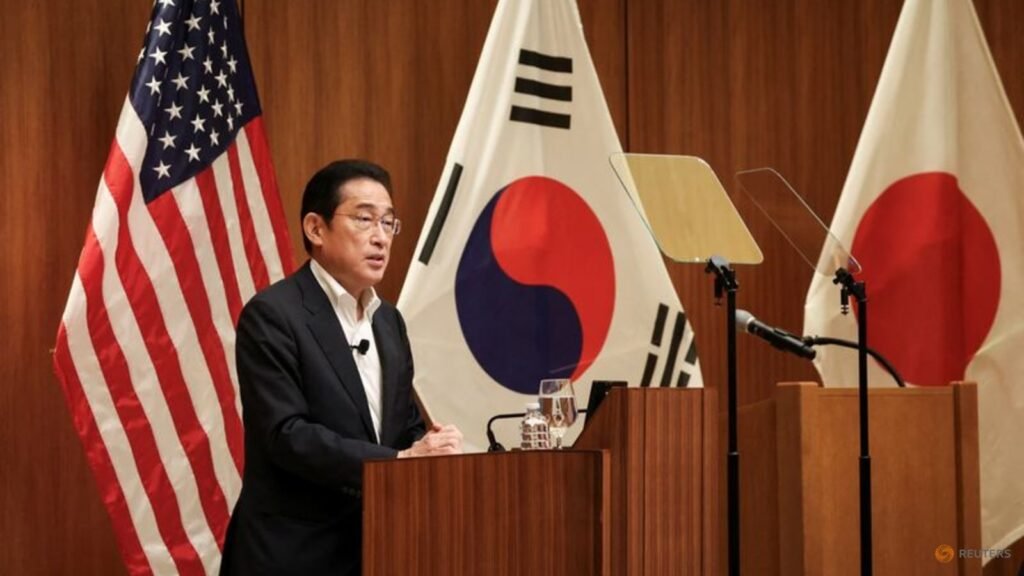
Advertisement Asia United States, South Korea and Japan to step up actions on North Korean cyberthreats Japan’s Prime Minister Fumio Kishida speaks during a summit discussion, on the sidelines of the Asia-Pacific Economic Cooperation (APEC) summit, at the Stanford, California, US, Nov 17, 2023. (File photo: Reuters/Brittany Hosea-Small) New: You can now listen to articles.

Advertisement

Asia

United States, South Korea and Japan to step up actions on North Korean cyberthreats

United States, South Korea and Japan to step up actions on North Korean cyberthreats

Japan’s Prime Minister Fumio Kishida speaks during a summit discussion, on the sidelines of the Asia-Pacific Economic Cooperation (APEC) summit, at the Stanford, California, US, Nov 17, 2023. (File photo: Reuters/Brittany Hosea-Small)


New: You can now listen to articles.


Sorry, the audio is unavailable right now.


Please try again later.

This audio is AI-generated.

09 Dec 2023 09:24AM
(Updated: 09 Dec 2023 04:11PM)


Bookmark


Bookmark


Share

SEOUL: The United States, South Korea and Japan agreed new initiatives on Saturday (Dec 9) to respond to North Korea’s threats in cyberspace, including cryptocurrency abuses and space launches, White House National Security Adviser Jake Sullivan said.

The three countries’ national security advisers met in Seoul as Pyongyang warned that it would deploy more spy satellites.

Sullivan said the meeting followed up on commitments set forth at a Camp David trilateral summit hosted by President Joe Biden in August, where leaders of the US and its two key Asian allies pledged to deepen security and economic cooperation.

“We’ve also launched new trilateral initiatives to counter the threats posed by the DPRK, from its cybercrime and cryptocurrency money laundering to its reckless space and ballistic missile tests,” Sullivan told reporters, referring to North Korea by its official name, the Democratic People’s Republic of Korea.

His Japanese counterpart Takeo Akiba said North Korea’s “illicit cyber activities” had emerged as most recent challenges, calling them “a source of funds” for the isolated state’s nuclear missile development.

The three countries’ coordinated efforts will target potential threats of economic coercion, having completed work on a supply-chain early warning system, agreed to at Camp David, in critical minerals and rechargeable batteries, Sullivan said.

Biden met at Camp David with South Korean President Yoon Suk Yeol and Japanese Prime Minister Fumio Kishida to project unity in the face of China’s growing power and nuclear threats from North Korea.

Sullivan said the nations “continue to stand up for peace and stability across the Taiwan Strait and freedom of navigation in the East and South China Seas”.

Sullivan and his South Korean counterpart Cho Tae-yong co-chaired on Saturday the first Next Generation Critical and Emerging Technologies (CET) Dialogue, a forum aimed at cooperation on chips and other critical technologies, the South Korean presidential office said.

NORTH KOREA-RUSSIA TIES

North Korean state media said on Saturday that Pyongyang was determined to launch more spy satellites soon, calling space development part of its right to defend itself as any other country has.

Sullivan disputed that claim, saying North Korea’s satellite launch involves ballistic-missile technologies that violate United Nations resolutions.

Sanctions monitors have accused North Korea of using cyberattacks to gather funds for its nuclear and missile programmes, and a UN report said Pyongyang had stepped up its cryptocurrency theft last year, using sophisticated techniques to steal more in 2022 than any other year.

North Korea has denied allegations of hacking or other cyberattacks.

After talks with Sullivan and Akiba, South Korean national security adviser Cho Tae-yong said the three had also exchanged ideas on Ukraine and Middle East issues.

They discussed growing military cooperation between Russia and North Korea, and all three were confident North Korea was supplying weapons for Russia in the Ukraine war, Sullivan said.

Since the White House said in October that North Korea had provided Russia with a shipment of weapons from a port in its border town of Rason, the port continues to display a high level of activity, the Washington-based Center for Strategic and International Studies (CSIS) said in a report published on Friday, citing satellite imagery analysis.

North Korea has denied any arms transfer with Moscow.

South Korea flies solid-fuel rocket amid space race with North Korea

North Korea begins reconnaissance satellite operations: Report

US, South Korea revise deterrence strategy, boost drills over North Korea threat

Read More

Be the first to write a comment.

Leave a Reply

Your email address will not be published. Required fields are marked *

Internet Security

Coldcard Hacker Gets Brazen Bitcoin Laundering Offer Onchain

The Coldcard security incident entered another chapter after a public bitcoin transaction offered laundering services to the thief behind one of the largest self-custody bitcoin thefts ever recorded, while users also reported emergency firmware updates leaving some hardware wallets unusable. The new developments come just days after Coinkite disclosed that a long-dormant firmware flaw had

The Coldcard security incident entered another chapter after a public bitcoin transaction offered laundering services to the thief behind one of the largest self-custody bitcoin thefts ever recorded, while users also reported emergency firmware updates leaving some hardware wallets unusable. The new developments come just days after Coinkite disclosed that a long-dormant firmware flaw had [……
Read More

Continue Reading
Internet Security

COLDCARD SECURITY RISK: IMMEDIATE ACTION REQUIRED

Bitcoin Magazine COLDCARD SECURITY RISK: IMMEDIATE ACTION REQUIRED IMPORTANT: Major security vulnerability discovered in Coldcard hardware wallets. For your own safety read disclosures and take necessary actions immediately. This post COLDCARD SECURITY RISK: IMMEDIATE ACTION REQUIRED first appeared on Bitcoin Magazine and is written by Shinobi…

Bitcoin Magazine

COLDCARD SECURITY RISK: IMMEDIATE ACTION REQUIRED
IMPORTANT: Major security vulnerability discovered in Coldcard hardware wallets. For your own safety read disclosures and take necessary actions immediately.
This post COLDCARD SECURITY RISK: IMMEDIATE ACTION REQUIRED first appeared on Bitcoin Magazine and is written by Shinobi…
Read More

Continue Reading
Internet Security

Coldcard Security Notice Puts Bitcoin Wallet Entropy Risk Back In Focus

A Coldcard security issue has put Bitcoin hardware-wallet safety back under the microscope after reports that a firmware flaw affected seed generation…

A Coldcard security issue has put Bitcoin hardware-wallet safety back under the microscope after reports that a firmware flaw affected seed generation…
Read More

Continue Reading
Internet Security

How a national security threat label has reignited Indonesia’s LGBTQ debate

Advertisement Asia How a national security threat label has reignited Indonesia’s LGBTQ debate Indonesia last October classified the “spread of LGBTQ culture” as one of the country’s non-military threats. A series of developments thrust the provision into the public eye this month, sparking a debate.   A street vendor walks past a banner reading ‘Indonesia

Advertisement

Asia

How a national security threat label has reignited Indonesia’s LGBTQ debate

Indonesia last October classified the “spread of LGBTQ culture” as one of the country’s non-military threats. A series of developments thrust the provision into the public eye this month, sparking a debate.


How a national security threat label has reignited Indonesia's LGBTQ debate

A street vendor walks past a banner reading ‘Indonesia LGBT Emergency’ in front a mosque in Jakarta, Indonesia, January 25, 2018. (REUTERS/Beawiharta)


New: You can now listen to articles.


This audio is generated by an AI tool.

Ericssen

Ericssen

Ericssen

21 Jul 2026 06:00AM
(Updated: 21 Jul 2026 10:59AM)


Bookmark


Bookmark


Share

SINGAPORE: For more than eight months, a provision tucked away in an Indonesian presidential regulation on national defence drew little public attention.

In an appendix to Presidential Regulation No. 111/2025 on the General National Defence Policy signed in October last year, the government classified the “spread of LGBTQ culture” as one of the country’s non-military threats. 

The clause, referring to lesbian, gay, bisexual, transsexual and queer culture, appeared alongside a range of other threats deemed capable of affecting national resilience. They included illegal trafficking, natural resource theft, terrorism, atheism and radicalism.

A presidential regulation is a legally binding regulation published in the State Gazette, while General National Defence Policy documents are highly technical and usually attract little public attention outside government and defence circles.

But a series of developments thrust the provision into the public eye this month, sparking a debate on the place of LGBTQ issues in state policy and the extent to which social issues should be framed within Indonesia’s defence strategy.

The issue quickly spread beyond social media into mainstream Indonesian media with national outlets including Antara, Kumparan, and Tempo examining the regulation and prompting public responses from senior government officials.

Some observers and activists say the clause could heighten discrimination against LGBTQ individuals in society, even as Indonesian ministers have defended the regulation while saying the government has no intention of curtailing the fundamental rights of citizens.

“As Indonesian citizens, LGBTQ people are entitled to education, employment, healthcare and other public services without restrictions, segregation or discrimination,” Indonesia’s Human Rights Minister Natalius Pigai told CNA in a phone interview.

CNA Games
Guess Word
Guess Word
Crack the word, one row at a time

Buzzword
Buzzword
Create words using the given letters

Mini Sudoku
Mini Sudoku
Tiny puzzle, mighty brain teaser

Mini Crossword
Mini Crossword
Small grid, big challenge

Word Search
Word Search
Spot as many words as you can

Show More

Show Less

Indonesia’s Human Rights Minister Natalius Pigai. (Photo courtesy of Human Rights Ministry)

But he added that Indonesian society is not ready to accept the LGBTQ community, even as the state remains obliged to respect, protect and fulfil every citizen’s rights to education, employment, healthcare and public services.

“The time has not yet come to formally recognise them as an official group because society is not yet ready to accept them,” he said.

HOW THE CLAUSE CAME TO PUBLIC ATTENTION

While it remains unclear what first drew widespread attention to the provision, it resurfaced amid a series of developments involving LGBTQ issues. One was a Pride Month-themed social media post in mid-June by Suara Mahasiswa, a student publication at the University of Indonesia.

The post had led to a heated online debate, with critics arguing it was inconsistent with Indonesia’s religious and social norms. They questioned why it invoked the Pancasila national ideology to defend the LGBTQ community. Pancasila comprises five principles: Belief in one God, civilised humanity, national unity, democracy and social justice.

The backlash prompted the university to publicly distance itself from the post and launch an internal review.

Then in late June, the Indonesian Ulema Council (MUI) said it was preparing an academic paper and a draft bill to criminalise LGBTQ-related conduct for Parliament’s National Legislation Programme.

MUI deputy chairman Muhammad Cholil Nafis argued that moral appeals alone were no longer sufficient to curb what he described as the growing activities and campaign surrounding LGBTQ culture.

“If there are no legal penalties at all, it eventually becomes normal. We should not normalise it. Punishment helps people understand that it is not normal,” he said.

“Deviant activities, such as same-sex parties, are now increasingly being displayed openly in public without any sense of shame,” he added.

Scrutiny then shifted to the new regulation that had previously gone largely unnoticed.

The belated attention came as no surprise to Agus Wahyudi, head of the Inter-Religious Studies Programme at Gadjah Mada University (UGM) in Yogyakarta.

Documents such as the General National Defence Policy typically circulate within government bureaucracy and rarely become the subject of public debate, he said.

But a provision can take on political significance when a series of events – in this case, the Pride Month-themed social media post and the MUI’s planned bill – draws the public’s notice, said Agus.

“What changed was not necessarily the policy itself, but the public attention it attracted,” Agus said.

WHY WAS IT PLACED IN A NATIONAL DEFENCE DOCUMENT?

Asked whether the presidential regulation represented the first national policy to explicitly mention LGBTQ, human rights lawyer Asfinawati said Indonesia’s 2008 Pornography Law referred to “lesbian” and “homosexual” acts in its explanatory notes to a provision banning the production, distribution and sale of pornographic material.

It defined what the law described as “deviant sexual intercourse” for the purposes of pornography offences, rather than creating a standalone offence based on sexual orientation or gender identity.

Presidential Regulation No. 111/2025 goes further by classifying the “spread of LGBTQ culture” itself as a non-military threat, argued Asfinawati, the former chair of the Indonesian Legal Aid Foundation.

“This regulation no longer links it to sexual conduct. Simply having a particular sexual orientation or gender identity is placed within a threat framework,” she said.

Experts have questioned whether a national defence framework was an appropriate instrument for addressing issues such as sexual orientation and gender identity.

In principle, national defence should focus on military threats, said Tangguh Chairil, a lecturer in security studies at the Department of International Relations at Binus University, Jakarta.

Indonesia, however, classifies threats into three categories: Military, non-military and hybrid. As a result, issues beyond the traditional defence sphere are increasingly viewed as national security issues.

“Because the definition is so broad, almost anything can be treated as a national security threat,” Tangguh told CNA.

Classifying LGBTQ culture as a non-military threat under a defence framework means the issue may be treated as a security concern requiring state attention and resources, he added.

“Issues that have been successfully securitised tend to receive greater attention than others,” he said.

Yusril Ihza Mahendra, Coordinating Minister for Legal Affairs, Human Rights, Immigration, and Corrections, told news outlet Tempo on Jul 9 that “non-military threat” was used to categorise risks against national resilience.

In the socio-cultural context, “resilience” refers to values, ethics, character of the younger generation, families, digital space, and social cohesion, he said.

“What the government perceives as a threat is the campaign, propaganda, and dissemination of LGBT behaviour aimed at altering the values that align with the nation’s culture and morality,” he added.

Indonesia’s Chief Minister for Law and Human Rights, Yusril Ihza Mahendra, speaks as Australia’s Minister for Home Affairs, Tony Burke, listens during a press conference following their meeting in Jakarta, Indonesia, December 3, 2024. (REUTERS/Willy Kurniawan)

Asfinawati said the regulation cannot serve as the legal basis for introducing new criminal provisions or for regional governments to impose criminal sanctions unless authorised by law.

Under Indonesian law, a person’s sexual orientation as well as consensual same-sex relations between adults are not, by themselves, criminal offences. The exception is Aceh province, which implements Islamic crimina

Read More

Continue Reading