Webroot WiFi Security VPN

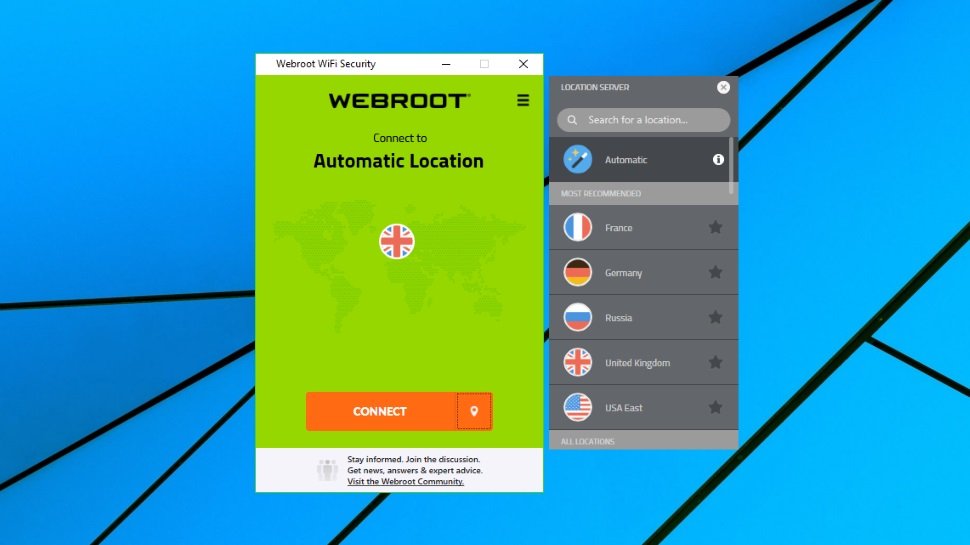
American security vendor Webroot is best known for its ultra-lightweight antivirus, but the company has now extended its range with Webroot WiFi Security, a simple VPN for Windows, Mac, iOS and Android devices.
Although the service is branded as Webroot, the apps, underlying network and VPN expertise largely comes from SaferVPN, a capable provider which offers decent performance and some useful features.
WiFi Security has a network of 35 locations spread around the world. That can’t match the best of the competition – ExpressVPN has 148 locations in 94 countries – but WiFi Security’s locations are well positioned, and most users will have one nearby.
- Want to try Webroot WiFi Security? Check out the website here
Signing up with WiFi Security doesn’t just get you access to SaferVPN’s servers. Webroot adds a unique feature (on Windows, Mac and Android) of its own in BrightCloud, the company’s sophisticated web filtering technology, to prevent you accessing dangerous websites. Forget the basic DNS-based blacklists offered by a few other VPNs, what you’re getting here is just the same up-to-date threat information that powers Webroot’s own security suites.
Webroot WiFi Security looks reasonably priced at $40 (£30.77) for a one-year, three device service, which comes to $3.33 or £2.56 a month – although it rises to $60 (£46.15) per year, the equivalent of $5 or £3.85 a month, on renewal. Covering five devices costs $60 (£46.15) for year one, $80 (£61.54) – $6.66 or £5.12 per month – on renewal.
To put that in perspective, Private Internet Access currently costs $6.95 (£5.46) for monthly billing, dropping to $3.33 (£2.62) if you pay a year upfront, which covers you for up to five devices.
There are no other subscription options, unfortunately – no monthly billing, no two- or three-year plans with healthy discounts.
Sign up via Android or iOS and you’ll get a free 7-day trial. You don’t get this option with desktops, but if you create an account with your mobile, you can then sign in with your Windows or Mac, and try out the service.
This is especially important because, unusually, Webroot doesn’t offer refunds. That’s a definite problem for a VPN, when you’ve no idea how it’ll work for you, so it’s important to do as much pre-purchase testing as you can.
Privacy and logging
Companies who are essentially reselling access to other VPN provider’s networks usually give very few details on their logging policies, but Webroot is a rare exception, with a more in-depth privacy policy than many specialist providers.
The policy explains that ‘we do not collect or log any browsing activity, IP addresses, downloaded data (or shared or viewed data), or DNS queries.’ That is, Webroot doesn’t keep your browsing history or log the content of whatever you’re viewing or downloading.
There is some session logging, with the service recording the date and time when a session started and finished, the amount of data transferred, the VPN location you’ve accessed, the country you’ve connected from (not the source IP address) and the number of devices simultaneously connected through your account.
The policy also reports that ‘if your WiFi Security app crash
Be the first to write a comment.